
Using data from the Spitzer Space Telescope, researchers observed an unusual protostar that periodically emits infrared light bursts, becoming 10 times brighter every 25.34 days, and suggest that the pulsed accretion may be associated with an unseen binary companion.
Just-forming stars, like growing babies, are always hungry and must “feed” on huge amounts of gas and dust from dense envelopes surrounding them at birth. Now a team of astronomers including Robert Gutermuth, a University of Massachusetts Amherst expert in imaging data from the Spitzer Space Telescope, reports observing an unusual “baby” star that periodically emits infrared light bursts, suggesting it may be twins, that is, a binary star. The discovery is reported this month in the journal Nature.
The extremely young object, dubbed LRLL 54361, is about 100,000 years old and is located about 950 light-years away toward the Perseus constellation. Years of monitoring its infrared with the Spitzer instrument reveal that it becomes 10 times brighter every 25.34 days, Gutermuth and colleagues say. This periodicity suggests that a companion to the central forming star is likely inhibiting the infall of gas and dust until its closest orbital approach, when matter eventually comes crashing down onto the protostellar “twins.”
Gutermuth, who surveys star-forming molecular clouds with Spitzer to search for protostars, says, “The idea that this object is a baby binary system fits our data, so, twins fit our data. In single protostars, we would still see matter dumping onto the star non-uniformly, but never with the regularity or intensity of the bursts we observe in LRLL 54361. The 25.43-day period is consistent with the orbital period we would expect from a very close binary star.”
The protostar twins, embedded in a gas “cocoon” many times larger than our solar system, offer an unusual chance to study what looks like a developing binary star system, he adds. Because dense envelopes of gas and dust surround embryonic stars, the only detectable light to escape is at longer, infrared wavelengths. “Spitzer’s infrared camera is perfect for penetrating this cool dust to detect emission from the warm center,” says Gutermuth.
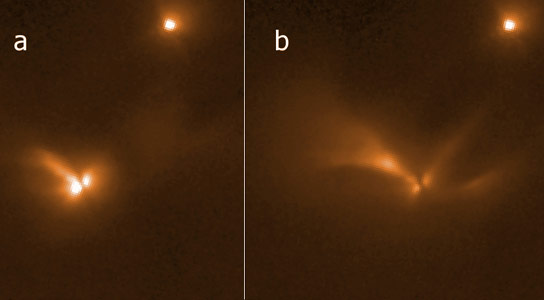
“When you have two young stars feeding from the same circumstellar disk, the gravitational influence of the secondary companion can cause hiccups, an inhibition of infalling material from the disk. But when the orbital paths approach closely, that material can rush in, triggering feeding pulses for both stars and releasing a bright burst of light. The flash moves out from the center, reflecting off the disk and cavities in the envelope like an echo reverberating out from cave walls. We’ve seen the light flashes with Spitzer and have imaged the echo-tracing cavities in its envelope with the Hubble Space Telescope.”
The light echo to which Gutermuth refers is seen in images taken at the near-infrared limit of the Hubble’s Wide Field Camera 3 instrument. The lead investigator for this work and the Spitzer study is UMass Amherst alumnus James Muzerolle, now of the Space Telescope Science Institute, Baltimore. The investigators are careful to point out that they’re not sure what is at the center of object LRLL 54361, but if it is an embryonic binary star, the prospects are exciting.
Scientists have shown that close binary low-mass stars are a somewhat rare outcome of the star formation process. But understanding their formation is critical to address some of the fundamental open questions in star and planet formation, such as how protostars form, how they accumulate their mass, and how planets form from their circumstellar disks, Gutermuth points out. It’s believed that most of a central star’s mass is assembled early, whereas planet formation in spinning outer gaseous disks may take several million years to complete.
Another reason this object is so interesting, he says, is that it provides a new demonstration of the impact of time-domain astronomy. “By analyzing the variability of this object’s light over time, we have obtained a unique set of constraints on its physical nature. This system offers us a rare chance to observe the evolution of the disk and envelope around a binary star in almost real time.”
“Looking ahead, we’ll characterize this system further at millimeter wavelengths with the aid of the Large Millimeter Telescope now becoming operational under a partnership between UMass Amherst and Mexico’s Instituto Nacional de Astrofísica, Óptica y Electrónica. Studying millimeter variability over time will be part of our approach.”
Reference: “Pulsed accretion in a variable protostar” by James Muzerolle, Elise Furlan, Kevin Flaherty, Zoltan Balog and Robert Gutermuth, 2 January 2013, Nature.
DOI: 10.1038/nature11746
Never miss a breakthrough: Join the SciTechDaily newsletter.
Follow us on Google and Google News.