
Close Menu
    Facebook X (Twitter) Instagram
    SciTechDaily
    • Biology
    • Chemistry
    • Earth
    • Health
    • Physics
    • Science
    • Space
    • Technology
    Facebook X (Twitter) Pinterest YouTube RSS
    SciTechDaily
    Home»Technology»Using Surface Waves to Help Cool Nanostructured Microelectronic Devices
    Technology

    Using Surface Waves to Help Cool Nanostructured Microelectronic Devices

    By Institute of Industrial Science, The University of TokyoOctober 16, 2020No Comments3 Mins Read
    Facebook Twitter Pinterest Telegram LinkedIn WhatsApp Email Reddit
    Share
    Facebook Twitter LinkedIn Pinterest Telegram Email Reddit
    Surface Waves Cool Nanostructured Devices
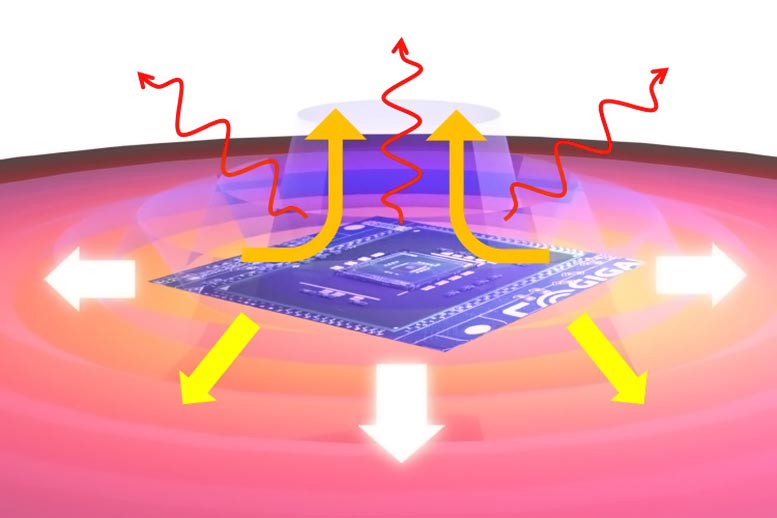
    A research team led by the Institute of Industrial Science, the University of Tokyo finds that hybrid surface waves called surface phonon-polaritons can conduct heat away from nanoscale material structures. Credit: Institute of Industrial Science, the University of Tokyo

    The continuing progress in miniaturization of silicon microelectronic and photonic devices is causing cooling of the device structures to become increasingly challenging. Conventional heat transport in bulk materials is dominated by acoustic phonons, which are quasiparticles that represent the material’s lattice vibrations, similar to the way that photons represent light waves. Unfortunately, this type of cooling is reaching its limits in these tiny structures.

    However, surface effects become dominant as the materials in nanostructured devices become thinner, which means that surface waves may provide the thermal transport solution required. Surface phonon-polaritons (SPhPs) — hybrid waves composed of surface electromagnetic waves and optical phonons that propagate along the surfaces of dielectric membranes — have shown particular promise, and a team led by researchers from the Institute of Industrial Science, the University of Tokyo has now demonstrated and verified the thermal conductivity enhancements provided by these waves.

    “We generated SPhPs on silicon nitride membranes with various thicknesses and measured the thermal conductivities of these membranes over wide temperature ranges,” says lead author of the study Yunhui Wu. “This allowed us to establish the specific contributions of the SPhPs to the improved thermal conductivity observed in the thinner membranes.”

    The team observed that the thermal conductivity of membranes with thicknesses of 50 nm or less actually doubled when the temperature increased from 300 K to 800 K (approximately 27°C to 527°C). In contrast, the conductivity of a 200-nm-thick membrane decreased over the same temperature range because the acoustic phonons still dominated at that thickness.

    “Measurements showed that the dielectric function of silicon nitride did not change greatly over the experimental temperature range, which meant that the observed thermal enhancements could be attributed to the action of the SPhPs,” explains the Institute of Industrial Science’s Masahiro Nomura, senior author of the study. “The SPhP propagation length along the membrane interface increases when the membrane thickness decreases, which allows SPhPs to conduct much more thermal energy than acoustic phonons when using these very thin membranes.”

    The new cooling channel provided by the SPhPs can thus compensate for the reduced phonon thermal conductivity that occurs in nanostructured materials. SPhPs are thus expected to find applications in thermal management of silicon-based microelectronic and photonic devices.

    Reference: “Enhanced thermal conduction by surface phonon-polaritons” by Y. Wu, J. Ordonez-Miranda, S. Gluchko, R. Anufriev, D. De Sousa Meneses, L. Del Campo, S. Volz and M. Nomura, 30 September 2020, Science Advances.
    DOI: 10.1126/sciadv.abb4461

    Never miss a breakthrough: Join the SciTechDaily newsletter.
    Follow us on Google and Google News.

    Nanotechnology Optics University of Tokyo
    Share. Facebook Twitter Pinterest LinkedIn Email Reddit

    Related Articles

    Solving Complex Problems at the Speed of Light

    Tiny Micromotor Is Powered Directly With Light

    “Perfect” Solar Energy Absorber Created by Laser Etching Metal With Nanoscale Structures

    New Nanoantenna Technology Developed to Harvest Light

    Light-Based ‘Tractor Beam’ Precisely Assembles Nanoscale Structures

    Speed of Light Mathematics With Nanostructured Metasurface

    Tiny, Biocompatible Laser Could Function Inside Living Tissues for Imaging or Treatment

    New Tool to Study Molecular Structures Uses a Laser, a Crystal and Light Detectors

    New Wavelength Detector Could Improve Data Communications

    Leave A Reply Cancel Reply

    • Facebook
    • Twitter
    • Pinterest
    • YouTube

    Don't Miss a Discovery

    Subscribe for the Latest in Science & Tech!

    Trending News

    Popular Sugar-Free Sweetener Linked to Liver Disease, Study Warns

    What Is Hantavirus? The Deadly Disease Raising Alarm Worldwide

    Scientists Just Discovered How the Universe Builds Monster Black Holes

    Scientists Unveil New Treatment Strategy That Could Outsmart Cancer

    A Simple Vitamin May Hold the Key to Treating Rare Genetic Diseases

    Scientists Think the Real Fountain of Youth May Be Hiding in Your Gut

    Ravens Don’t Follow Wolves, They Predict Them

    This Common Knee Surgery May Be Doing More Harm Than Good

    Follow SciTechDaily
    • Facebook
    • Twitter
    • YouTube
    • Pinterest
    • Newsletter
    • RSS
    SciTech News
    • Biology News
    • Chemistry News
    • Earth News
    • Health News
    • Physics News
    • Science News
    • Space News
    • Technology News
    Recent Posts
    • Why Are So Many New Fathers Dying? Scientists Say the U.S. Has a Dangerous Blind Spot
    • Scientists Identify Simple Supplement That Greatly Reduces Alzheimer’s Damage
    • You May Have a Dangerous Type of Cholesterol Even if Your Tests Look Normal
    • Study Reveals Dangerous Flaw in AI Symptom Checkers
    • New MRI Breakthrough Captures Stunningly Clear Images of the Eye and Brain
    Copyright © 1998 - 2026 SciTechDaily. All Rights Reserved.
    • Science News
    • About
    • Contact
    • Editorial Board
    • Privacy Policy
    • Terms of Use

    Type above and press Enter to search. Press Esc to cancel.