
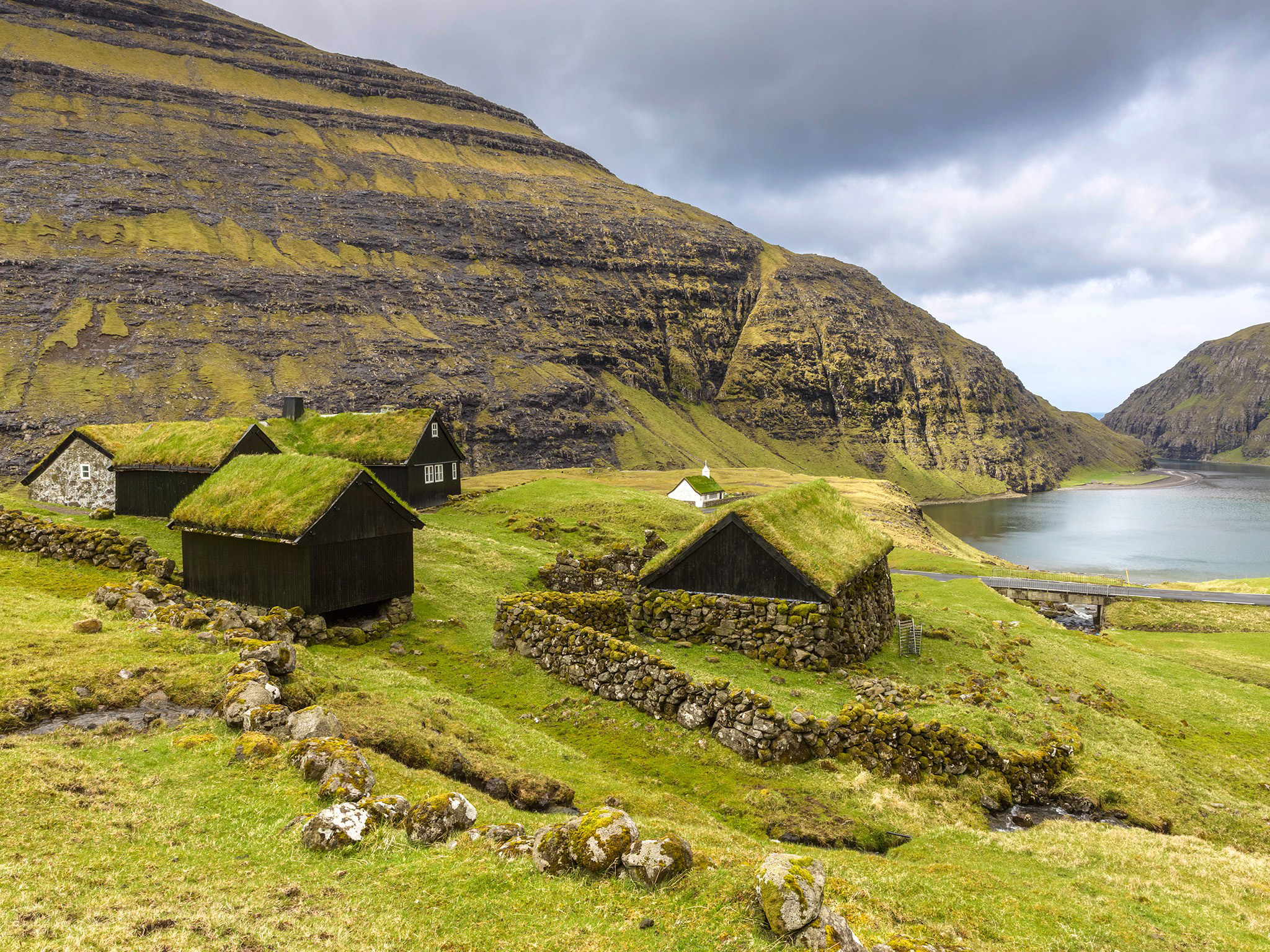
Viking men from across Scandinavia were the first settlers of the Faroe Islands, geneticists reveal.
The ancient Vikings certainly had the travel bug. Between the late eighth century and around 1050 CE, they ventured across the Atlantic in their iconic longships, reaching Newfoundland, Labrador, and Greenland. Their explorations also extended into the Mediterranean and across continental Eurasia.
Among the places the Vikings are known to have settled were the Faroe Islands, an archipelago of 18 islands in the North Atlantic. They probably weren’t the first to do so: archaeologists have found evidence that these islands had been inhabited since approximately 300 CE, possibly by Celtic monks or others from the British Isles. But according to the Færeyinga Saga, written around 1200, a Viking chief called Grímur Kamban settled in the Faroe Islands between approximately 872 and 930 CE.
Tracing Viking Origins in the Faroes
But where in Scandinavia did Grímur and his followers come from?
“Here we provide strong evidence that the Faroe Islands were colonized by a diverse group of male settlers from multiple Scandinavian populations,” said Dr Christopher Tillquist, an associate professor at the University of Louisville in Kentucky and the lead author of a new study in Frontiers in Genetics.
Tillquist’s co-authors were Dr Allison Mann from the University of Wyoming and Dr Eyðfinn Magnussen from the University of the Faroe Islands.
The scientists determined the genotype at 12 ‘short tandem repeat’ (STR) loci on the Y-chromosome of 139 men from the Faroese islands of Borðoy, Streymoy, and Suðuroy. They assigned each man to the most likely haplogroup, each of which has different known distribution across today’s Europe.
The researchers compared the distribution of genotypes to those found in 412 men from Norway, Sweden, Denmark, Iceland, and Ireland. This allowed them to reconstruct the source population of the Viking population founders.
Genetic Distinctions Among Viking Settlers
Advanced analyses showed that the range of Faroese samples resembled the range of genotypes from broader Scandinavian, whereas the Icelandic genotypes were distinct.
The authors also developed a powerful innovative genetic method, called ‘Mutational Distance from Modal Haplotype’ to analyze variation in SNPs (single-nucleotide polymorphisms) within the STRs. This allowed them to reveal a ‘founder effect’ – traces of random loss of diversity during historic colonization by a small number of people – persisting in the genetic make-up of today’s Faroese and Icelandic male populations.
“Scientists have long assumed that the Faroe Islands and Iceland were both settled by similar Norse people. Yet our novel analysis has shown that these islands were founded by men from different gene pools within Scandinavia,” said Tillquist.
“One group, diverse in their Scandinavian origins, established themselves in the Faroe Islands, while another and more genetically divergent band of Vikings colonized Iceland. They have separate genetic signatures that persist to this day.”
“There doesn’t seem to have been any interbreeding afterward between these two populations, despite their geographic proximity. Our results demonstrate that Viking expansion into the North Atlantic was more complex than previously thought.”
“Each longship that set sail for these distant islands carried not just Vikings, but distinct genetic legacies. We can now trace these separate journeys of conquest and settlement, revealing a more nuanced story of Viking exploration than told by the history books.”
Reference: “Genetic evidence points to distinct paternal settlers of the Faroe Islands and Iceland” by Allison E. Mann, Eyðfinn Magnussen and Christopher R. Tillquist, 2 October 2024, Frontiers in Genetics.
DOI: 10.3389/fgene.2024.1462736
Never miss a breakthrough: Join the SciTechDaily newsletter.
Follow us on Google and Google News.
3 Comments
Should one assume that Viking women also travelled to the Faero Islands? Otherwise the Viking genetics in the Faeros might only have lasted for a generation or two e.g father and son.
MAP!!!!!!
Why are you using a defunct “colonial” term, I.e “British Isles”? It’s now over 25 (!) Years that British and Irish governments decided this was no longer an appropriate term.