
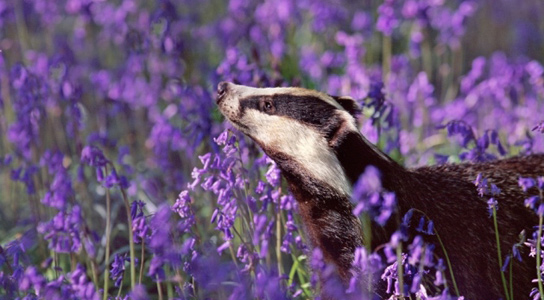
The issue at hand is that the common badger, Meles meles, one of the largest predators left in the British Isles, while loved by the public, is a bane to farmers, as they infect cattle with bovine tuberculosis. The disease could cost the UK government $1.6 billion in control measures and compensation over the next decade.
Next week, government-sanctioned hunters will begin an effort to cull the badgers while animal rights activists are planning protests, boycotts, and sabotage. In the US, environmentalists and ranchers argue over wolves, which have been reintroduced to many states. In Western Australia, the government has proposed a cull of coastal sharks, angering activists. However, the badger issue has been systematically studied for more than a decade in universities.
Badgers do carry TB and can infect cows through indirect and direct contact. During a 9-year trial, scientists produced a 287-page report and various scientific papers, including several in Nature. John Krebs, zoologist and member of the House of Lords states that the government went against science on political grounds. However, the schism that was revealed showcases and uneasy truth about the badger issue: science doesn’t give a clear answer about what to do.
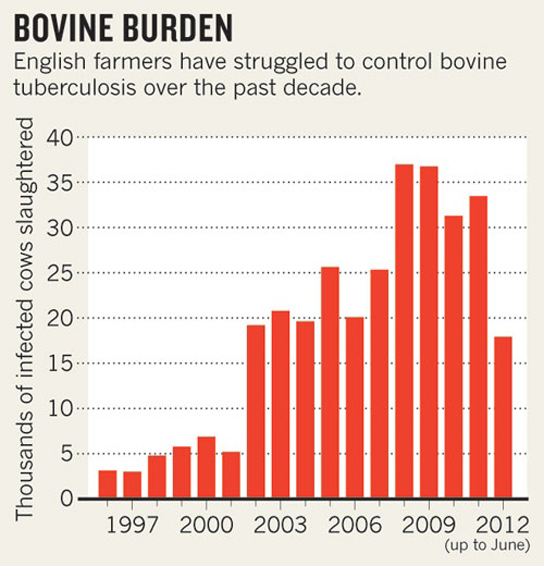
For more than a decade, bovine TB has been on the rise. In order to control the disease, which can spread to humans through contaminated milk, cattle are routinely screened and infected animals are destroyed. Killing a large number of badgers will reduce the levels of bovine TB.
The Krebs-backed trial showed a 23% reduction in bovine TB in the area of the cull, while the regions immediately outside of the trial saw an increase of roughly 25%, which is explained by the badgers extending their normal range. Culling 70% of the badgers in larger areas would lead to an overall reduction of bovine TB of up to 16%.
The Department for Environment, Food and Rural Affairs (DEFRA) laid out a plan in July 2011 for the bovine TB eradication in England. The plan included increased surveillance on farms, as well as security measures, and a policy of killing badgers in areas with high bovine TB. The government hopes that the cull will stabilize infection rates.
It is virtually impossible to determine badger population in advance of actually killing them. If the targets are missed, the levels of bovine TB could actually increase because infected badgers will begin to roam more freely. The Irish have used targeted snare-trapping to almost eliminate badgers from selected areas, however even if this is more affordable, it would be considered unethical in England. In Wales, officials have begun an expensive campaign to immunize badgers against TB.
Tougher biosecurity standards will prove to be instrumental in controlling bovine TB, and conservationists concede that badgers are a major source for the disease.
References:
“Impact of localized badger culling on tuberculosis incidence in British cattle” by Christl A. Donnelly, Rosie Woodroffe, D. R. Cox, John Bourne, George Gettinby, Andrea M. Le Fevre, John P. McInerney and W. Ivan Morrison, 23 November 2003, Nature.
DOI: 10.1038/nature02192
“Positive and negative effects of widespread badger culling on tuberculosis in cattle” by Christl A. Donnelly, Rosie Woodroffe, D. R. Cox, F. John Bourne, C. L. Cheeseman, Richard S. Clifton-Hadley, Gao Wei, George Gettinby, Peter Gilks, Helen Jenkins, W. Thomas Johnston, Andrea M. Le Fevre, John P. McInerney and W. Ivan Morrison, 14 December 2005, Nature.
DOI: 10.1038/nature04454
Never miss a breakthrough: Join the SciTechDaily newsletter.
Follow us on Google and Google News.
2 Comments
Question: is there any possibility of inoculating badgers? Generally when a territorial predator is a vector culls will simply open up territories which eventually draw in new infected animals. Immunized animals create a genuinely disease free area and will be able to defend it against diseased newcomers.
It seems like cost may be an issue. The Nature article states that, “In Wales, officials have begun an expensive campaign to immunize badgers against TB.”