
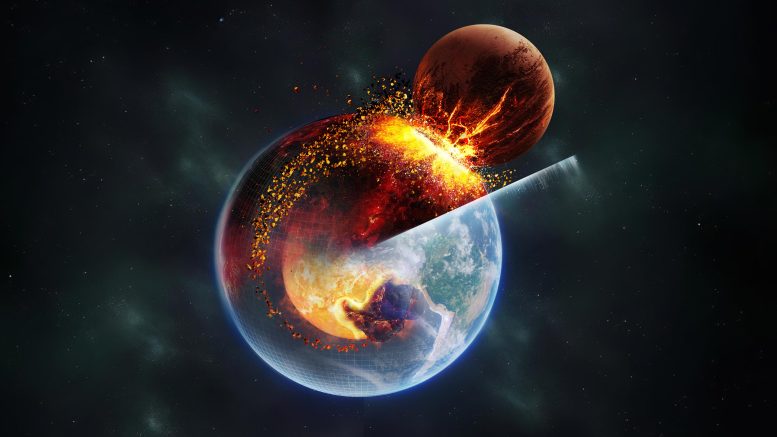
Scientists have found that Earth’s deep mantle may hold pieces of the ancient planet Theia, offering new insights into the Moon’s origin and Earth’s formative years.
An interdisciplinary international research team has recently discovered that a massive anomaly deep within the Earth’s interior may be a remnant of the collision about 4.5 billion years ago that formed the Moon.
This research offers important new insights not only into Earth’s internal structure but also into its long-term evolution and the formation of the inner solar system.
The study, which relied on computational fluid dynamics methods pioneered by Prof. Hongping Deng of the Shanghai Astronomical Observatory (SHAO) of the Chinese Academy of Sciences, was published as a featured cover in the journal Nature on November 2.
The Enigma of the Moon’s Formation
The formation of the Moon has been a persistent enigma for several generations of scientists. The prevailing theory has suggested that, during the late stages of Earth’s growth approximately 4.5 billion years ago, a massive collision—known as the “giant impact”—occurred between primordial Earth (Gaia) and a Mars-sized proto-planet known as Theia. The Moon is believed to have formed from the debris generated by this collision.
Numerical simulations have indicated that the Moon likely inherited material primarily from Theia, while Gaia, due to its much larger mass, was only mildly contaminated by Theian material.
MFM simulation of the canonical Moon-Forming giant impact. Here different colors trace different components of Gaia and Theia. The lower mantle of Gaia, denoted by the dashed circle with a radius of 0.8 Earth radii (RE), is only marginally contaminated by Theian mantle. Credit: Rongxi Bi and Hongping Deng
Since Gaia and Theia were relatively independent formations and composed of different materials, the theory suggested that the Moon—being dominated by Theian material—and the Earth—being dominated by Gaian material—should have distinct compositions. However, high-precision isotope measurements later revealed that the compositions of the Earth and Moon are remarkably similar, thus challenging the conventional theory of Moon formation.
While various refined models of the giant impact have subsequently been proposed, they have all faced challenges.
Unveiling Earth’s Mantle Mysteries
To further refine the theory of lunar formation, Prof. Deng began conducting research on the Moon’s formation in 2017. He focused on developing a new computational fluid dynamics method called Meshless Finite Mass (MFM), which excels at accurately modeling turbulence and material-mixing.
Using this novel approach and conducting numerous simulations of the giant impact, Prof. Deng discovered that the early Earth exhibited mantle stratification after the impact, with the upper and lower mantle having different compositions and states. Specifically, the upper mantle featured a magma ocean, created through a thorough mixing of material from Gaia and Theia, while the lower mantle remained largely solid and retained the material composition of Gaia.
“Previous research had placed excessive emphasis on the structure of the debris disk (the precursor to the Moon) and had overlooked the impact of the giant collision on the early Earth,” said Deng.
The LLVPs and Theia’s Legacy
After discussions with geophysicists from the Swiss Federal Institute of Technology in Zurich, Prof. Deng and collaborators realized that this mantle stratification may have persisted to the present day, corresponding to the global seismic reflectors in the mid-mantle (located around 1000 km beneath the Earth’s surface). Specifically, the entire lower mantle of the Earth may still be dominated by pre-impact Gaian material, which has a different elemental composition (including higher silicon content) than the upper mantle, according to Prof. Deng’s previous study.
“Our findings challenge the traditional notion that the giant impact led to the homogenization of the early Earth,” said Prof. Deng. “Instead, the Moon-forming giant impact appears to be the origin of the early mantle’s heterogeneity and marks the starting point for the Earth’s geological evolution over the course of 4.5 billion years.”
Another example of Earth’s mantle heterogeneity is two anomalous regions—called Large Low Velocity Provinces (LLVPs)—that stretch for thousands of kilometers at the base of the mantle. One is located beneath the African tectonic plate and the other under the Pacific tectonic plate. When seismic waves pass through these areas, wave velocity is significantly reduced.
LLVPs have significant implications for the evolution of the mantle, the separation and aggregation of supercontinents, and the Earth’s tectonic plate structures. However, their origins have remained a mystery.
Dr. Qian Yuan from the California Institute of Technology, along with collaborators, proposed that LLVPs could have evolved from a small amount of Theian material that entered Gaia’s lower mantle. They subsequently invited Prof. Deng to explore the distribution and state of Theian material in the deep Earth after the giant impact.
Through in-depth analysis of previous giant-impact simulations and by conducting higher-precision new simulations, the research team found that a significant amount of Theian mantle material, approximately two percent of Earth’s mass, entered the lower mantle of Gaia.
Prof. Deng then invited computational astrophysicist Dr. Jacob Kegerreis to confirm this conclusion using traditional Smoothed Particle Hydrodynamics (SPH) methods.
The research team also calculated that this Theian mantle material, similar to lunar rocks, is enriched with iron, making it denser than the surrounding Gaian material. As a result, it rapidly sank to the bottom of the mantle and, over the course of long-term mantle convection, formed two prominent LLVP regions. These LLVPs have remained stable throughout 4.5 billion years of geological evolution (see image at the top of the article).
Surface Expressions of Ancient Heterogeneity
Heterogeneity in the deep mantle, whether in the mid-mantle reflectors or the LLVPs at the base, suggests that the Earth’s interior is far from a uniform and “boring” system. In fact, small amounts of deep-seated heterogeneity can be brought to the surface by mantle plumes—cylindrical upwelling thermal currents caused by mantle convection—such as those that likely formed Hawaii and Iceland.
For example, geochemists studying isotope ratios of rare gases in samples of Icelandic basalt have discovered that these samples contain components different from typical surface materials. These components are remnants of heterogeneity in the deep mantle dating back more than 4.5 billion years and serve as keys to understanding Earth’s initial state and even the formation of nearby planets.
Envisioning a Universal Application
According to Dr. Yuan, “Through precise analysis of a wider range of rock samples, combined with more refined giant impact models and Earth evolution models, we can infer the material composition and orbital dynamics of the primordial Earth, Gaia, and Theia. This allows us to constrain the entire history of the formation of the inner solar system.”
Prof. Deng sees an even broader role for the current study: “This research even provides inspiration for understanding the formation and habitability of exoplanets beyond our solar system.”
For more on this research, see Strange Blobs in Earth’s Deep Mantle Are the Remains of an Ancient Planet.
Reference: “Moon-forming impactor as a source of Earth’s basal mantle anomalies” by Qian Yuan, Mingming Li, Steven J. Desch, Byeongkwan Ko, Hongping Deng, Edward J. Garnero, Travis S. J. Gabriel, Jacob A. Kegerreis, Yoshinori Miyazaki, Vincent Eke and Paul D. Asimow, 1 November 2023, Nature.
DOI: 10.1038/s41586-023-06589-1
Never miss a breakthrough: Join the SciTechDaily newsletter.
Follow us on Google and Google News.