
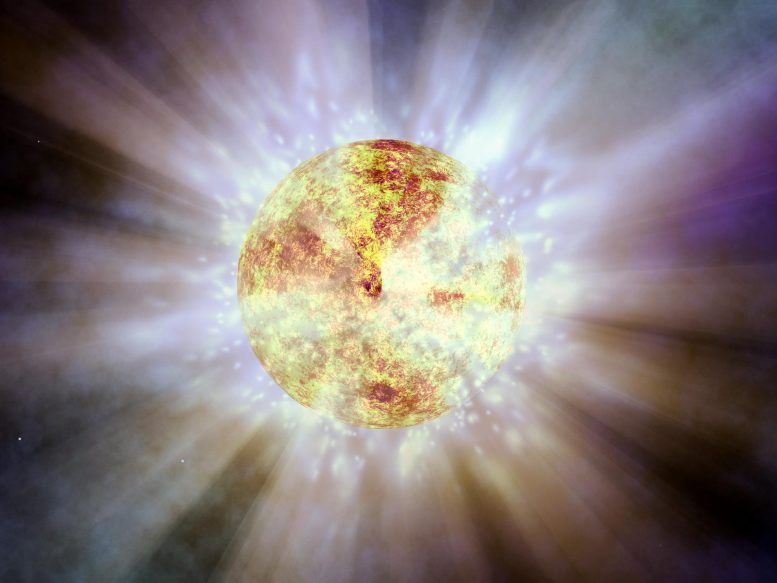
Pulsar speeds suggest weak supernovae are rare and mostly happen in close binary systems, not in isolated stars.
Many of the heaviest stars in the Universe will end their lives in a bright explosion, known as a supernova, which briefly outshines the rest of its host galaxy, allowing us to view these rare events out to great distances. At the lower end of this mass range, the supernova explosion will squeeze the core of the star into a dense ball of neutrons that is much denser than what can be reproduced in laboratories. So, scientists must rely on theoretical models and astronomical observations to study these objects, known as neutron stars.
At the very low end of this range, the supernova explosions are thought to be weaker and dimmer, but even for state-of-the-art supernova simulations, it’s challenging to test this hypothesis. In our recently published study, we found a new way to test these weaker supernovae: by associating weaker supernova explosions with slowly moving neutron star remnants, neutron star speeds could accurately estimate the weaker supernovae, without the need for expensive simulations.
Pulsars as Cosmic Speedometers
Neutron stars don’t shine bright like other stars, but instead produce a very narrow beam of radio waves which may (if we’re lucky) point toward the Earth. As the neutron star rotates, the beam of light appears to flash on and off, creating a lighthouse effect. When this effect is observed, we refer to it as a pulsating star, or pulsar. Recent advances in radio telescopes allow for precise measurements of pulsar velocities. We combined our measurements with simulations of millions of stars and found that the typically high pulsar speeds did not allow for many weak supernovae.
However, there is a caveat: many of the massive stars that produce neutron stars are born in stellar binaries. If a normal supernova occurs in a stellar binary, the neutron star remnant will experience a large recoil kick—like a cannonball rushing away from the exploding gunpowder—and it will likely eject away from its companion star where it may later be observed as a single pulsar. But if the supernova is weak, the neutron star may not have enough energy to escape the gravitational tug of its companion star, and the stellar binary system will remain intact. This is a necessary step in the formation of neutron star binaries, so the existence of these binaries proves that some supernova explosions must be weak.
We found that to explain both the existence of neutron star binaries and the absence of slow-moving pulsars, weak supernovae can only occur in very close stellar binaries, not in single, isolated stars. This is useful for modeling supernova simulations and adds to a growing body of research suggesting that weak supernovae may only happen in stellar binaries which have previously interacted with each other. Studies like this, which simulate many stars in relatively low detail, are key to understanding the effects of uncertain physics on stellar populations, which is unfeasible with highly-detailed simulations.
Written by PhD student Reinhold Wilcox, Monash University.
Reference: “Constraints on Weak Supernova Kicks from Observed Pulsar Velocities” by Reinhold Willcox, Ilya Mandel, Eric Thrane, Adam Deller, Simon Stevenson and Alejandro Vigna-Gómez, 18 October 2021, The Astrophysical Journal Letters.
DOI: 10.3847/2041-8213/ac2cc8
Never miss a breakthrough: Join the SciTechDaily newsletter.
Follow us on Google and Google News.