
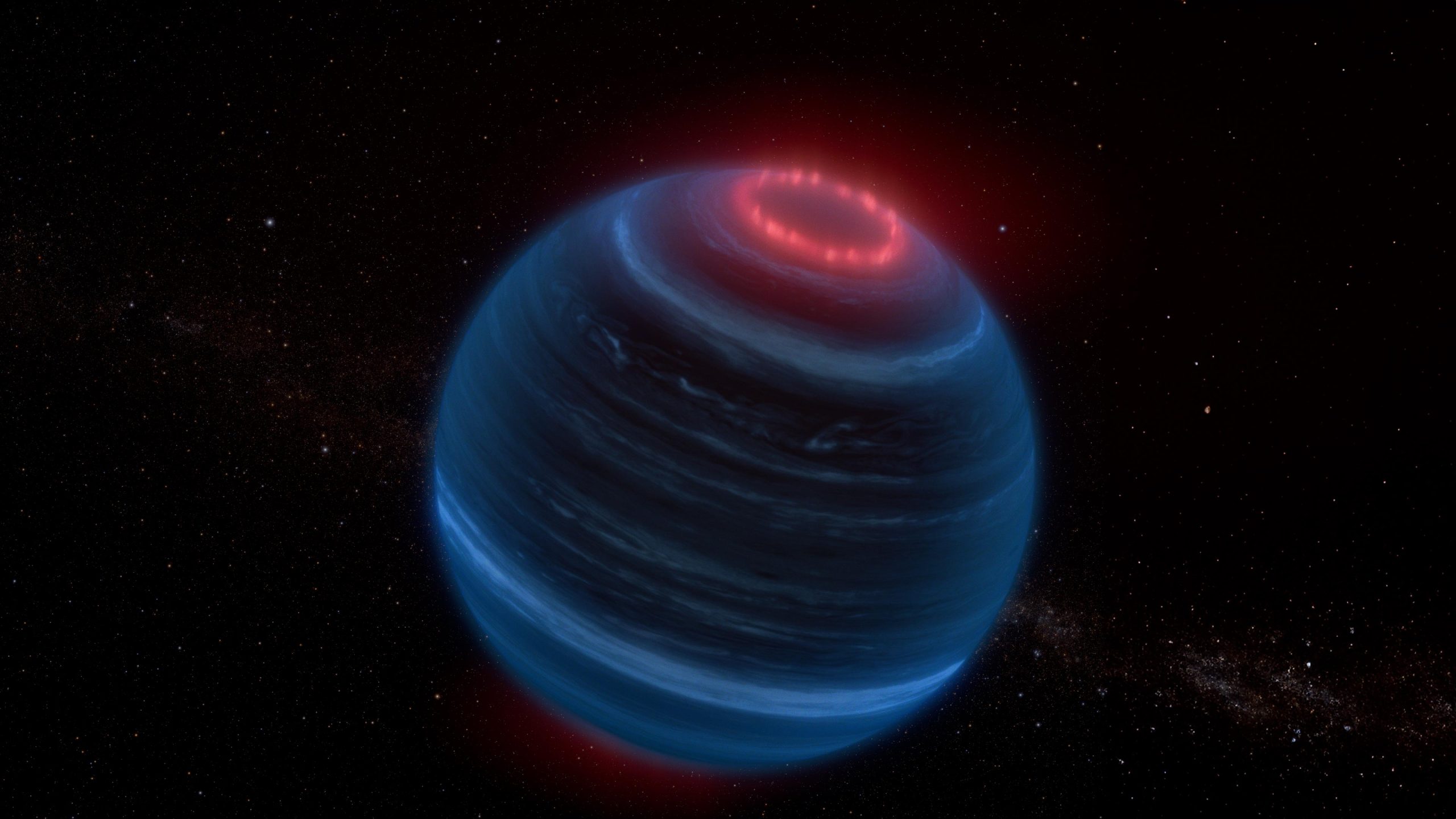
James Webb Space Telescope data pinpoints possible aurorae on isolated world in our solar neighborhood.
Using new observations from the James Webb Space Telescope (JWST), astronomers have discovered methane emission on a brown dwarf, an unexpected finding for such a cold and isolated world. Published in the journal Nature, the findings suggest that this brown dwarf might generate aurorae similar to those seen on our own planet as well as on Jupiter and Saturn.
The Study of Brown Dwarfs
More massive than planets but lighter than stars, brown dwarfs are ubiquitous in our solar neighborhood, with thousands identified. Last year, Jackie Faherty, a senior research scientist and senior education manager at the American Museum of Natural History, led a team of researchers who were awarded time on JWST to investigate 12 brown dwarfs.
Among those was CWISEP J193518.59–154620.3 (or W1935 for short)—a cold brown dwarf 47 light years away that was co-discovered by Backyard Worlds: Planet 9 citizen science volunteer Dan Caselden and the NASA CatWISE team.
W1935 is a cold brown dwarf with a surface temperature of about 400° Fahrenheit, or about the temperature at which you’d bake chocolate chip cookies. The mass for W1935 isn’t well known but it likely ranges between 6–35 times the mass of Jupiter.
Unique Methane Emission
After looking at a number of brown dwarfs observed with JWST, Faherty’s team noticed that W1935 looked similar but with one striking exception: it was emitting methane, something that’s never been seen before on a brown dwarf.
“Methane gas is expected in giant planets and brown dwarfs but we usually see it absorbing light, not glowing,” said Faherty, the lead author of the study. “We were confused about what we were seeing at first but ultimately that transformed into pure excitement at the discovery.”
Temperature Inversion on W1935
Computer modeling yielded another surprise: the brown dwarf likely has a temperature inversion, a phenomenon in which the atmosphere gets warmer with increasing altitude. Temperature inversions can easily happen to planets orbiting stars, but W1935 is isolated, with no obvious external heat source.
“We were pleasantly shocked when the model clearly predicted a temperature inversion,” said co-author Ben Burningham from the University of Hertfordshire. “But we also had to figure out where that extra upper atmosphere heat was coming from.”
Potential Causes of Temperature Inversion
To investigate, the researchers turned to our solar system. In particular, they looked at studies of Jupiter and Saturn, which both show methane emission and have temperature inversions. The likely cause for this feature on solar system giants is aurorae, therefore, the research team surmised that they had uncovered that same phenomenon on W1935.
Planetary scientists know that one of the major drivers of aurorae on Jupiter and Saturn are high-energy particles from the Sun that interact with the planets’ magnetic fields and atmospheres, heating the upper layers. This is also the reason for the aurorae that we see on Earth, commonly referred to as the Northern or Southern Lights since they are most extraordinary near the poles. But with no host star for W1935, a solar wind cannot contribute to the explanation.
Speculations on Additional Causes
There is an enticing additional reason for the aurora in our solar system. Both Jupiter and Saturn have active moons that occasionally eject material into space, interact with the planets, and enhance the auroral footprint on those worlds. Jupiter’s moon Io is the most volcanically active world in the solar system, spewing lava fountains dozens of miles high, and Saturn’s moon Enceladus ejects water vapor from its geysers that simultaneously freezes and boils when it hits space. More observations are needed, but the researchers speculate that one explanation for the aurora on W1935 might be an active, yet-to-be-discovered moon.
“Every time an astronomer points JWST at an object, there’s a chance of a new mind-blowing discovery,” said Faherty. “Methane emission was not on my radar when we started this project but now that we know it can be there and the explanation for it so enticing I am constantly on the lookout for it. That’s part of how science moves forward.”
Reference: “Methane emission from a cool brown dwarf” by Jacqueline K. Faherty, Ben Burningham, Jonathan Gagné, Genaro Suárez, Johanna M. Vos, Sherelyn Alejandro Merchan, Caroline V. Morley, Melanie Rowland, Brianna Lacy, Rocio Kiman, Dan Caselden, J. Davy Kirkpatrick, Aaron Meisner, Adam C. Schneider, Marc Jason Kuchner, Daniella Carolina Bardalez Gagliuffi, Charles Beichman, Peter Eisenhardt, Christopher R. Gelino, Ehsan Gharib-Nezhad, Eileen Gonzales, Federico Marocco, Austin James Rothermich and Niall Whiteford, 17 April 2024, Nature.
DOI: 10.1038/s41586-024-07190-w
Other authors on the study include Jonathan Gagne, Institute for Research on Exoplanets and Université de Montréal; Genaro Suarez, Dan Caselden, Austin Rothermich, and Niall Whiteford, American Museum of Natural History; Johanna Vos, Trinity College Dublin; Sherelyn Alejandro Merchan, City University of New York; Caroline Morley, University of Texas; Melanie Rowland and Brianna Lacy, University of Texas, Austin; Rocio Kiman, Charles Beichman, Federico Marocco, and Christopher Gelino, California Institute of Technology; Davy Kirkpatrick, IPAC; Aaron Meisner, NOIRLab; Adam Schneider, USNO; Marc Kuchner and Ehsan Gharib-Nezhad, NASA; Daniella Bardalez Gagliuffi, Amherst; Peter Eisenhardt, Jet Propulsion Laboratory; and Eileen Gonzales, San Francisco State University.
This work was supported in part by NASA and the Space Telescope Science Institute.
Never miss a breakthrough: Join the SciTechDaily newsletter.
Follow us on Google and Google News.
1 Comment
So, from the paper above: brown dwarfs, in our solar neighborhood, with thousands identified, a team of researchers to investigate 12 brown dwarfs, Right okay what is a solar Neighborhood ? Someone define it, PLEASE !!! what thousands identified ? where is this list ? what 12 brown dwarfs ? Can I get a List ? PLEASE…