
Nearby Planetary System Seen in Breathtaking Detail
A new Webb Space Telescope image of the bright, nearby star Fomalhaut reveals its planetary system with details never seen before, including nested concentric rings of dust. These belts most likely are carved by the gravitational forces produced by embedded, unseen planets. Similarly, inside our solar system, Jupiter corrals the asteroid belt of leftover debris that lies between us and the giant planet. Astronomers first discovered Fomalhaut’s disk in 1983. But there has never been a view as spectacular – or as revealing – as Webb’s.
Webb Space Telescope Looks for Fomalhaut’s Asteroid Belt and Finds Much More
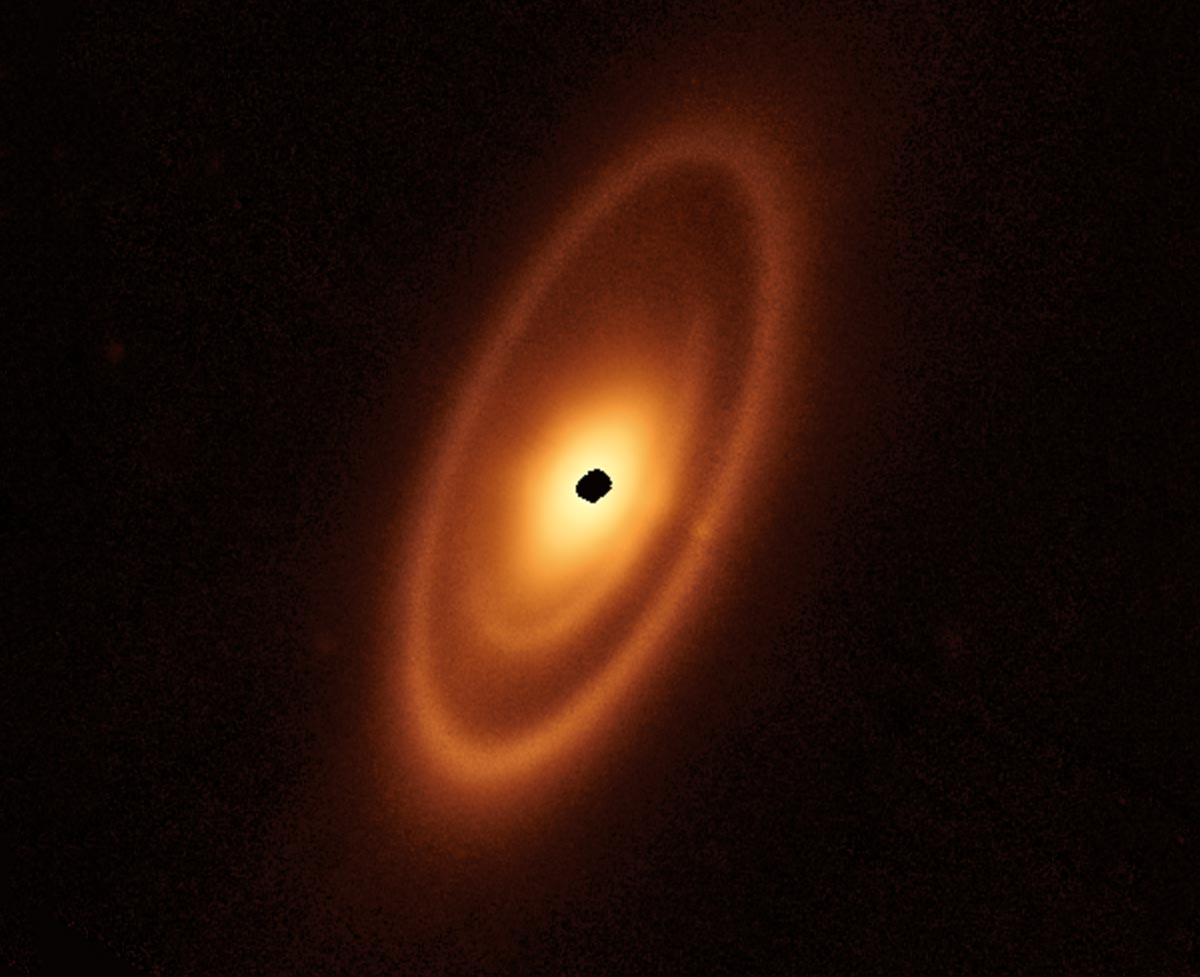
Astronomers used NASA’s James Webb Space Telescope to image the warm dust around a nearby young star, Fomalhaut, in order to study the first asteroid belt ever seen outside of our solar system in infrared light. But to their surprise, the dusty structures are much more complex than the asteroid and Kuiper dust belts of our solar system. Overall, there are three nested belts extending out to 14 billion miles (23 billion kilometers) from the star; that’s 150 times the distance of Earth from the Sun. The scale of the outermost belt is roughly twice the scale of our solar system’s Kuiper Belt of small bodies and cold dust beyond Neptune. The inner belts – which had never been seen before – were revealed by Webb for the first time.
The belts encircle the young hot star, which can be seen with the naked eye as the brightest star in the southern constellation Piscis Austrinus. The dusty belts are the debris from collisions of larger bodies, analogous to asteroids and comets, and are frequently described as ‘debris disks.’ “I would describe Fomalhaut as the archetype of debris disks found elsewhere in our galaxy, because it has components similar to those we have in our own planetary system,” said András Gáspár of the University of Arizona in Tucson and lead author of a new paper describing these results. “By looking at the patterns in these rings, we can actually start to make a little sketch of what a planetary system ought to look like — if we could actually take a deep enough picture to see the suspected planets.”
The Hubble Space Telescope and the Herschel Space Observatory, as well as the Atacama Large Millimeter/submillimeter Array (ALMA), have previously taken sharp images of the outermost belt. However, none of them found any structure interior to it. The inner belts have been resolved for the first time by Webb in infrared light. “Where Webb really excels is that we’re able to physically resolve the thermal glow from dust in those inner regions. So you can see inner belts that we could never see before,” said Schuyler Wolff, another member of the team at the University of Arizona.
Hubble, ALMA, and Webb are tag-teaming to assemble a holistic view of the debris disks around a number of stars. “With Hubble and ALMA, we were able to image a bunch of Kuiper Belt analogs, and we’ve learned loads about how outer disks form and evolve,” said Wolff. “But we need Webb to allow us to image a dozen or so asteroid belts elsewhere. We can learn just as much about the inner warm regions of these disks as Hubble and ALMA taught us about the colder outer regions.”
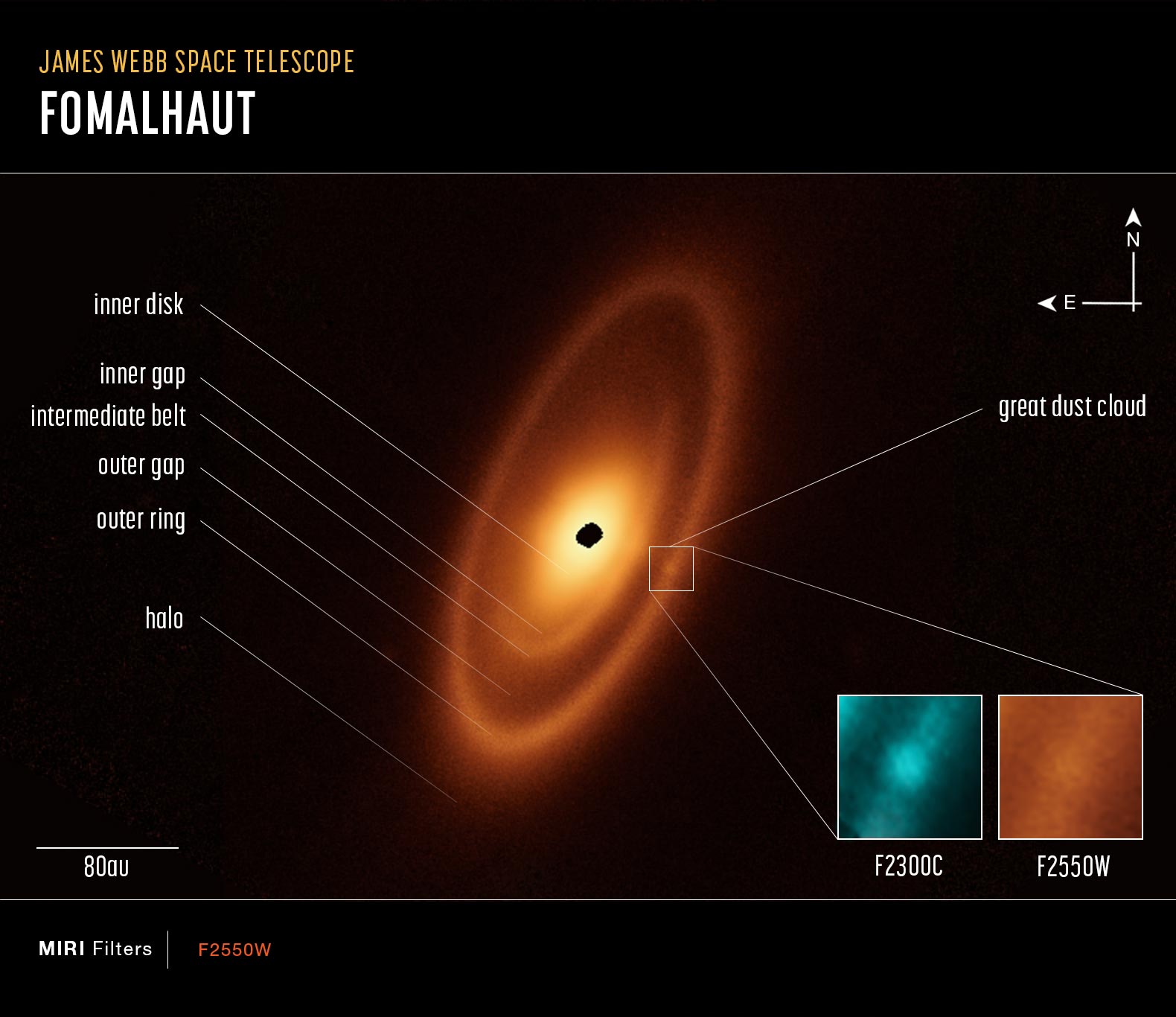
The north and east compass arrows show the orientation of the image on the sky. Note that the relationship between north and east on the sky (as seen from below) is flipped relative to direction arrows on a map of the ground (as seen from above).
The scale bar is labeled in astronomical units, which is the average distance between the Earth and the Sun, or 93 million miles. The outer ring is about 240 astronomical units in diameter.
This image shows invisible mid-infrared wavelengths of light that have been translated into visible-light colors. The color key and labels show which MIRI filters were used when collecting the light.
Credit: NASA, ESA, CSA, András Gáspár (University of Arizona), Alyssa Pagan (STScI)
Gravitational Forces Shaping Debris Disks
These belts most likely are carved by the gravitational forces produced by unseen planets. Similarly, inside our solar system Jupiter corrals the asteroid belt, the inner edge of the Kuiper Belt is sculpted by Neptune, and the outer edge could be shepherded by as-yet-unseen bodies beyond it. As Webb images more systems, we will learn about the configurations of their planets.
Fomalhaut’s dust ring was discovered in 1983 in observations made by NASA’s Infrared Astronomical Satellite (IRAS). The existence of the ring has also been inferred from previous and longer-wavelength observations using submillimeter telescopes on Mauna Kea, Hawaii, NASA’s Spitzer Space Telescope, and Caltech’s Submillimeter Observatory.
“The belts around Fomalhaut are kind of a mystery novel: Where are the planets?” said George Rieke, another team member and U.S. science lead for Webb’s Mid-Infrared Instrument (MIRI), which made these observations. “I think it’s not a very big leap to say there’s probably a really interesting planetary system around the star.”
“We definitely didn’t expect the more complex structure with the second intermediate belt and then the broader asteroid belt,” added Wolff. “That structure is very exciting because any time an astronomer sees a gap and rings in a disk, they say, ‘There could be an embedded planet shaping the rings!’”
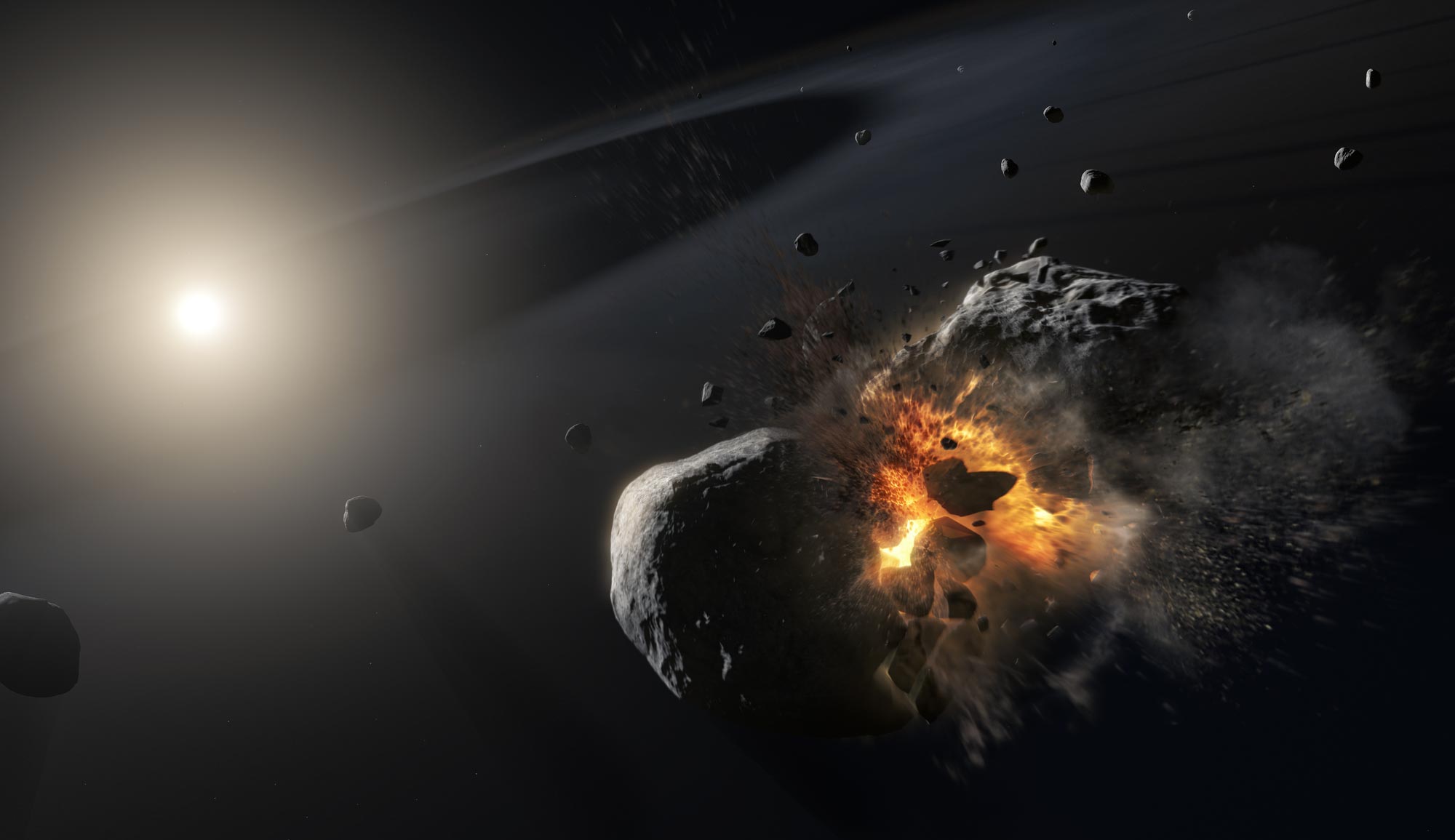
Webb also imaged what Gáspár dubs “the great dust cloud” that may be evidence of a collision occurring in the outer ring between two protoplanetary bodies. This is a different feature from a suspected planet first seen inside the outer ring by Hubble in 2008. Subsequent Hubble observations showed that by 2014 the object had vanished. A plausible interpretation is that this newly discovered feature, like the earlier one, is an expanding cloud of very fine dust particles from two icy bodies that smashed into each other.
Protoplanetary Disk Origins
The idea of a protoplanetary disk around a star goes back to the late 1700s when astronomers Immanuel Kant and Pierre-Simon Laplace independently developed the theory that the Sun and planets formed from a rotating gas cloud that collapsed and flattened due to gravity. Debris disks develop later, following the formation of planets and dispersal of the primordial gas in the systems. They show that small bodies like asteroids are colliding catastrophically and pulverizing their surfaces into huge clouds of dust and other debris. Observations of their dust provide unique clues to the structure of an exoplanetary system, reaching down to earth-sized planets and even asteroids, which are much too small to see individually.
The team’s results were published in the journal Nature Astronomy.
Reference: “Spatially resolved imaging of the inner Fomalhaut disk using JWST/MIRI” by András Gáspár, Schuyler Grace Wolff, George H. Rieke, Jarron M. Leisenring, Jane Morrison, Kate Y. L. Su, Kimberly Ward-Duong, Jonathan Aguilar, Marie Ygouf, Charles Beichman, Jorge Llop-Sayson and Geoffrey Bryden, 8 May 2023, Nature Astronomy.
DOI: 10.1038/s41550-023-01962-6
The James Webb Space Telescope is the world’s premier space science observatory. The Fomalhaut observations utilized the Mid-Infrared Instrument (MIRI), which was contributed by NASA and ESA (European Space Agency), with the instrument designed and built by a consortium of nationally funded European Institutes (the MIRI European Consortium) and NASA’s Jet Propulsion Laboratory, in partnership with the University of Arizona. Webb will solve mysteries in our solar system, look beyond to distant worlds around other stars, and probe the mysterious structures and origins of our universe and our place in it. Webb is an international program led by NASA with its partners, ESA, and the Canadian Space Agency.
Never miss a breakthrough: Join the SciTechDaily newsletter.
Follow us on Google and Google News.