

Webb discovered dozens of small, powerful galaxies from 800 million years ago that likely drove cosmic reionization by emitting strong ultraviolet radiation.
Astronomers using data from NASA’s James Webb Space Telescope have discovered dozens of small galaxies that played a key role in reshaping the early universe into its present form.
“When it comes to producing ultraviolet light, these small galaxies punch well above their weight,” said Isak Wold, an assistant research scientist at Catholic University of America in Washington and NASA’s Goddard Space Flight Center in Greenbelt, Maryland. “Our analysis of these tiny but mighty galaxies is 10 times more sensitive than previous studies, and shows they existed in sufficient numbers and packed enough ultraviolet power to drive this cosmic renovation.”
Wold recently presented his findings at the 246th meeting of the American Astronomical Society in Anchorage, Alaska. The study used previously collected images from Webb’s NIRCam (Near-Infrared Camera) and incorporated new data from its NIRSpec (Near-Infrared Spectrograph).
Discovery through UNCOVER program
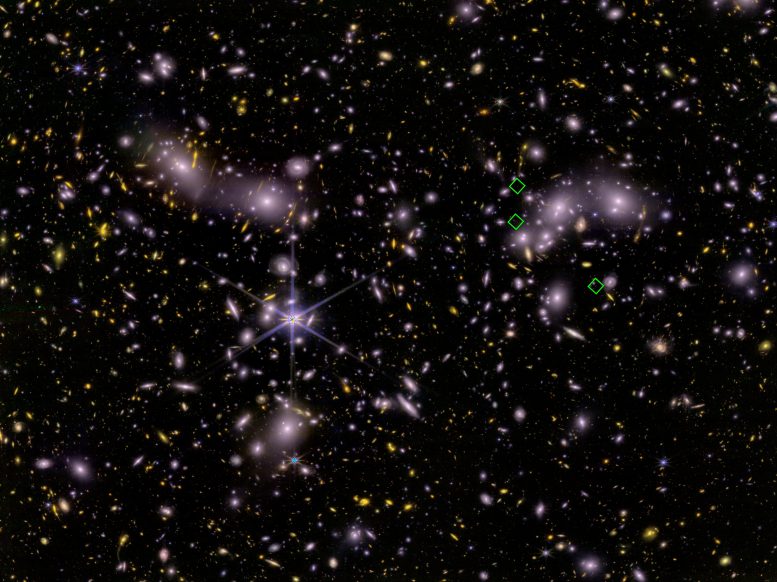
Wold and his colleagues at NASA Goddard, Sangeeta Malhotra and James Rhoads, discovered the tiny galaxies by analyzing images from the UNCOVER program (Ultradeep NIRSpec and NIRCam Observations before the Epoch of Reionization), which is led by Rachel Bezanson at the University of Pittsburgh in Pennsylvania.
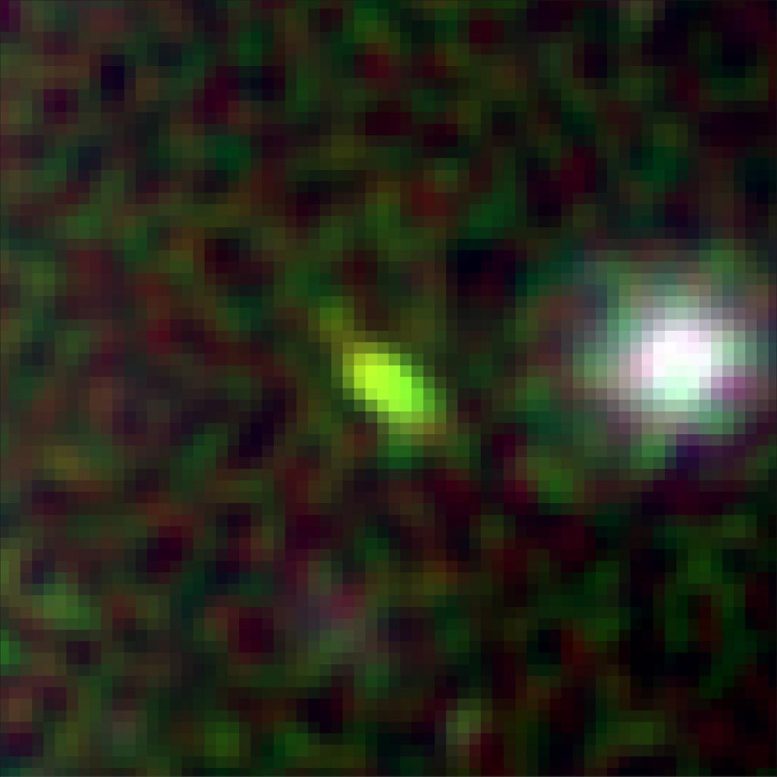
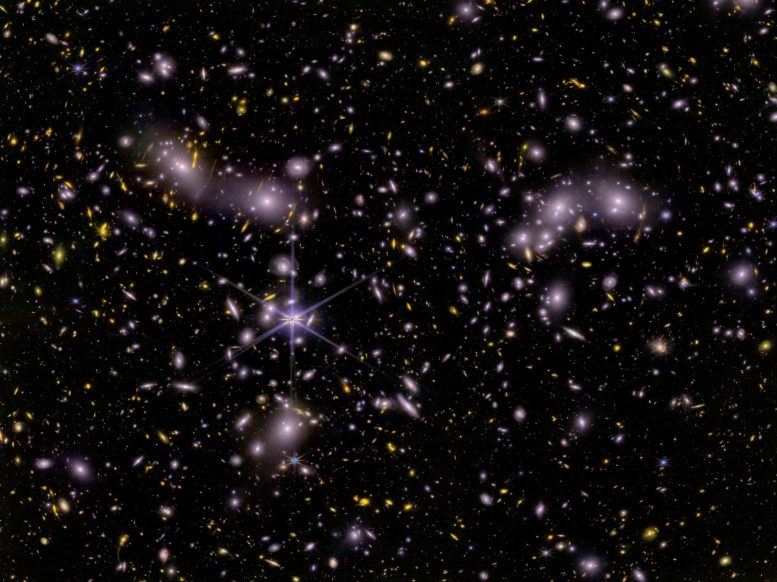
The program focused on a massive galaxy cluster called Abell 2744, also known as Pandora’s cluster, located about 4 billion light-years away in the southern constellation Sculptor. The mass of the cluster acts as a gravitational lens, magnifying more distant objects and extending the reach of Webb’s observations.
During its first billion years, the universe was filled with a fog of neutral hydrogen gas. Today, that gas is ionized, meaning its electrons have been stripped away. This transformation, known as reionization, has raised long-standing questions among astronomers about which sources were most responsible—large galaxies, small galaxies, or supermassive black holes in active galaxies. One of Webb’s main scientific goals is to help answer these questions about this major shift in the universe’s history.
Starburst galaxies take center stage
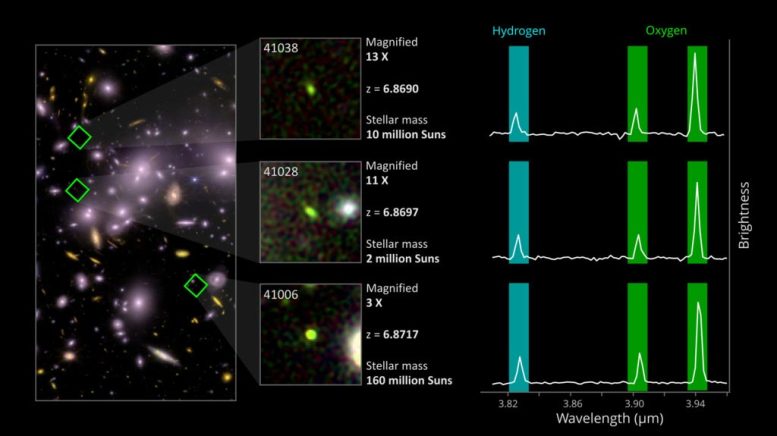
Recent studies have shown that small galaxies undergoing vigorous star formation could have played an outsized role. Such galaxies are rare today, making up only about 1% of those around us. But they were abundant when the universe was about 800 million years old, an epoch astronomers refer to as redshift 7, when reionization was well underway.
The team searched for small galaxies of the right cosmic age that showed signs of extreme star formation, called starbursts, in NIRCam images of the cluster.
“Low-mass galaxies gather less neutral hydrogen gas around them, which makes it easier for ionizing ultraviolet light to escape,” Rhoads said. “Likewise, starburst episodes not only produce plentiful ultraviolet light — they also carve channels into a galaxy’s interstellar matter that helps this light break out.”
Detecting galaxies with green oxygen lines
The astronomers looked for strong sources of a specific wavelength of light that signifies the presence of high-energy processes: a green line emitted by oxygen atoms that have lost two electrons. Originally emitted as visible light in the early cosmos, the green glow from doubly ionized oxygen was stretched into the infrared as it traversed the expanding universe and eventually reached Webb’s instruments.
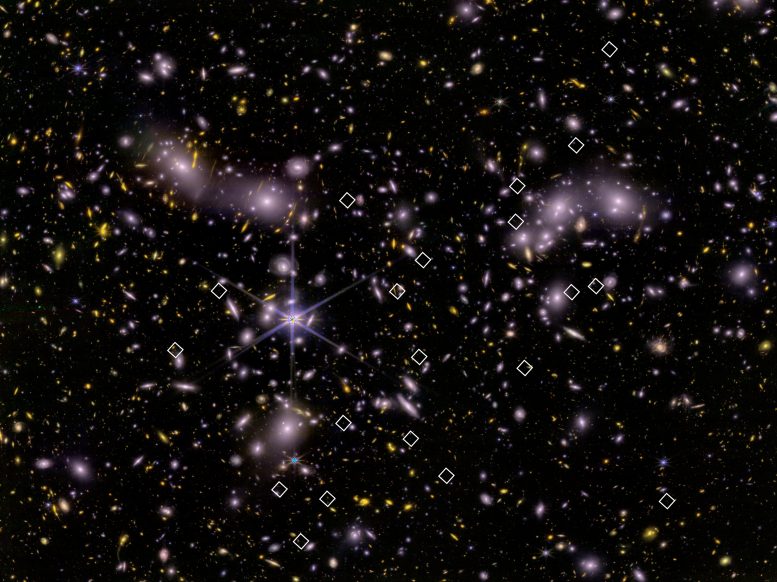
This technique revealed 83 small starburst galaxies as they appear when the universe was 800 million years old, or about 6% of its current age of 13.8 billion years. The team selected 20 of these for deeper inspection using NIRSpec.
“These galaxies are so small that, to build the equivalent stellar mass of our own Milky Way galaxy, you’d need from 2,000 to 200,000 of them,” Malhotra said. “But we are able to detect them because of our novel sample selection technique combined with gravitational lensing.”
Reionization powered by small galaxies
Similar types of galaxies in the present-day universe, such as green peas, release about 25% of their ionizing ultraviolet light into surrounding space. If the low-mass starburst galaxies explored by Wold and his team release a similar amount, they can account for all of the ultraviolet light needed to convert the universe’s neutral hydrogen to its ionized form.
Meeting: 246th meeting of the American Astronomical Society
Never miss a breakthrough: Join the SciTechDaily newsletter.
Follow us on Google and Google News.
4 Comments
Not another story ‘rewriting history’ – how utterly cliche-ridden SciTech copy is.
In this case there is also a blunder. The galaxies do not (purportedly) date to ‘800 million years ago’ but to 800 my after the Big Bang.
Not another comment that the story is at fault when the issue is only found in the clickbait title – how utterly cliche-ridden SciTech commentariat can be. /s
The original title was “NASA’s Webb ‘UNCOVERs’ Galaxy Population Driving Cosmic Renovation”, which may have been authored by story author Reddy himself. Popular science outlets gets copies and have clickbait centered (and often seemingly clueless) title editors deciding how to best pervert the titles.
The ingress error is more of a find, thank you. Some commenters have noted that these article parts recently seem inserted (without notice. but again likely within the ethical codes of e.g. journals) in a title clickbait like manner now. They seem authored by LLMs rather than humans. Not exactly a hallucinated claim this time, more like a (clueless) misunderstanding.
These images were seeing is really amazing we have no idea of what they really are (I believe) it sometimes looks like we are looking at what we think we have seen something similar here on earth some friendly some not some deceiving so on and so forth NASA is really amazing and all the galaxies and planets man were we wrong on e again
I’m still trying to figure out how the galaxy communicates to us human here on Earth.
I find it very interesting in intriguing.!!!!
I wished upon a star and I strongly feel the stars do hear wishes.!!!!.