

Protective brain structures called perineuronal nets play a critical role in preserving social memory and may offer a new target for Alzheimer’s treatment.
For many families affected by Alzheimer’s disease, one of the most devastating experiences is when a loved one can no longer recognize them. New findings from the University of Virginia School of Medicine may help explain why this loss occurs and point toward a possible way to prevent it.
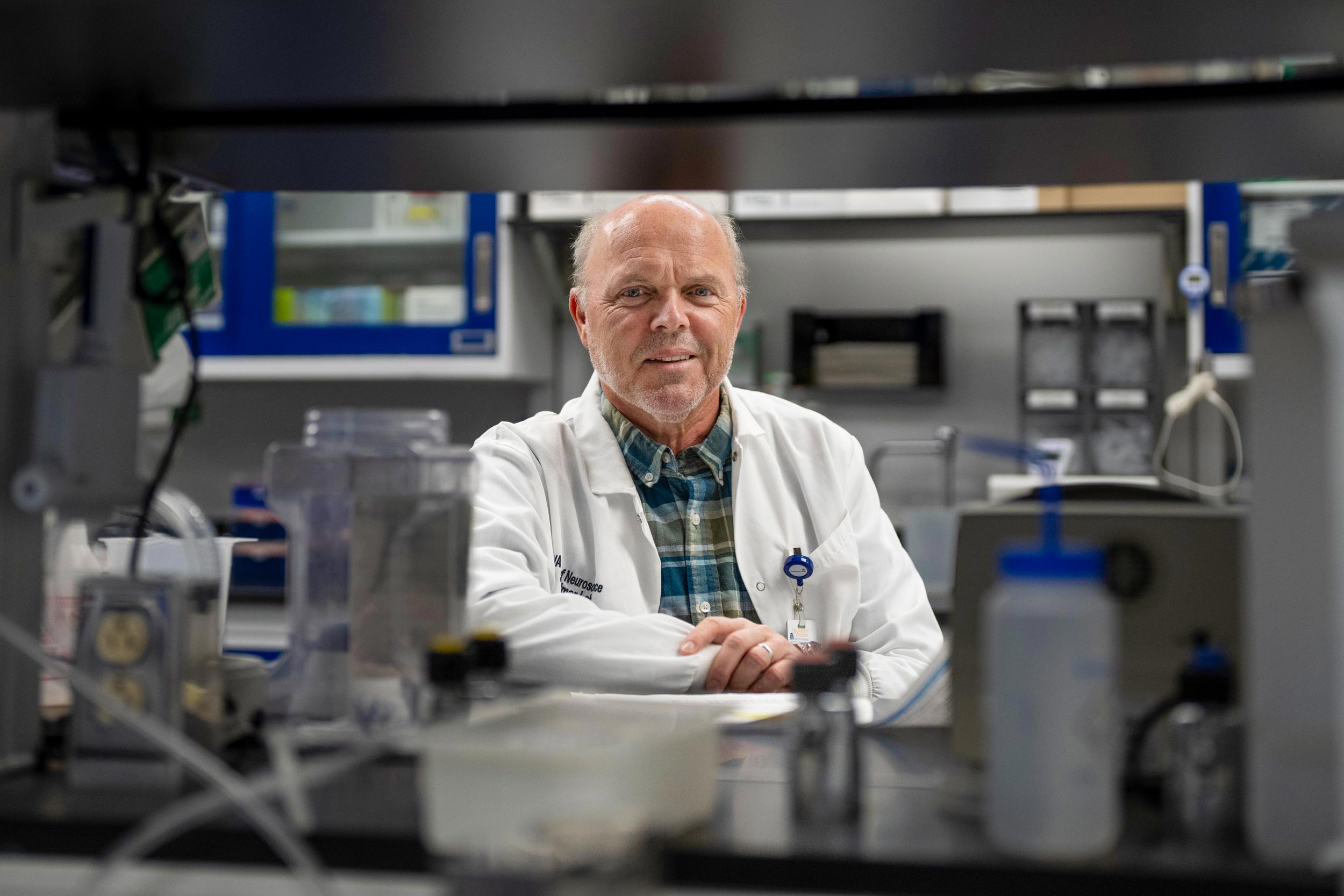
Researchers led by Harald Sontheimer, PhD, along with graduate student Lata Chaunsali and their colleagues, discovered that the loss of recognition of family members, friends, and caregivers is linked to the breakdown of protective “nets” that surround brain cells. When these structures were preserved in laboratory mice, the animals retained their ability to remember past social interactions.
According to the researchers, this discovery highlights a promising new direction for developing treatments aimed at protecting memory in people with Alzheimer’s disease.
“Finding a structural change that explains a specific memory loss in Alzheimer’s is very exciting,” said Sontheimer, chair of UVA’s Department of Neuroscience and member of the UVA Brain Institute. “It is a completely new target, and we already have suitable drug candidates in hand.”
Alzheimer’s: A Growing Problem
Alzheimer’s affects an estimated 55 million people worldwide, and that figure is projected to rise by 35% within the next five years. To confront this growing challenge, UVA has launched the Harrison Family Translational Research Center in Alzheimer’s and Neurodegenerative Diseases as part of its Paul and Diane Manning Institute of Biotechnology. The center is focused on speeding up the development of new therapies and potential cures for Alzheimer’s and related conditions.
Sontheimer’s latest research builds on earlier work showing the importance of structures known as “perineuronal nets” in the brain. These net-like formations surround neurons and act as protective barriers that support proper communication between nerve cells. This communication is essential for forming and maintaining new memories.
Based on those results, Sontheimer and his collaborators suspected that disruptions of the nets could be a critical turning point in Alzheimer’s. Their latest work bears that out: The scientists found that lab mice that had faulty nets lost their ability to remember other mice – their “social memory” – even as they could still form new memories of objects in their environment. This mirrors what is seen in people with Alzheimer’s, where social memory often fails before object memory.
Preserving nets preserves memory in mice
Sontheimer and his team then used “MMP inhibitors” – a class of drugs already being investigated for their potential to treat cancer and arthritis – to see if they could prevent the loss of the perineuronal nets. It worked. The approach staved off the degradation of the nets and preserved the mice’s social memory.

“In Alzheimer’s disease, people have trouble remembering their family and friends due to the loss of a memory known as social memory. We found that the net-like coating known as perineuronal nets protects these social memories. In our research with mice, when we kept these brain structures safe early in life, the mice suffering from this disease were better at remembering their social interactions,” Chaunsali said. “Our research will help us get closer to finding a new, non-traditional way to treat or better yet prevent Alzheimer’s disease, something that is much needed today.”
A path beyond amyloid focused theories
The changes the scientists saw in the mice’s brains align with those seen in human patients with Alzheimer’s, suggesting that the targeting the nets in people could provide similar benefits. Developing a treatment based on the findings will require additional research, but Sontheimer and Chaunsali are hopeful about what the future could hold.
“Although we have drugs that can delay the loss of perineuronal nets, and thereby delay memory loss in disease, more research needs to be done regarding safety and effectiveness of our approach before this can be considered in humans,” Sontheimer said. “One of the most interesting aspect of our research is the fact that the loss of perineuronal nets observed in our studies occurred completely independent of amyloid and plaque pathology, adding to the suspicion that those protein aggregates may not be causal of disease.”
Reference: “Degradation of perineuronal nets in hippocampal CA2 explains the loss of social cognition memory in Alzheimer’s disease” by Lata Chaunsali, Jiangtao Li, Erik Fleischel, Courtney E. Prim, Izabela Kasprzak, Shan Jiang, Silky Hou, Miguel Escalante, Elise C. Cope, Michelle L. Olsen, Bhanu P. Tewari and Harald Sontheimer, 22 October 2025, Alzheimer’s & Dementia.
DOI: 10.1002/alz.70813
The research was supported by the National Institutes of Health, grants R01AG065836, R01NS036692, and R01NS123069; The Owens Family Foundation; a Wagner fellowship; and a Double Hoo fellowship.
Never miss a breakthrough: Join the SciTechDaily newsletter.
Follow us on Google and Google News.