

An accidental discovery and a love of spectroscopic perturbations leads to the solution of a 90-year-old puzzle.
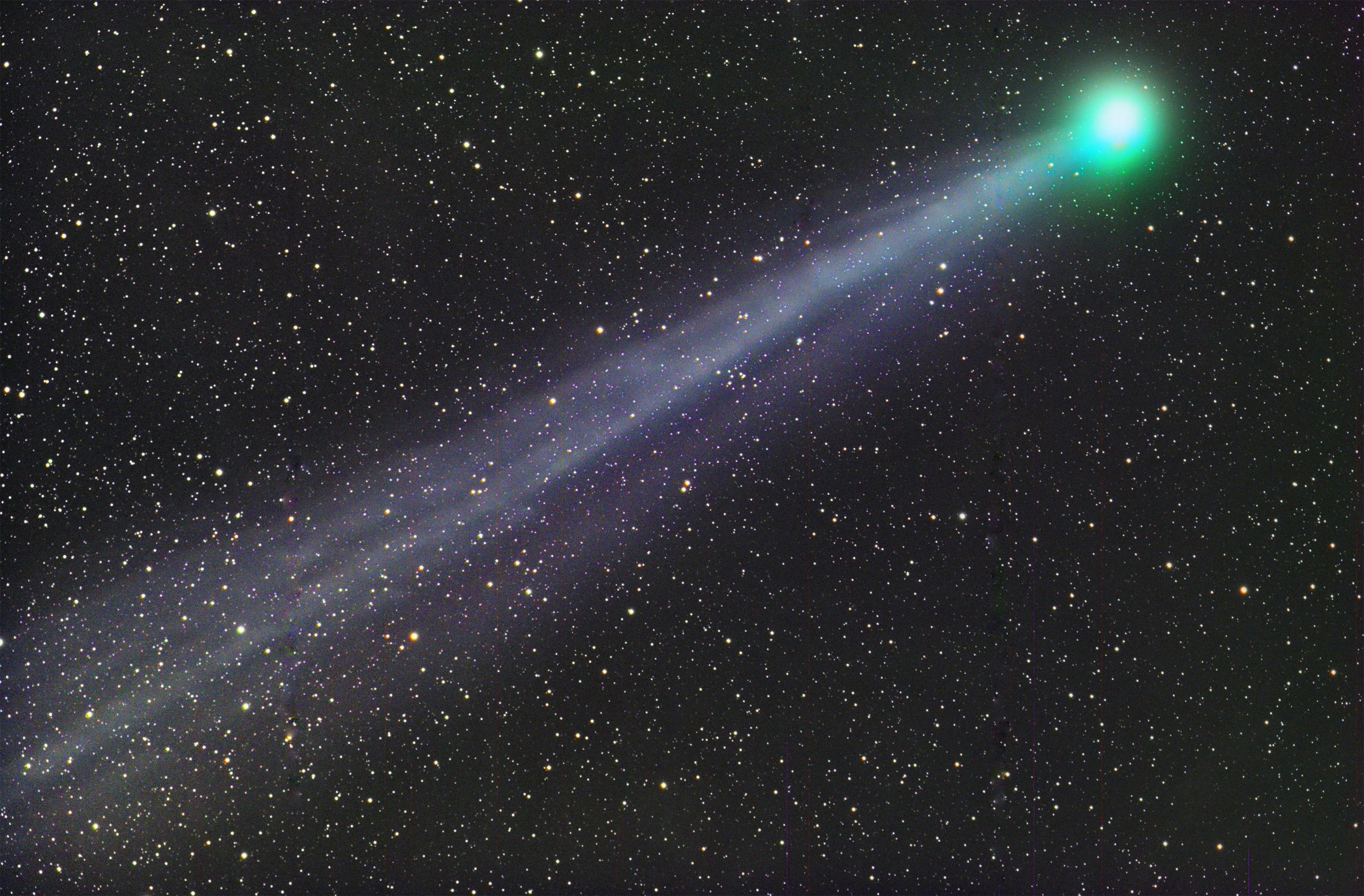
In a global collaboration, a team of researchers recently proved a 90-year-old theory on why comets’ heads, but never the tails, are green.
The scientific explanation, published recently in PNAS, has to do with the way the molecule dicarbon (C2) gets blown apart by sunlight. The other part of the story lies in an accidental discovery and a love of spectroscopic perturbations, passed from a recently retired professor to another generation of scientists.
When Molecules Misbehave
As a graduate student at MIT in the lab of Robert W. Field, Jun Jiang PhD ’17 was studying the molecule acetylene by exciting it with a high-power frequency-tunable UV laser. As the acetylene blew apart, one of the resulting molecules, C2, emitted light from several highly excited states.
One of these high-energy states, the C1Πg state of C2, showed an irregular vibrational energy level structure and was strongly perturbed by another mysterious electronic state. In other words, Jiang noticed that the carbon-carbon bond in the dicarbon C state vibrates in a highly unusual manner not readily explained, in some ways like a child throwing a tantrum for no apparent reason.
Introductory classes in quantum mechanics teach a model system of how molecules are supposed to act or react in various situations. “Perturbations are deviations that are so large, spectroscopists often give up and label the observed spectra of the molecule as ‘strongly perturbed,’” says Jiang, now a researcher at Lawrence Livermore National Laboratory and a co-author of the paper.
According to Field, even physicist Gerhard Herzberg, who all but created the study of small molecule spectroscopy and originated the proposal of why comet’s tails are never green, would usually set perturbations aside “for future study” in his research.
“I started my career dealing with Herzberg’s garbage,” says Field, professor of chemistry post-tenure at MIT who also co-authored the paper. Field’s interest in the “bad behavior” of molecules began over 40 years ago with deviations in carbon monoxide. “When molecules misbehave, it can lead to great insight.”
The Valence-Hole Concept
The perturbations in the C state of C2 led researchers to more than what was previously known about the molecule’s electronic structure, a concept invented by quantum chemists to describe the complex, many-body interactions among the electrons and nuclei in the molecule.
“At MIT, we discovered that the source of these systematic perturbations in C2 is a new phenomenon that we call ‘valence-hole electron configurations,’” says Field.
Despite the simplicity of its chemical composition, dicarbon possesses a surprisingly intricate electronic structure, which manifests strident anomalies in energy level patterns. These signs of “spectroscopic perturbations” are far more numerous and complex than those found in other simple, textbook-featured diatomic molecules, such as CO, N2, and O2.
“The perturbations caused by these special, unexpectedly stable valence-hole configurations profoundly affect the photodissociation and predissociation properties of C2, which, as we show in our PNAS paper, determine how long C2 molecules survive on a comet before being destroyed by ultraviolet radiation in sunlight,” says Field. “Perturbations, predissociation, and photodissociation are three spectroscopic arcanae that explain the mystery of the color difference between the head and tail of a strikingly visible comet.”
These insights were crucial to the solution of an almost-century-old puzzle that Professor Timothy W. Schmidt of the University of New South Wales and lead author of the paper was investigating on the other side of the world. Arriving at similar conclusions about the excited C state of C2, Schmidt reached out to Field, leading to the first time in history scientists observed the diagnostic details of this chemical interaction, theorized by Herzberg in the 1930s.
Putting Humpty Together Again
After seven years in the Field research group, Jiang has learned to embrace a curiosity-guided approach to research. “Bob always challenged us to look beyond the conventional expectations about how a molecule should behave. There can be beautiful stories to learn,” says Jiang.
The stories from this discovery reach even further than C2. Studies have shown the importance of the valence-hole state in dinitrogen, but the high energy of this state in N2 makes a more complete spectroscopic investigation difficult. As Jiang’s accidental discovery determined that spectra for the valence-hole states of dicarbon are more easily obtained than for other related molecules, C2 can serve as a model for understanding the disruptive impact of valence-hole states in general.
“Perturbations break the regular Herzbergian pattern, and theory based on the valence-hole concept puts the broken pieces back together,” says Jiang, whose current work compares the idea to achieving what was impossible in the Humpty Dumpty nursery rhyme.
Perhaps children’s tales have more in common with chemical breakthroughs than we may think. If unexpected deviations lead to deeper understanding of a subject’s nature, we might say that misbehavior is simply misunderstood behavior.
Molecules, like children, “act out” for reasons not readily obvious. But once we identify the cause, the pieces fit together to tell a more complete story.
As Field says, “Nature leaves a breadcrumb trail of insights through perturbations.” We can reap those insights if we follow where curiosity leads.
For more on this research, see Why Comets’ Heads Can Be Green, but Never Their Tails.
Reference: “Photodissociation of dicarbon: How nature breaks an unusual multiple bond” by Jasmin Borsovszky, Klaas Nauta, Jun Jiang, Christopher S. Hansen, Laura K. McKemmish, Robert W. Field, John F. Stanton, Scott H. Kable, and Timothy W. Schmidt, 20 December 2021, Proceedings of the National Academy of Sciences.
DOI: 10.1073/pnas.2113315118
Never miss a breakthrough: Join the SciTechDaily newsletter.
Follow us on Google and Google News.
1 Comment
hi