
Exploring the process of change could uncover novel functions for elements of the genetic code.
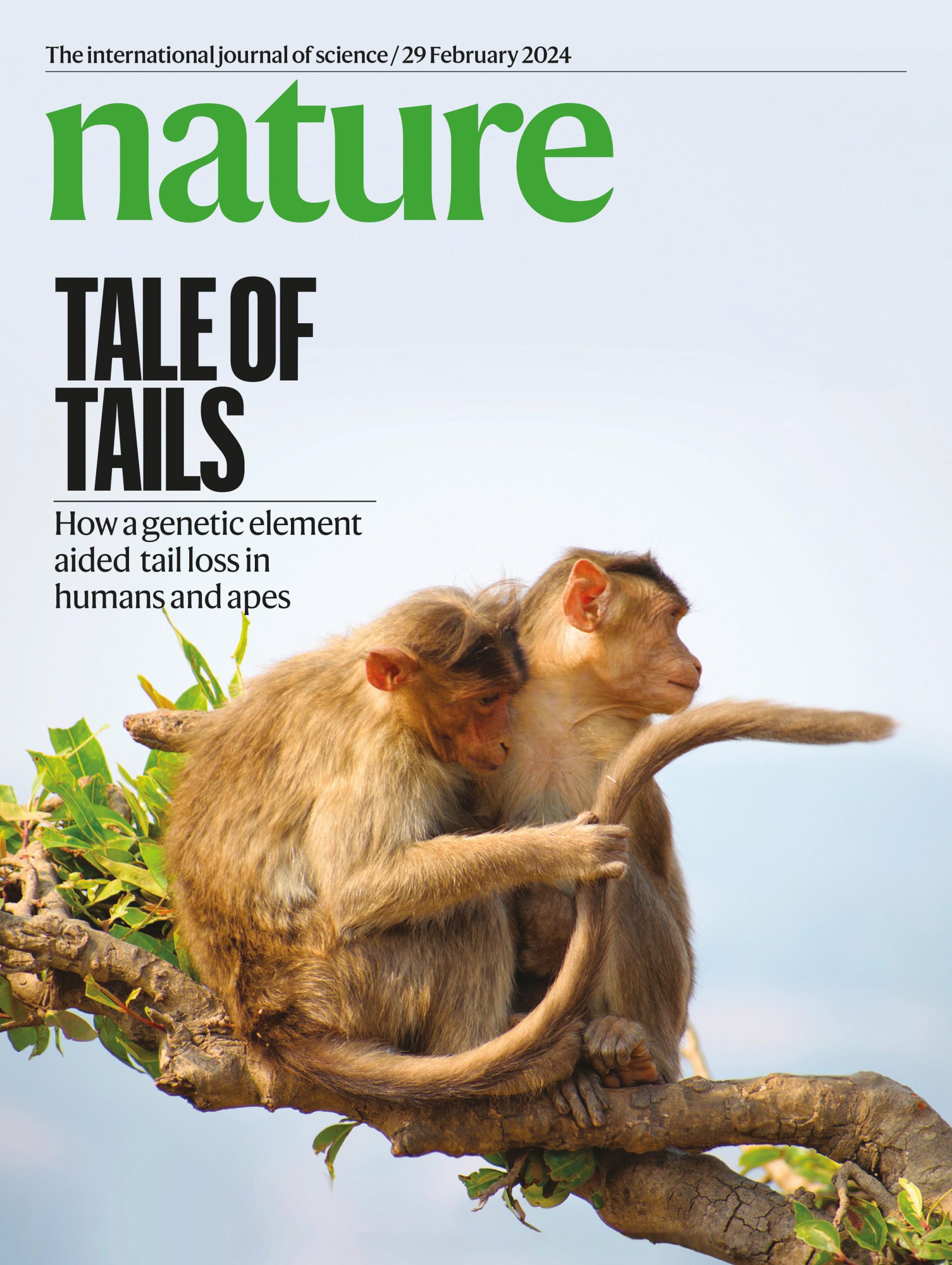
A new study conducted by researchers at NYU Grossman School of Medicine suggests that a genetic change in our ancient ancestors could partially explain why humans don’t have tails, unlike monkeys.
Recently published in the journal Nature, the work compared the DNA of tail-less apes and humans to that of tailed monkeys and found an insertion of DNA shared by apes and humans, but missing in monkeys. When the research team engineered a series of mice to examine whether the insertion, in a gene called TBXT, affected their tails, they found a variety of tail effects, including some mice born without tails.
“Our study begins to explain how evolution removed our tails, a question that has intrigued me since I was young,” says corresponding study author Bo Xia, Ph.D., a student at the time of the study in the labs of study senior co-authors Jef D. Boeke, Ph.D., and Itai Yanai, Ph.D. at NYU Grossman School of Medicine. Xia is now a junior fellow of the Harvard Society of Fellows, and a principal investigator at the Broad Institute of MIT and Harvard.
More than 100 genes had been linked by past work to the development of tails in various vertebrate species, and the study authors hypothesized that tail loss occurred through changes in the DNA code (mutations) of one or more of them. Remarkably, say the study authors, the new study found that the differences in tails came not from TBXT mutations, but instead from the insertion of a DNA snippet called AluY into the gene’s regulatory code in the ancestors of apes and humans.
Profound Surprise
The new finding proceeds from the process by which genetic instructions are converted into proteins, the molecules that make up the body’s structures and signals. DNA is “read” and converted into a related material in RNA, and ultimately into mature messenger RNA (mRNA), which produces proteins.
In a key step that produces mRNA, “spacer” sections called introns are cut out of the code, but before that guide the stitching together (splicing) of just the DNA sections, called exons, which encode the final instructions. Further, the genomes of vertebrate animals evolved to feature alternative splicing, in which a single gene can code for more than one protein by leaving out or adding exon sequences. Beyond splicing, the human genome grew more complex still by evolving to include “countless” switches, part of the poorly understood “dark matter” that turns on genes at different levels in different cell types.
Still other work has shown that half of this non-gene “dark matter” in the human genome, which lies both between genes and within the introns, consists of highly repeated DNA sequences. Further, most of these repeats consist of retrotransposons, also called “jumping genes” or “mobile elements,” which can move around and insert themselves repeatedly and randomly in human code.
Pulling these details together, the “astounding” current study found that the transposon insertion of interest, AluY, which affected tail length, had randomly occurred in an intron within the TBXT code. Although it did not change a coding portion, the intron insertion, so the research team showed, influenced alternative splicing, something not seen before, to result in a variety of tail lengths. Xia found an AluY insertion that remained in the same location within the TBXT gene in humans and apes resulted in the production of two forms of TBXT RNA. One of these, they theorize, directly contributed to the tail loss.
“This finding is remarkable because most human introns carry copies of repetitive, jumping DNAs without any effect on gene expression, but this particular AluY insertion did something as obvious as determine tail length,” said Boeke, the Sol and Judith Bergstein Director of the Institute for System Genetics at NYU Langone Health.
Tail loss in the group of primates that includes gorillas, chimpanzees, and humans is believed to have occurred about 25 million years ago, when the group evolved away from Old World monkeys, said the authors. Following this evolutionary split, the group of apes that includes present-day humans evolved the formation of fewer tail vertebrae, giving rise to the coccyx, or tailbone. Although the reason for the tail loss is uncertain, some experts propose that it may have better-suited life on the ground than in the trees.
Any advantage that came with tail loss was likely powerful, the researchers say, because it may have happened despite coming with a cost. Genes often influence more than one function in the body, so changes that bring an advantage in one place may be detrimental elsewhere. Specifically, the research team found a small uptick in neural tube defects in mice with the study insertion in the TBXT gene.
“Future experiments will test the theory that, in an ancient evolutionary trade-off, the loss of a tail in humans contributed to the neural tube birth defects, like those involved in spinal bifida, which are seen today in one in a thousand human neonates,” said Yanai, also in the Institute for Systems Genetics.
Reference: “On the genetic basis of tail-loss evolution in humans and apes” by Bo Xia, Weimin Zhang, Guisheng Zhao, Xinru Zhang, Jiangshan Bai, Ran Brosh, Aleksandra Wudzinska, Emily Huang, Hannah Ashe, Gwen Ellis, Maayan Pour, Yu Zhao, Camila Coelho, Yinan Zhu, Alexander Miller, Jeremy S. Dasen, Matthew T. Maurano, Sang Y. Kim, Jef D. Boeke and Itai Yanai, 28 February 2024, Nature.
DOI: 10.1038/s41586-024-07095-8
In addition to Xia, Boeke and Yanai, other NYU Langone study authors were Weimin Zhang, Guisheng Zhao, Ran Brosh, Aleksandra Wudzinska, Emily Huang, Hannah Ashe, Gwen Ellis, Maayan Pour, Yu Zhao, Camila Coelho, Yinan Zhu, Alexander Miller, Jeremy Dasen, Matthew Maurano, and Sang Yong Kim. The mouse engineering work was supported by the NYU Langone Health Rodent Genetic Engineering Laboratory (RGEL) led by Dr. Sang Yong Kim. The study was funded by NYU Langone research fund and National Institutes of Health grants RM1HG009491, P01AG051449, DP5OD033430, and R35GM119703, and by NYSTEM predoctoral fellowship C322560GG.
Never miss a breakthrough: Join the SciTechDaily newsletter.
Follow us on Google and Google News.