

Scientists have visualized, for the first time, how a key sensory protein detects both cold temperatures and cooling compounds like menthol.
Stepping into chilly air or tasting a mint sets off a specialized sensor in your body that signals the brain that something feels cold. Researchers have now obtained the first high-resolution images showing how this sensor works, revealing how it responds both to low temperatures and to menthol, the cooling compound found in mint plants. The findings were recently presented at the 70th Biophysical Society Annual Meeting in San Francisco.
The research centers on TRPM8, a protein channel that detects cool conditions. “Imagine TRPM8 as a microscopic thermometer inside your body,” said Hyuk-Joon Lee, a postdoctoral fellow from Seok-Yong Lee’s laboratory at Duke University. “It’s the primary sensor that tells your brain when it’s cold. We’ve known for a long time that this happens, but we didn’t know how. Now we can see it.”
TRPM8 is located in the membranes of sensory nerve cells that serve the skin, mouth, and eyes. When temperatures drop to roughly between 46°F and 82°F, the channel opens and allows charged particles known as ions to enter the cell. This movement of ions generates an electrical signal that travels to the brain, where it is interpreted as a cooling sensation. The same pathway explains why menthol, eucalyptus, and similar substances create a cool feeling even when the temperature does not change.
“Menthol is like a trick,” Lee explained. “It attaches to a specific part of the channel and triggers it to open, just like cold temperature would. So even though menthol isn’t actually freezing anything, your body gets the same signal as if it were touching ice.”
Visualizing the Channel in Action
To understand how TRPM8 changes shape during activation, the team used cryo-electron microscopy, a method that images rapidly frozen proteins with an electron beam. This approach allowed them to capture a series of structural states as the channel shifted from closed to open.
Their analysis showed that cold and menthol activate TRPM8 through overlapping but distinct internal pathways. Cold exposure mainly alters the pore region, which is the part of the channel that opens to let ions pass. Menthol binds at a separate site on the protein and triggers structural changes that spread through the molecule until the pore opens.
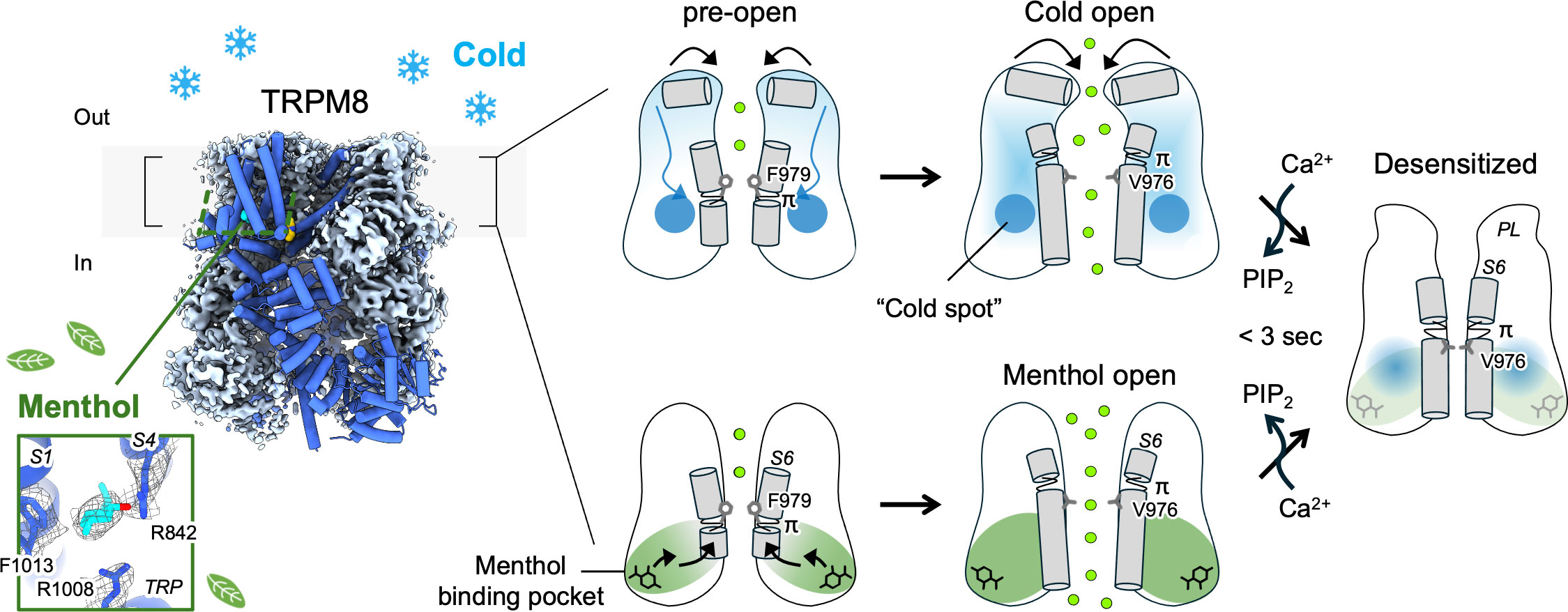
“When cold is combined with menthol, the response is enhanced synergistically,” Lee said. “We used this combination to capture the channel in its open state—something that hadn’t been achieved with cold by itself.”
Medical Relevance and a “Cold Spot”
Understanding how TRPM8 operates could have important clinical implications. Problems with this channel have been associated with chronic pain, migraines, dry eye and certain cancers. One drug that targets TRPM8, acoltremon, is an FDA-approved eye drop used to treat dry eye disease. As a menthol analogue, it activates the cooling pathway to boost tear production and relieve irritation.
The scientists also identified what they describe as a “cold spot,” a specific region of the protein that plays a central role in sensing temperature. This area appears to help the channel remain responsive during extended exposure to cold, preventing it from becoming desensitized.
“Previously, it was unclear how cold activates this channel at the structural level,” Lee said. “Now we can see that cold triggers specific structural changes in the pore region. This gives us a foundation for developing new treatments that target this pathway.”
By revealing how temperature changes and cooling chemicals converge on the same molecular sensor, the study provides the first detailed structural explanation of how the body detects coolness. The results address a long-standing mystery in sensory biology and may guide the development of more precise therapies that target this pathway.
Meeting: 70th Biophysical Society Annual Meeting
Never miss a breakthrough: Join the SciTechDaily newsletter.
Follow us on Google and Google News.
1 Comment
thanks