
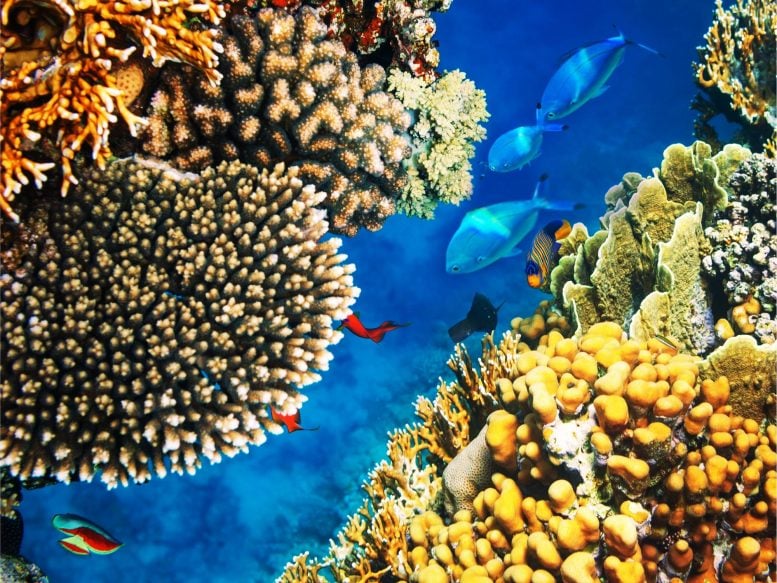
Actions in the coming decade will determine whether reefs survive, scientists say.
An international group of researchers representing thousands of coral scientists across the globe is calling for new commitments and actions by the world’s policymakers to protect and restore coral reefs.
In a paper presented July 20 at the International Coral Reef Symposium, the scientists said that the coming decade will likely offer the last chance for policymakers at all levels to prevent coral reefs “from heading towards worldwide collapse.”
Three Key Strategies to Save Coral Reefs
The paper, developed by the International Coral Reef Society, pushes for three strategies to save the reefs: addressing climate change, improving local conditions, and actively restoring coral.
“The model projections show that up to 30% of coral reefs will persist through this century if we limit global warming to 1.5 degrees Celsius (2.7 degrees Fahrenheit),” said Andréa Grottoli, distinguished professor of earth sciences at The Ohio State University, society president and a contributing author of the paper.
“But if we are to limit warming to 1.5 degrees, we have to do it now: The science and the models show that we have only a few years left to reduce carbon dioxide emissions that put us on that path. It has to happen this decade, or we won’t make that target.”
Coral reefs are at an inflection point, the researchers say. Stop climate change now – and start to reverse it – and some reefs might survive, with the possibility that they could be rebuilt in the future and provide the seeds to regrow damaged reefs elsewhere.
“From a coral reef perspective, we go from 30% of reefs surviving to only a few percent surviving if we don’t act now,” Grottoli said. “We are already faced with a grand challenge in trying to restore the reefs. Once we do eventually reduce carbon dioxide emissions and the planet is no longer warming at an accelerated rate, trying to restore from just a few percent is much more difficult.”
This year, policymakers from around the world will create updated global frameworks for addressing both of those crises, via the upcoming Conference of the Parties to the United Nations Framework Convention on Climate Change (COP26) and the Conference of the Parties to the Convention on Biological Diversity (COP15). Grottoli said the society created its policy paper to influence those frameworks.
The society’s paper makes three asks of policymakers:
- Commit to addressing biodiversity loss and the effect climate change has had on coral reefs, ensure policies are ambitious enough to address those crises, and ensure that policies are implemented.
- Build coordinated actions across related policy fields at all levels of governance, from local councils to international bodies. This includes efforts in conservation, management, and restoration, as well as policies that address climate change adaptation, biodiversity, and sustainable development.
- Innovate new approaches to help coral adapt to climate change. Global warming is here, and adaptation is unavoidable. A small percentage of reefs and some coral species have been successfully managed. “Studies of these ‘bright spots’ provide important lessons to guide future actions, such as how local community participation can improve management outcomes,” the scientists wrote.
“As bad as climate change has been for the last decades, we also have lost vast amounts of coral reefs through overfishing, pollution and other local actions, and we need to tackle both of those fronts simultaneously,” said Nancy Knowlton, lead author of the paper and Sant Chair for Marine Science Emerita at the Smithsonian Institution’s National Museum of Natural History.
“Climate change is important but it’s important that these other things aren’t neglected. There’s no time for arguing about which is most important; we need to do all of them.”
Small in Size, Huge in Value
Coral reefs are crucial ecosystems, housing about a third of the known ocean species despite covering less than 0.1% of the world’s oceans. They are also critical for local food supplies and economies. Reef-related tourism alone generates some $36 billion per year and the global economic value of reefs across all sectors approaches $10 trillion per year.
They are sources for important biochemical compounds, including drugs that treat cancer.
And they protect coasts from storm flooding: A healthy reef can break waves and buffer more than 90% of incoming wave height and energy. In the United States and its territories alone, according to the ICRS paper, the annual value of flood risk reduction provided by coral reefs is more than 18,000 lives affected by flooding and $1.8 billion. Without reefs, researchers have estimated that annual flood damage would more than double, and that flooding would increase by 69%.
Climate Change’s Deadly Effects on Reefs
But reefs are particularly susceptible to the negative effects of climate change, which causes ocean temperatures to increase and ocean waters to acidify. Those environmental changes can cause coral to bleach, stop growing and die.
“The window for opportunities to act both on coral reef adaptation and on climate change mitigation will soon close for good,” said David Obura, contributing author to the paper and director of CORDIO East Africa, a nonprofit research organization focused on coral reefs and sustainability in Africa. “We need a massive increase in commitment now and even more in coming years, coherence across all scales and jurisdictions, and innovation – new mindsets, approaches and techniques. More than anything we need everyone to act, including us scientists by providing our approaches and knowledge, to do our part in saving coral reefs.”
The ICRS policy paper was authored by scientists from the U.S., Africa, Europe, the Middle East, and Australia. The mission of the ICRS is to promote the acquisition and dissemination of scientific knowledge to secure the future of coral reefs, including via relevant policy frameworks and decision-making processes. The policy statement released in coordination with the 14th International Coral Reef Symposium is the most comprehensive in the society’s history.
The full document, along with translations of this press release and the paper’s executive summary (Spanish, German, French, Portuguese, Arabic and Mandarin), are available online at http://coralreefs.
Never miss a breakthrough: Join the SciTechDaily newsletter.
Follow us on Google and Google News.
1 Comment
“The model projections show that up to 30% of coral reefs will persist through this century if we limit global warming to 1.5 degrees Celsius,”
Some questions:
1) What is special about 1.5 degrees C? Why not 1.0 or 1.6?
2) Why is 30% acceptable? Why not demand 50% survival, or more?
3) How has the model been validated? Why should we trust it?
Commonly, one looks for a knickpoint in a graph showing the relationship between two variables; it shows an abrupt change that is untypical. Alternatively, one looks for a point of inflection, where the behavior changes from a positive rate of growth to a negative rate. Or, in engineering or economics, one looks for a point of diminishing returns that illustrates that it takes an extraordinary effort (large increase in the independent variable) to make a constant change in the dependent variable. These are reasoned approaches to dealing with problems. However, I don’t see that kind of justification for accepting either 1.5 deg C, or 30%. Instead, these latter values seem to be arbitrary or even capricious!
Computer models are quantitative representations of reality. Shouldn’t we expect quantitative justifications for the variables they deal with?