

A neuroscience study identifies specific brain neurons that are vital for learning from negative stimuli, highlighting their potential role in mental health.
We often say ‘I’m not going to do this again’ when faced with negative feedback, adverse effects, or disappointing outcomes. From these experiences, we attempt to learn.
How does the brain facilitate this type of learning? Positive and negative reinforcements are crucial mechanisms within the brain’s valuation system. Neurons releasing the neurotransmitter dopamine signify outcomes that are better or worse than expected by either increasing or decreasing their activity. Meanwhile, there is growing evidence that other parts of the brain handle ‘negative’ and ‘positive’ differently.
Arousal and Attention in Negative Experiences
Negative experiences often provoke a significant arousal effect, activating specific parts of the neocortex. This activation helps us focus on pertinent features and learn from the experience, a concept known as ‘attention for aversive learning’.
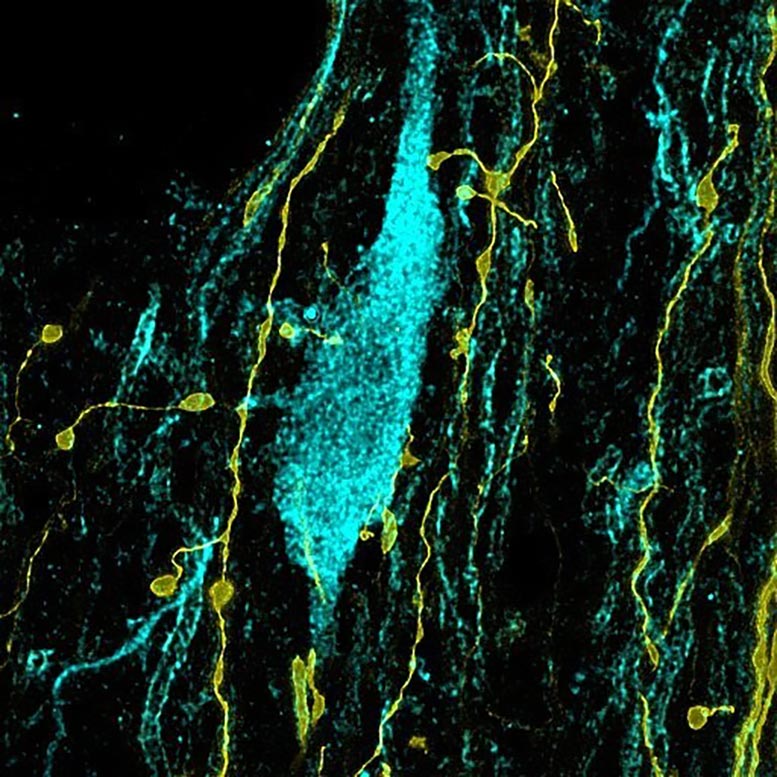
Researchers from the HUN-REN Institute of Experimental Medicine, led by Balazs Hangya, explored which brain regions and neuron types are involved in aversive learning. Their study, published in the journal Nature Communications, reveals that long-range projecting inhibitory neurons that express the protein parvalbumin (PV) in the horizontal limb of the diagonal band of Broca (HDB) play a crucial role in this process.
Neuron Functionality and Experimental Findings
These HDB-PV neurons, known for their fast activity, convey arousing effects to the neocortex and control gamma oscillations critical for cognitive functions. Therefore, they appeared as good candidates for mediating ‘attention for aversive learning’. Hangya’s team showed that these neurons are indeed recruited by aversive events in experimental mice, like an unexpected puff of air on the face mice strive to avoid, or the odor of a fearful predator.
The Effects of Aversive Events
Aversive events activate a range of pathways, leading to a series of consequences in the brain. First, they promote avoidance behaviors that reduce the risk of enduring negative impacts. Second, they enhance arousal and attention by activating relevant parts of the neocortex, helping the organism cope with the situation. Third, they facilitate learning to avoid or mitigate similar future scenarios.
Panna Hegedüs, the first author of the study, noted, “Learning from negative experience is a deeply rooted, ancient survival strategy. It can even override the effects of positive reinforcement.”
Insights from Optogenetics
Hangya’s team used a technology called optogenetics, which can render specific cell types, in this case, HDB-PV neurons, sensitive to light. These techniques enable precise activation or suppression of the activity of neurons by the timed delivery of light into the brain tissue via small optic fibers. They found that activating HDB-PV neurons did not cause avoidance behavior in mice, suggesting that this pathway is not involved in active avoidance like seeking a shelter, but more likely mediates attention and/or learning aspects induced by aversive stimuli.
Indeed, when they optogenetically blocked the responses of the neurons to facial air puffs, mice failed to learn discriminating predictive auditory stimuli forecasting likely or unlikely air puffs. This experiment demonstrated that HDB-PV neurons are necessary to learn from aversive stimuli.
Neural Circuits and Behavioral Responses
Neurons do not act in isolation but are part of complex circuits with diverse input and output pathways. Hangya’s team, together with Gabor Nyiri and coworkers from the same institute, mapped the inputs to and outputs of HDB-PV neurons. They found that these cells integrate multiple sources of aversive information including prominent pathways from the hypothalamus and the brainstem raphe nuclei. In turn, they transmit integrated information to the so-called limbic system broadly responsible for behavioral and emotional responses, including the septo-hippocampal system important for storing and recalling episodic memories.
Furthermore, the inhibitory HDB-PV cells mostly target other inhibitory neurons in these regions, thus likely relieving excitatory cells from inhibition and allowing them to be more active – a ubiquitous brain mechanism called disinhibition.
Conclusion and Implications for Mental Health
The study suggests that long-range inhibitory HDB-PV neurons are recruited by aversive stimuli to serve crucial associative learning functions through increasing cortical excitability at specific target areas, probably by disinhibition. Thus, at least for aversive stimuli, HDB-PV neurons might be the physical substrate of the ‘attention for learning’ concept.
“The dysregulation of processing positive and negative valence can be observed in different psychiatric disorders including anxiety and depression. Therefore, it is crucial to understand how negative valence is encoded in the brain and how it contributes to learning,” Hegedüs concludes.
Reference: “Parvalbumin-expressing basal forebrain neurons mediate learning from negative experience” by Panna Hegedüs, Bálint Király, Dániel Schlingloff, Victoria Lyakhova, Anna Velencei, Írisz Szabó, Márton I. Mayer, Zsofia Zelenak, Gábor Nyiri and Balázs Hangya, 7 June 2024, Nature Communications.
DOI: 10.1038/s41467-024-48755-7
Never miss a breakthrough: Join the SciTechDaily newsletter.
Follow us on Google and Google News.