

New research led by the University of Osaka reports the multi-sensor detection of an intense gamma-ray flash that occurred during the collision of two lightning paths.
Lightning has long captured human curiosity, serving as a powerful reminder of nature’s intensity and unpredictability. While studying lightning presents many challenges, recent scientific advances have significantly improved our understanding of this dramatic natural event.
In a study recently published in Science Advances, researchers from the University of Osaka report the first-ever observation of a powerful burst of radiation, known as a terrestrial gamma-ray flash (TGF), that occurred in sync with a lightning discharge.
“The ability to study extreme processes such as TGFs originating in lightning allows us to better understand the high-energy processes occurring in Earth’s atmosphere,” explains Yuuki Wada, lead author of the study.
Overcoming the challenge of short-lived TGFs
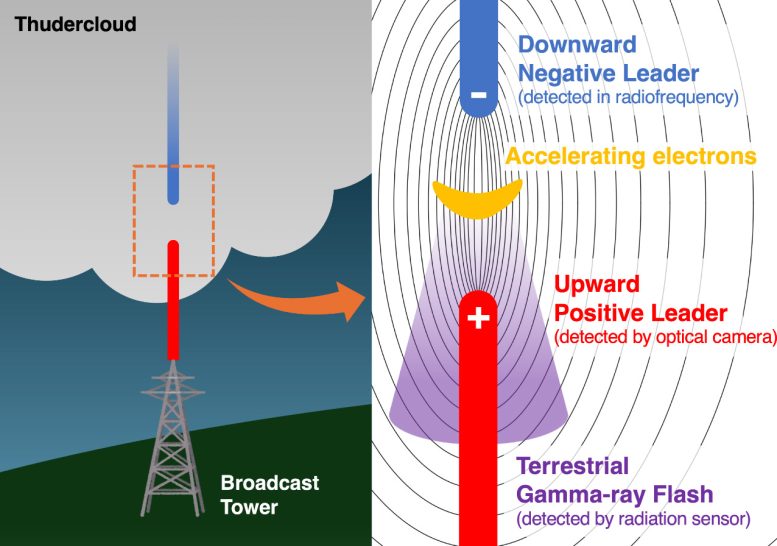
Scientists had previously hypothesized that terrestrial gamma-ray flashes (TGFs) are produced during lightning discharges when electrons are accelerated to extremely high speeds. However, because TGFs last only a few tens of microseconds, confirming this theory has been difficult.
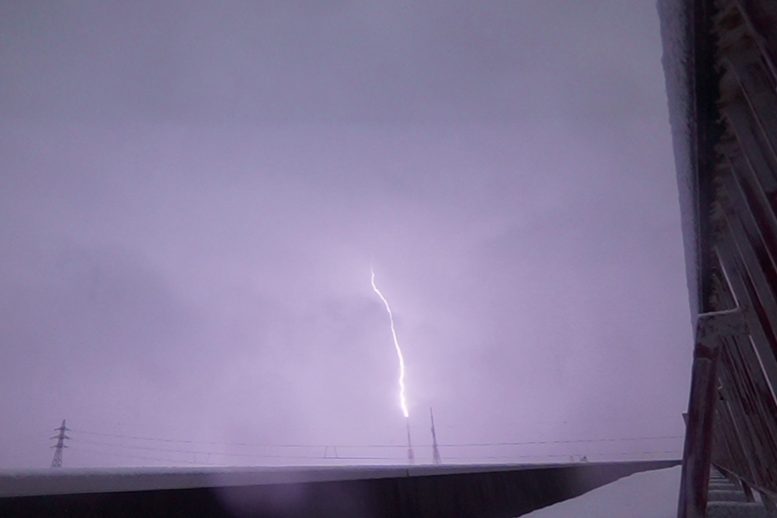
In this study, researchers used a state-of-the-art multi-sensor system to observe TGFs during lightning storms in Kanazawa City, Ishikawa Prefecture. The setup included instruments that detected optical signals, radio-frequency emissions, and high-energy radiation.
Electron acceleration at lightning path collision
Two discharge paths were observed, one descending from the thundercloud to the ground-based transmission tower and one ascending in the opposite direction. The researchers found that a TGF occurred just before the two discharge paths met, creating a highly concentrated electric field that accelerated electrons in the air to near light speed.
The first TGF photon was observed 31 microseconds before the collision of the discharge paths, and the full burst lasted for 20 microseconds after they met to form the lightning strike. A discharge of −56 kA occurred as a result of the collision of lightning leaders.
Linking gamma rays to lightning energy
This observation contributes critical data to the longstanding mystery of how lightning generates enough energy to produce gamma rays—phenomena typically associated with outer space events like supernovae or black hole jets. The study also supports emerging theories about lightning leader dynamics and the potential role of thermal runaway or relativistic feedback in these extreme bursts.
“The multi-sensor observations performed here are a world-first; although some mysteries remain, this technique has brought us closer to understanding the mechanism of these fascinating radiation bursts,” says Harufumi Tsuchiya, senior author.
The research offers not only a rare glimpse into the inner workings of lightning, but also valuable data that could be used to improve the safety and resilience of structures vulnerable to high-energy atmospheric phenomena.
Reference: “Downward terrestrial gamma-ray flash associated with collision of lightning leaders” by Yuuki Wada, Takeshi Morimoto, Ting Wu, Daohong Wang, Hiroshi Kikuchi, Yoshitaka Nakamura, Eiichi Yoshikawa, Tomoo Ushio and Harufumi Tsuchiya, 21 May 2025, Science Advances.
DOI: 10.1126/sciadv.ads6906
Funding: Japan Society for the Promotion of Science
Never miss a breakthrough: Join the SciTechDaily newsletter.
Follow us on Google and Google News.
1 Comment
HELLO SCIENTIFIC FRIENDS *
I heard that lightning is necessary for the Earth’s atmosphere. Please , post any other comments you have so we can all learn more.
****** THANK YOU *****