
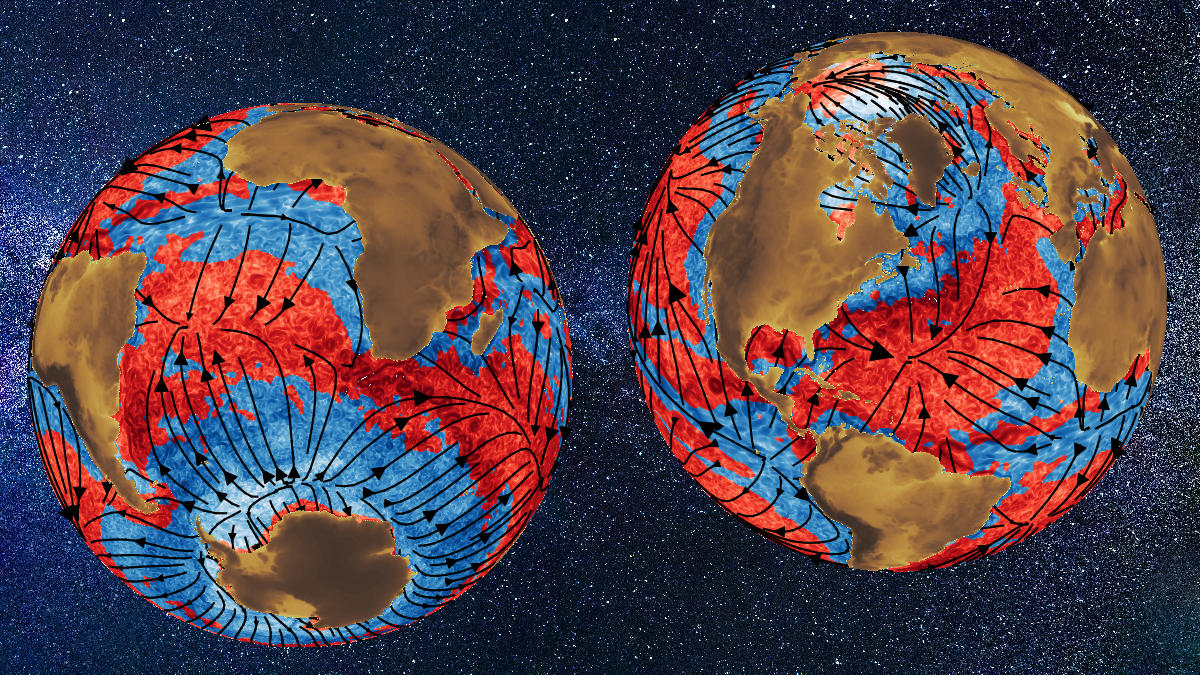
The team provides a new framework for understanding the climate system by employing mechanical analysis instead of statistical analysis.
An international group of scientists has discovered the first direct evidence linking seemingly random weather systems in the ocean with climate on a global scale. Led by Hussein Aluie, an associate professor in the University of Rochester’s Department of Mechanical Engineering and staff scientist at the University’s Laboratory for Laser Energetics, the team reported their findings in Science Advances.
The ocean has weather patterns like what we experience on land, but on different time and length scales, says lead author Benjamin Storer, a research associate in Aluie’s Turbulence and Complex Flow Group. A weather pattern on land might last a few days and be about 500 kilometers wide, while oceanic weather patterns such as swirling eddies last three to four weeks but are about one-fifth the size.
Linking Oceanic Motions to Climate
“Scientists have long speculated that these ubiquitous and seemingly random motions in the ocean communicate with climate scales, but it has always been vague because it wasn’t clear how to disentangle this complex system to measure their interactions,” says Aluie. “We developed a framework that can do exactly that. What we found was not what people were expecting because it requires the mediation of the atmosphere.”
The group’s goal was to understand how energy passes through different channels in the ocean throughout the planet. They used a mathematical method developed by Aluie in 2019, which was subsequently implemented into an advanced code by Storer and Aluie, that allowed them to study energy transfer across different patterns ranging from the circumference of the globe down to 10 kilometers. These techniques were then applied to ocean datasets from an advanced climate model and from satellite observations.
Findings and Implications
The study revealed that ocean weather systems are both energized and weakened when interacting with climate scales and in a pattern that mirrors the global atmospheric circulation. The researchers also found that an atmospheric band near the equator called the “intertropical convergence zone,” which produces 30 percent of global precipitation, causes an intense amount of energy transfer, and produces ocean turbulence.
Storer and Aluie say that studying such complex fluid motion happening at multiple scales is not easy, but that it has advantages over previous attempts to link weather to climate change. They believe the team’s work creates a promising framework for better understanding the climate system.
“There’s a lot of interest in how global warming and our changing climate is influencing extreme weather events,” says Aluie. “Usually, such research efforts are based on statistical analysis that requires expansive data to have confidence in the uncertainties. We are taking a different approach based on mechanistic analysis, which alleviates some of these requirements and allows us to understand cause and effect more easily.”
Reference: “Global cascade of kinetic energy in the ocean and the atmospheric imprint” by Benjamin A. Storer, Michele Buzzicotti, Hemant Khatri, Stephen M. Griffies and Hussein Aluie, 20 December 2023, Science Advances.
DOI: 10.1126/sciadv.adi7420
The team that played a central role in the investigation also included Michele Buzzicotti, a research scientist at the University of Rome Tor Vergata; Hemant Khatri, a research associate at the University of Liverpool, and Stephen Griffies, a senior scientist at Princeton.
Support for the project included funding from the National Science Foundation, the National Aeronautics and Space Administration, and the Department of Energy.
Never miss a breakthrough: Join the SciTechDaily newsletter.
Follow us on Google and Google News.