
Close Menu
    Facebook X (Twitter) Instagram
    SciTechDaily
    • Biology
    • Chemistry
    • Earth
    • Health
    • Physics
    • Science
    • Space
    • Technology
    Facebook X (Twitter) Pinterest YouTube RSS
    SciTechDaily
    Home»Technology»World’s First Continuous Room-Temperature Solid-State Maser
    Technology

    World’s First Continuous Room-Temperature Solid-State Maser

    By Caroline Brogan, Imperial College LondonMarch 21, 2018No Comments3 Mins Read
    Facebook Twitter Pinterest Telegram LinkedIn WhatsApp Email Reddit
    Share
    Facebook Twitter LinkedIn Pinterest Telegram Email Reddit
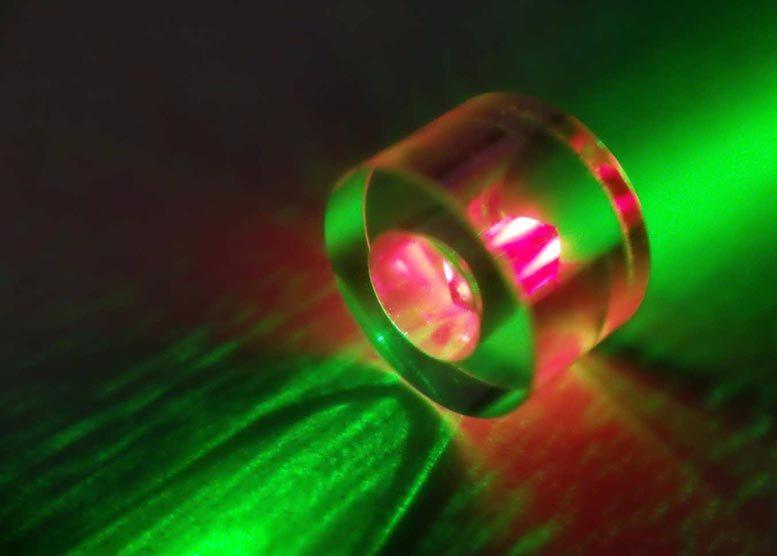
    World's First Continuous Room-Temperature Solid-State Maser
    World’s First Continuous Room-Temperature Solid-State Maser. Credit: Thomas Angus / Jonathan Breeze, Imperial College London

    The breakthrough means masers — the microwave version of lasers — could now be used more widely in a range of applications.

    Masers (microwave amplification by stimulated emission of radiation), the older, microwave frequency sibling of the laser, was invented in 1954. However, unlike lasers, which have become widespread, masers are much less widely used because in order to function they must be cooled to temperatures close to absolute zero (-273°C or -459°F).

    However, a new study from Imperial College London and UCL, published in Nature, reports for the first time a maser that can act continuously at room temperature.

    In 2012, Imperial scientists demonstrated that a maser could operate at room temperature using the organic molecule pentacene. However, it produced only short bursts of maser radiation that lasted less than one-thousandth of a second. In any case, had the maser operated continuously, the crystal would likely have melted.

    Now, Dr. Breeze and colleagues have used a synthetic diamond grown in a nitrogen-rich atmosphere to create a new maser that operates continuously.
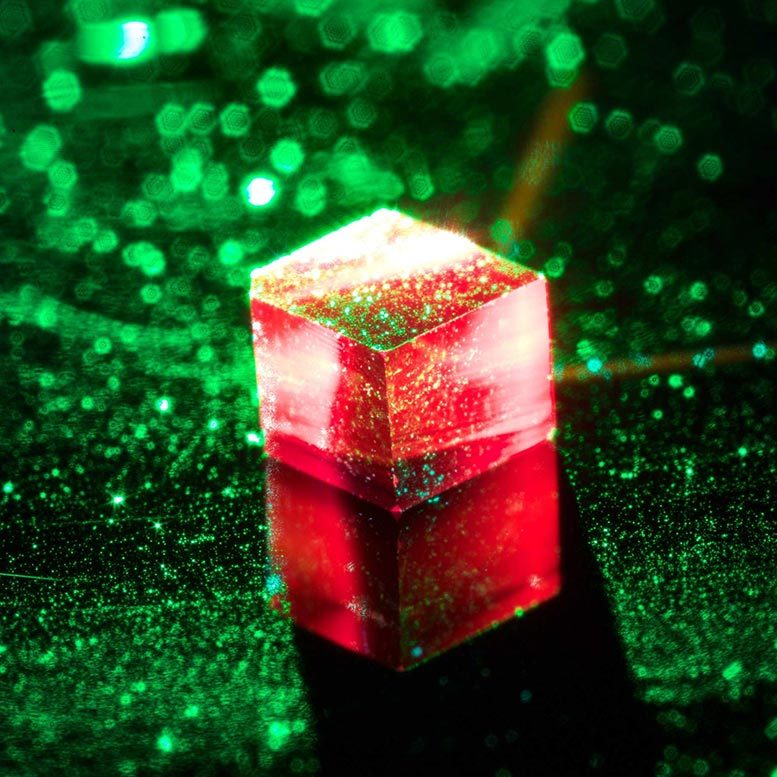
    Diamond For Room-Temperature Solid-State Maser
    The diamond before being placed in the sapphire ring. Credit: Thomas Angus / Jonathan Breeze, Imperial College London

    Lead researcher Dr. Jonathan Breeze, from Imperial’s Department of Materials, said: “This breakthrough paves the way for the widespread adoption of masers and opens the door for a wide array of applications that we are keen to explore. We hope the maser will now enjoy as much success as the laser.”

    Carbon atoms were ‘knocked out’ from the diamond using a high-energy electron beam, creating spaces known as ‘vacancies’. The diamond was then heated, which allowed nitrogen atoms and carbon vacancies to pair up, forming a type of defect known as a nitrogen-vacancy (NV) defect center.
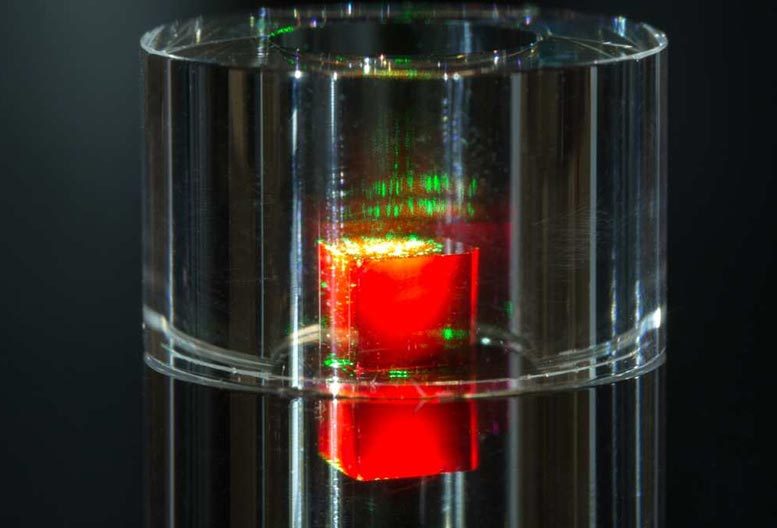
    Diamond Inside Sapphire Ring
    The diamond is held inside a sapphire ring before the laser is used. Credit: Thomas Angus / Jonathan Breeze, Imperial College London

    When placed inside a ring of sapphire to concentrate the microwave energy, and illuminated by green laser light, the researchers found that the maser worked at room temperature and importantly, continuously.

    Co-author Professor Neil Alford, also from Imperial’s Department of Materials, said: “This technology has a way to go, but I can see it being used where sensitive detection of microwaves is essential.”
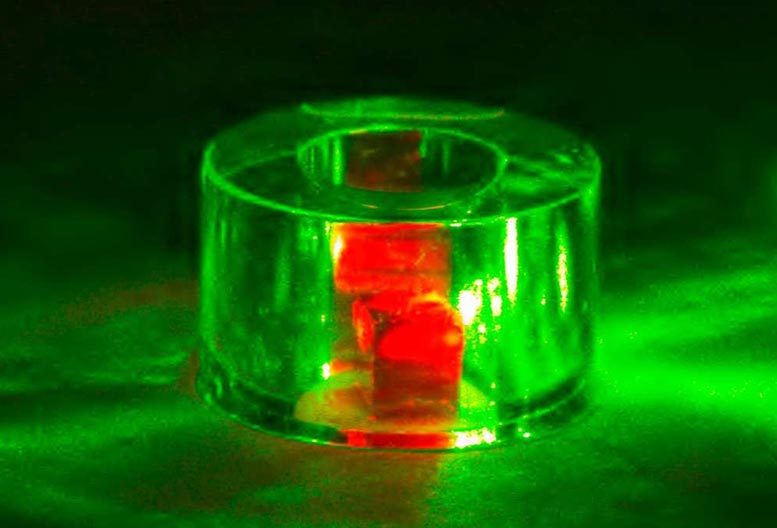
    Maser Illuminated by Green Laser Light
    The maser is illuminated by green laser light. The red light is fluorescence from the NV centers. Credit: Thomas Angus / Jonathan Breeze, Imperial College London

    The team who made the discovery says masers could be used in a range of applications such as medical imaging and airport security scanning. They have more traditionally been used in deep space communication and radio astronomy.

    As well as medical imaging and airport security scanning, masers could play a pivotal role in improving sensors to remotely detect bombs, new technology for quantum computers, and might even improve space communication methods to potentially find life on other planets.

    This work was funded by the UK Engineering and Physical Sciences Research Council and supported by the Henry Royce Institute.

    The synthetic diamond was created and provided by Element Six.

    Reference: “Continuous-wave room-temperature diamond maser” by Jonathan D. Breeze, Enrico Salvadori, Juna Sathian, Neil McN. Alford and Christopher W. M. Kay, 22 March 2018, Nature.
    DOI: 10.1038/nature25970


    Never miss a breakthrough: Join the SciTechDaily newsletter.
    Follow us on Google and Google News.

    Imperial College London Masers Popular UCL
    Share. Facebook Twitter Pinterest LinkedIn Email Reddit

    Related Articles

    New Membrane Technology Improves Water Purification and Battery Energy Storage

    Researchers Design Cell-Sorting Microchip

    Super-Adhesive “Geckskin” Material Holds 700 Pounds

    Researchers Developing Handheld Pathogen Detector

    Nanoscale Biological Coating Instantly Stops Bleeding

    Sleeping On The Job: Russian Rocket Security

    The Future Of Incandescent Bulbs Not So Bright

    Scottish Wind Turbine Explodes

    Harvard Scientists Develop $5 Rubber Robot

    Leave A Reply Cancel Reply

    • Facebook
    • Twitter
    • Pinterest
    • YouTube

    Don't Miss a Discovery

    Subscribe for the Latest in Science & Tech!

    Trending News

    The Universe Is Expanding Too Fast and Scientists Can’t Explain Why

    “Like Liquid Metal”: Scientists Create Strange Shape-Shifting Material

    Early Warning Signals of Esophageal Cancer May Be Hiding in Plain Sight

    Common Blood Pressure Drug Shows Surprising Power Against Deadly Antibiotic-Resistant Superbug

    Scientists Uncover Dangerous Connection Between Serotonin and Heart Valve Disease

    Scientists Discover a “Protector” Protein That Could Help Reverse Hair Loss

    Bone-Strengthening Discovery Could Reverse Osteoporosis

    Scientists Uncover Hidden Trigger Behind Stem Cell Aging

    Follow SciTechDaily
    • Facebook
    • Twitter
    • YouTube
    • Pinterest
    • Newsletter
    • RSS
    SciTech News
    • Biology News
    • Chemistry News
    • Earth News
    • Health News
    • Physics News
    • Science News
    • Space News
    • Technology News
    Recent Posts
    • 5 Common Myths About Learning a New Language, Debunked
    • The Neanderthal “Love Story” Isn’t What It Seems
    • Scientists Unlock Hidden Secrets of 2,300-Year-Old Mummies Using Cutting-Edge CT Scanner
    • Men vs. Women: Scientists Uncover Dramatic Differences in How the Immune System Ages
    • Eating Chili Peppers Linked to Longer Life
    Copyright © 1998 - 2026 SciTechDaily. All Rights Reserved.
    • Science News
    • About
    • Contact
    • Editorial Board
    • Privacy Policy
    • Terms of Use

    Type above and press Enter to search. Press Esc to cancel.