
Close Menu
    Facebook X (Twitter) Instagram
    SciTechDaily
    • Biology
    • Chemistry
    • Earth
    • Health
    • Physics
    • Science
    • Space
    • Technology
    Facebook X (Twitter) Pinterest YouTube RSS
    SciTechDaily
    Home»Space»Astronomers Track the Motions of Masers, Find That They Move at 45,000 MPH
    Space

    Astronomers Track the Motions of Masers, Find That They Move at 45,000 MPH

    By Harvard-Smithsonian Center for AstrophysicsFebruary 7, 2014No Comments3 Mins Read
    Facebook Twitter Pinterest Telegram LinkedIn WhatsApp Email Reddit
    Share
    Facebook Twitter LinkedIn Pinterest Telegram Email Reddit
    New Measurements Track the Motions of Masers Over a Ten Year Period
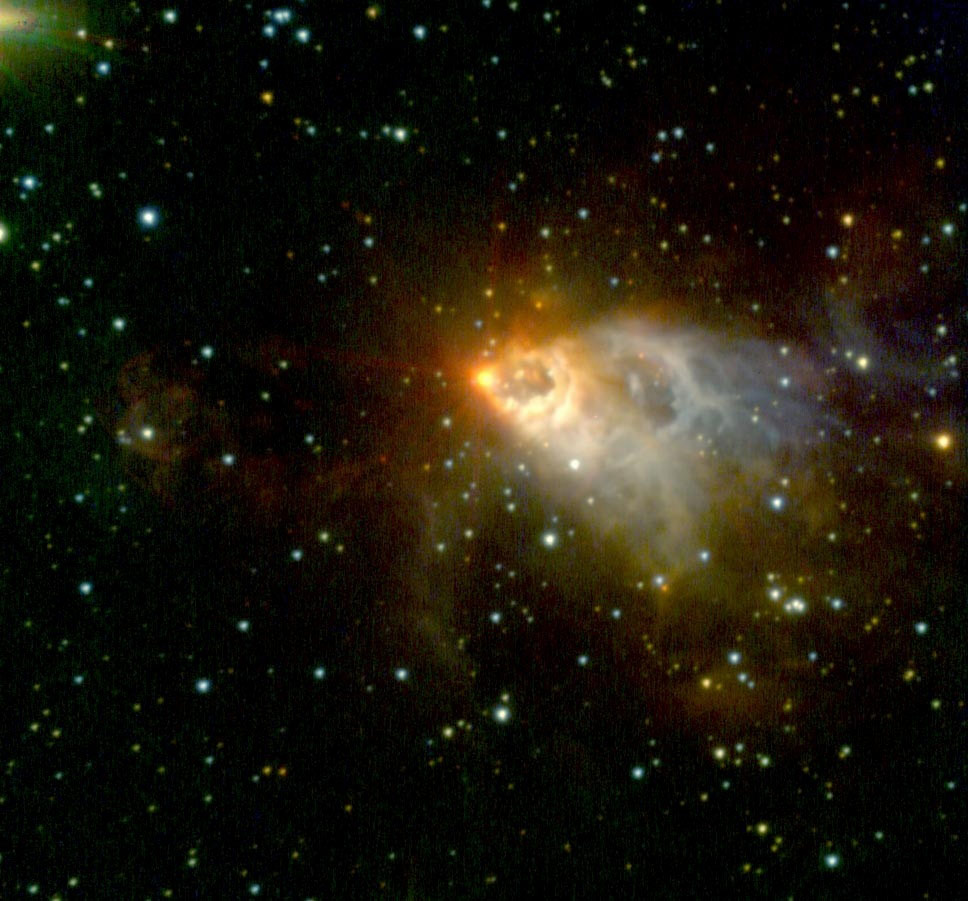
    The young star AFGL 2591 star is expelling gas and dust as seen in the infrared. Amidst the nebulosity and rings of activity are clumps emitting as water vapor masers. New measurements have tracked the motions of these masers over a ten-year period, and find them moving at velocities of about 45,000 mph (72,400 kph). Credit: C. Aspin et al., NIRI, Gemini Obs., NSF

    Using a coordinated set of widely separated radio telescopes, astronomers tracked the motions of masers over a ten-year period, finding that they moved at velocities of about twenty kilometers per second (forty-five thousand mph).

    A maser, like a laser, is a source of bright electromagnetic radiation, with the difference being that maser radiation is not optical light but rather longer wavelength, microwave radiation. Small, dense molecular clouds in interstellar space sometimes produce natural masers; water vapor in clouds undergoing active star formation generates some of the most spectacular such masers. In the most dramatic cases, a water vapor maser can radiate more energy at a single wavelength than does the Sun over its entire visible spectrum.

    Masers are interesting in their own right, but also because their bright emission provides a powerful diagnostic probe of regions where massive star formation is still underway. CfA astronomer Nimesh Patel and his colleagues have used a coordinated set of widely separated radio telescopes (an interferometer) to study a dramatic region of star formation about ten thousand light-years away, achieving a spatial resolution of only a few hundred astronomical units (one AU is the average distance of the Earth from the Sun). This spectacular precision is possible because the masers are so bright.

    The star formation region was known to have several clumps of young, high-mass stars accompanied by phenomena typically associated with such star birth like powerful outflows and shocks. The astronomers combined relatively recent and archival observations of masers in the region spanning a period of about ten years, starting in 1999; the precision of the data enabled them to detect the masers motion over this period. The maser clusters, which are distributed over about a thousand AU, had some clumps seen to move as much as fifty AU, corresponding to velocities of about twenty kilometers per second (forty-five thousand mph).

    In the case of one bright region, the measurements over ten years found that the material is tracing the shell of an outward-moving shock, presumably propelled by radiation from the young star forming at the center. The results confirm and extend detailed models of how newly born massive stars affect their environment.

    Reference: “Multi-epoch VLBA H2O maser observations towards the massive YSOs AFGL 2591 VLA 2 and VLA 3” by J. M. Torrelles, M. A. Trinidad, S. Curiel, R. Estalella, N. A. Patel, J. F. Gómez, G. Anglada, C. Carrasco-González, J. Cantó, A. Raga and L. F. Rodríguez, 6 December 2013, MNRAS.
    DOI: 10.1093/mnras/stt2177
    arXiv:1311.1901


    Never miss a breakthrough: Join the SciTechDaily newsletter.
    Follow us on Google and Google News.

    Astronomy Astrophysics Harvard-Smithsonian Center for Astrophysics Masers
    Share. Facebook Twitter Pinterest LinkedIn Email Reddit

    Related Articles

    Masers as Evolutionary Indicators for Star Formation

    Examining the Accuracy of the Spectral Energy Distribution Models

    Scientists Report Details of the Gravity Probe-B Mission

    Two Planets Separated by Less Than 5 Earth Moon Distances

    Study Challenges Prevailing Ideas About How Supermassive Black Holes Grow

    Calculations Show the Ideal Time to Study the Cosmos

    Using Infrared Images from Hubble & Spitzer, Scientists Discover 25 Distant Galaxies

    Supernova Shock Wave Breaks Through a Cocoon of Gas

    Origins of Type Ia Supernovae

    Leave A Reply Cancel Reply

    • Facebook
    • Twitter
    • Pinterest
    • YouTube

    Don't Miss a Discovery

    Subscribe for the Latest in Science & Tech!

    Trending News

    Largest-Ever Study Finds Medicinal Cannabis Ineffective for Anxiety, Depression, PTSD

    250-Million-Year-Old Egg Solves One of Evolution’s Biggest Mysteries

    Living With Roommates Might Be Changing Your Gut Microbiome Without You Knowing

    Century-Old Cleaning Chemical Linked to 500% Increased Risk of Parkinson’s Disease

    What if Your Memories Never Happened? Physicists Take a New Look at the Boltzmann Brain Paradox

    One of the Universe’s Largest Stars May Be Getting Ready To Explode

    Scientists Discover Enzyme That Could Supercharge Ozempic-Like Weight Loss Drugs

    Popular Sweetener Linked to DNA Damage – “It’s Something You Should Not Be Eating”

    Follow SciTechDaily
    • Facebook
    • Twitter
    • YouTube
    • Pinterest
    • Newsletter
    • RSS
    SciTech News
    • Biology News
    • Chemistry News
    • Earth News
    • Health News
    • Physics News
    • Science News
    • Space News
    • Technology News
    Recent Posts
    • Challenging the Narrative: New Study Shows U.S. Life Expectancy Is Rising Across All States
    • Mystery Illness Kills 5 in Burundi As Doctors Scramble for Answers
    • Bone-Strengthening Discovery Could Reverse Osteoporosis
    • The Most Elusive Number in Physics Just Got Even More Mysterious
    • Scientists Uncover Hidden Trigger Behind Stem Cell Aging
    Copyright © 1998 - 2026 SciTechDaily. All Rights Reserved.
    • Science News
    • About
    • Contact
    • Editorial Board
    • Privacy Policy
    • Terms of Use

    Type above and press Enter to search. Press Esc to cancel.