
Close Menu
    Facebook X (Twitter) Instagram
    SciTechDaily
    • Biology
    • Chemistry
    • Earth
    • Health
    • Physics
    • Science
    • Space
    • Technology
    Facebook X (Twitter) Pinterest YouTube RSS
    SciTechDaily
    Home»Space»Secrets of a Massive Star Revealed Through Astrophysical Lasers
    Space

    Secrets of a Massive Star Revealed Through Astrophysical Lasers

    By National Radio Astronomy ObservatoryJanuary 19, 2023No Comments5 Mins Read
    Facebook Twitter Pinterest Telegram LinkedIn WhatsApp Email Reddit
    Share
    Facebook Twitter LinkedIn Pinterest Telegram Email Reddit
    Oddball star MWC 349A
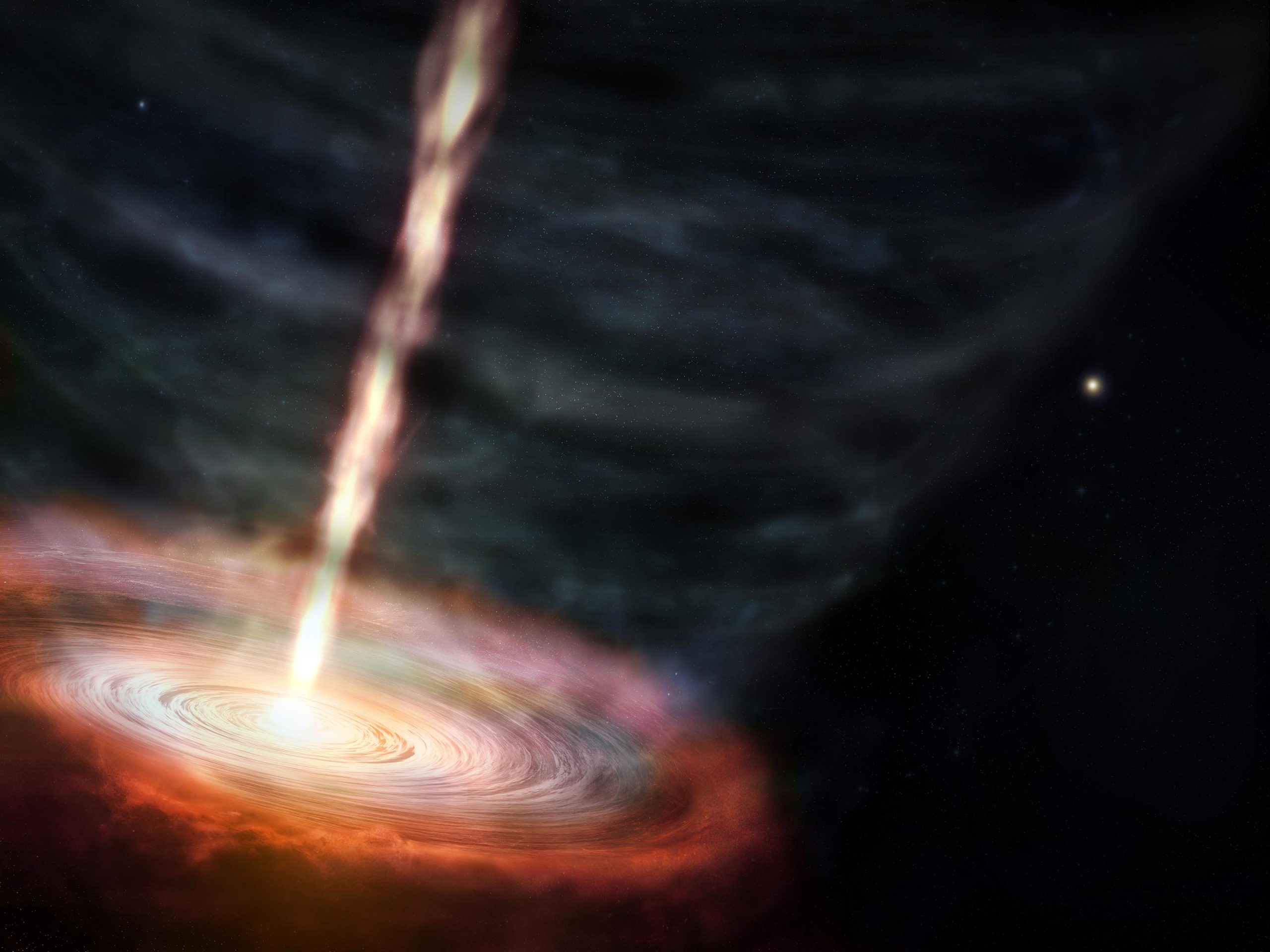
    Scientists studying masers— naturally occurring lasers that amplify microwave radio emissions— around the massive star MWC 349A discovered a 500 km/s jet of material launching out of the star’s gas disk from within the winds that are flowing away from the star. The bigger surprise is that the jet may be caused by magnetic forces. This artist’s conception shows a zoomed in view of MWC 349A and its surrounding disk of gas and dust that are being shaped by the winds and high-speed jet. Credit: ALMA (ESO/NAOJ/NRAO), M. Weiss (NRAO/AUI/NSF)

    ALMA scientists used the unique hydrogen radio recombination lines on MWC 349A to reveal hidden collimated jets.

    While using the Atacama Large Millimeter/submillimeter Array (ALMA) to study the masers around oddball star MWC 349A scientists discovered something unexpected: a previously unseen jet of material launching from the star’s gas disk at impossibly high speeds. What’s more, they believe the jet is caused by strong magnetic forces surrounding the star. The discovery could help researchers to understand the nature and evolution of massive stars and how hydrogen masers are formed in space. The new observations were presented on January 9 in a press conference at the 241st meeting of the American Astronomical Society (AAS) in Seattle, Washington.

    Located roughly 3,900 light-years away from Earth in the constellation Cygnus, MWC 349A’s unique features make it a hot spot for scientific research in optical, infrared, and radio wavelengths. The massive star— roughly 30 times the mass of the Sun— is one of the brightest radio sources in the sky, and one of only a handful of objects known to have hydrogen masers. These masers amplify microwave radio emissions, making it easier to study processes that are typically too small to see. It is this unique feature that allowed scientists to map MWC 349A’s disk in detail for the first time.
    Massive Star MWC 349A
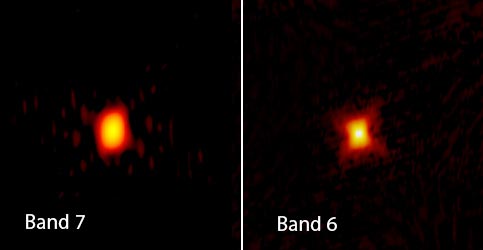
    The massive star MWC 349A is one of the brightest radio sources in the sky. But, at 3,900 light-years away from Earth, scientists needed help to see what’s really going on, and in this case, to discover a jet of material blasting out from the star’s gas disk at 500 km/s. Previously hidden amongst the winds flowing out from the star, the jet was discovered using the combined resolving power of ALMA’s Band 6 (right) and Band 7 (left), and hydrogen masers— naturally occurring lasers that amplify microwave radio emissions, shown here in this ALMA science image. The revelation may help scientists to better understand the nature and evolution of massive stars. Credit: ALMA (ESO/NAOJ/NRAO), S. Prasad/CfA

    Mapping the Star’s Gas Disk with Masers

    “A maser is like a naturally occurring laser,” said Sirina Prasad, an undergraduate research assistant at the Center for Astrophysics | Harvard & Smithsonian (CfA), and the primary author of the paper. “It’s an area in outer space that emits a really bright kind of light. We can see this light and trace it back to where it came from, bringing us one step closer to figuring out what’s really going on.” 

    Leveraging the resolving power of ALMA’s Band 6, developed by the US National Science Foundation’s National Radio Astronomy Observatory (NRAO), the team was able to use the masers to uncover the previously unseen structures in the star’s immediate environment. Qizhou Zhang, a senior astrophysicist at CfA, and the project’s principal investigator added, “We used masers generated by hydrogen to probe the physical and dynamic structures in the gas surrounding MWC 349A and revealed a flattened gas disk with a diameter of 50 au, approximately the size of the Solar System, confirming the near-horizontal disk structure of the star. We also found a fast-moving jet component hidden within the winds flowing away from the star.” 

    The observed jet is ejecting material away from the star at a blistering 500 km per second. That’s akin to traveling the distance between San Diego, California, and Phoenix, Arizona in the literal blink of an eye. According to researchers, it is probable that a jet moving this fast is being launched by a magnetic force. In the case of MWC 349A, that force could be a magnetohydrodynamic wind— a type of wind whose movement is dictated by the interplay between the star’s magnetic field and gases present in its surrounding disk.

    “Our previous understanding of MWC 349A was that the star was surrounded by a rotating disk and photo-evaporating wind. Strong evidence for an additional collimated jet had not yet been seen in this system. Although we don’t yet know for certain where it comes from or how it is made, it could be that a magnetohydrodynamic wind is producing the jet, in which case the magnetic field is responsible for launching rotating material from the system,” said Prasad. “This could help us to better understand the disk-wind dynamics of MWC 349A, and the interplay between circumstellar disks, winds, and jets in other star systems.”

    Never miss a breakthrough: Join the SciTechDaily newsletter.
    Follow us on Google and Google News.

    Astronomy Astrophysics National Radio Astronomy Observatory
    Share. Facebook Twitter Pinterest LinkedIn Email Reddit

    Related Articles

    Stellar Collision Triggers Supernova Explosion – “This Is the First Time We’ve Actually Seen Such an Event”

    Gas Re-Accretion Observed in Dying Galaxies for the First Time

    Surprising Insights Into Star Formation From Unprecedented Survey of the “Nurseries” Where Stars Are Born

    Mind the Gap: Direct Link Uncovered Between Protoplanetary Disk Structures and Giant Exoplanets

    Young Chaotic Star System Reveals Secrets of Planet Formation

    Astronomers Discover Jets from Massive Protostars Might be Very Different from Lower-Mass Systems

    Map of the Nearby Universe Created by Cosmic Cartographers Reveals the Diversity of Star-Forming Galaxies

    Cosmic Lens Reveals Faint Radio Galaxy More Than 8 Billion Light-Years From Earth

    New Clues About Early Universe From Black Hole Powered Cosmic Jet 13 Billion Light-Years From Earth

    Leave A Reply Cancel Reply

    • Facebook
    • Twitter
    • Pinterest
    • YouTube

    Don't Miss a Discovery

    Subscribe for the Latest in Science & Tech!

    Trending News

    Scientists Discover How Coffee Impacts Memory, Mood, and Gut Health

    Why Did the Neanderthals Disappear? Scientists Reveal Humans Had a Hidden Advantage

    Physicists Propose Strange Experiment Where Time Goes Quantum

    Magnesium Magic: New Drug Melts Fat Even on a High-Fat, High-Sugar Diet

    Weight-Loss Drugs Like Ozempic May Come With an Unexpected Cost

    Mezcal “Worm” in a Bottle Mystery: DNA Testing Reveals a Surprise

    New Research Reveals That Your Morning Coffee Activates an Ancient Longevity Switch

    This Is What Makes You Irresistible to Mosquitoes

    Follow SciTechDaily
    • Facebook
    • Twitter
    • YouTube
    • Pinterest
    • Newsletter
    • RSS
    SciTech News
    • Biology News
    • Chemistry News
    • Earth News
    • Health News
    • Physics News
    • Science News
    • Space News
    • Technology News
    Recent Posts
    • Harvard Scientists Reveal Secret Structure Behind How You Smell
    • Scientists Just Discovered the Hidden Trick That Keeps Your Cells Alive
    • This Simple Movement Could Be Secretly Cleaning Your Brain
    • Male Birth Control Breakthrough: Scientists Find Way To Turn Sperm Production Off and Back On
    • A Common Vitamin Could Hold the Key to Treating Fatty Liver Disease
    Copyright © 1998 - 2026 SciTechDaily. All Rights Reserved.
    • Science News
    • About
    • Contact
    • Editorial Board
    • Privacy Policy
    • Terms of Use

    Type above and press Enter to search. Press Esc to cancel.