
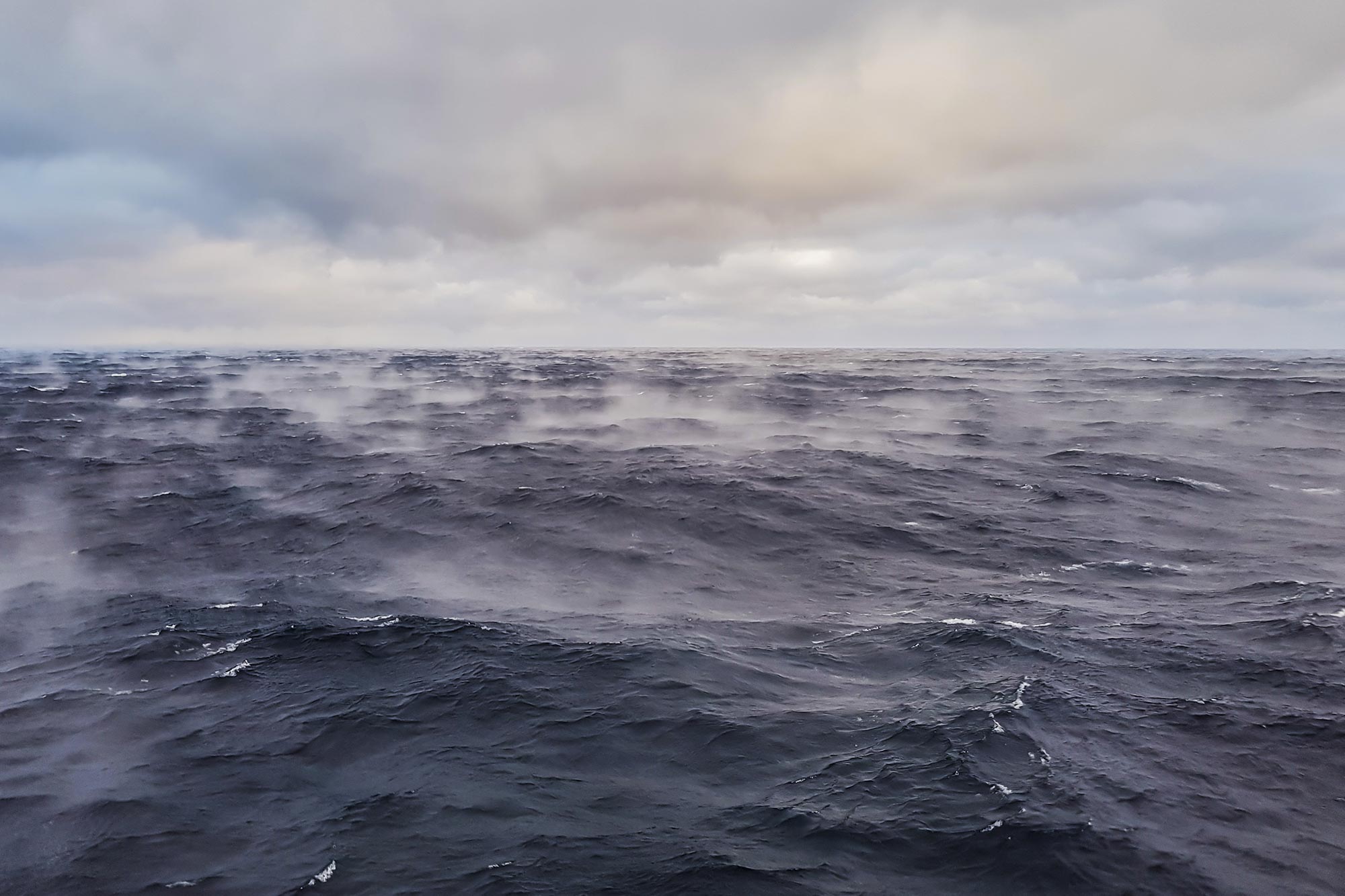
Some regions are acidifying faster than previously believed, posing an existential threat to coastal economies worldwide.
New research from the University of St Andrews indicates that certain coastal regions are on track to experience far greater acidification than previously estimated. As atmospheric CO2 continues to rise, these areas are becoming acidic at an accelerated pace, creating a serious long-term risk for coastal communities and the economies that depend on them.
Atmospheric CO2 and ocean pH (acidity) are closely connected. When additional CO2 enters the air, the ocean absorbs much of it, which steadily lowers seawater pH and increases overall acidity.
A new paper released on November 13th in Nature Communications reports that this process intensifies within ocean upwelling systems. Using the California Current as a representative example, the research team found that upwelling regions do not simply follow global acidification trends but actually amplify them.
Upwelling occurs when cold, nutrient rich and naturally acidic deep waters move upward along continental coastlines. Organic matter that sinks from the surface is broken down by microbes in the deep ocean, producing CO2 and further increasing the acidity of these waters. When this water rises during upwelling, it carries that high acidity back to the surface, where it interacts with atmospheric CO2 and becomes even more acidic.
Reconstructing the Past, Predicting the Future
To understand how acidity has shifted over time, the team examined historic coral samples and measured boron isotope signatures preserved in their skeletons. These records reveal how pH changed throughout the 20th century. The researchers then used a regional ocean model to project how acidity in the California Current is likely to evolve during the 21st century.
The results show that upwelling regions experience ocean acidification at rates that surpass the level “expected” from rising atmospheric CO2 alone. The deep waters that surface during upwelling begin with high acidity, and the continuing increase in human-produced CO2 intensifies this effect even further.

Upwelling systems are among the most productive systems on our planet and support much of the world’s fisheries. Understanding how they respond to rising CO2₂ is therefore not only critical for ocean science, but also carries major implications for fisheries and their potential vulnerabilities.
Co Author Dr. Hana Jurikova, Senior Research Fellow in from the School of Earth and Environmental Science, said: “Predicting how upwelling systems will respond to climate change is highly complex, as anthropogenic influences interact with natural sources of ocean acidification. Our research shows that such interactions can amplify environmental change in the California Current System, highlighting the need for similar studies in other regions to better anticipate future change.”
A Global Concern
The California Current can be used as an example of other upwelling systems. Other important areas of coastal upwelling around the world include the Humboldt Current off the coast of Peru, or the Benguela and Canary Currents off the coast of West Africa.
Co-author Dr. James Rae, Reader in the School of Earth and Environmental Science, said: ”The ocean becoming more acidic poses major risks to marine ecosystems and the communities and economies they support. The solutions we now have for climate change, like heat pumps and electric vehicles, also fix ocean acidification, so it’s critical that we support them.”
Reference: “A century of change in the California Current: upwelling system amplifies acidification” by Mary Margaret V. Stoll, Curtis A. Deutsch, Hana Jurikova, James W. B. Rae, Hartmut Frenzel, Anne M. Gothmann, Simone R. Alin and Alexander C. Gagnon, 13 November 2025, Nature Communications.
DOI: 10.1038/s41467-025-63207-6
Never miss a breakthrough: Join the SciTechDaily newsletter.
Follow us on Google and Google News.
7 Comments
This is the most misleading article I have read on the topic. It starts out with a photo showing patchy condensed water vapor above the ocean surface, not unlike what I see with my hot tub on a cold day. The implication is that the so-called ‘acidic’ ocean is causing it to boil, releasing steam. It was probably just a cold day causing the water vapor to condense quickly.
The article then says, “As atmospheric CO2 continues to rise, these areas are becoming acidic at an accelerated pace, …” Not so! First of all, the oceans are NOT acidic and probably never will be according to renowned Stanford University geochemist, Konrad Krauskopf. The authors never mention the chemical buffering that resists changes in the pH, albeit there are daily and seasonal changes resulting from temperature changes, which change the solubility of CO2, and also result in evaporation that changes both pH and salinity.
The article then erroneously claims, “Atmospheric CO2 and ocean pH (acidity) are closely connected. When additional CO2 enters the air, the ocean absorbs much of it, which steadily lowers seawater pH and increases overall acidity.” Ocean pH is NOT a measure of acidity. It is defined as being a metric of the hydrogen ion (hydronium) concentration. An aqueous solution is defined as being acidic ONLY if it has a pH less than 7. At a pH of 7, the solution has equal concentrations of hydronium (+) and hydroxyl (-) ions (1:1) and is called “neutral.” The open oceans, far from land, are reported to have an average pH of about 8.1, distinctly basic or alkaline. The reason that the “ocean absorbs much of it [CO2]” and not all of it is because temperature and pressure determine how much can be dissolved, and as the saturated up-welling water arrives at the surface, the warm air and low pressure (compared to the deep abyss) causes the water to become over-saturated with CO2 and actually delivers CO2 to the atmosphere rather than the other way around. Most of the CO2 is absorbed in the cold polar waters. Note the NASA OCO-2 map showing the out-gassing in the ocean tropics, here: https://www.spxdaily.com/images-lg/global-atmospheric-co2-concentrations-oct-1-to-nov-11-2014-oco-2-lg.jpg
“Upwelling occurs when cold, nutrient rich and naturally acidic deep waters move upward along continental coastlines.” Note that these up-welling zones that are rich in nutrients are some of the most productive fisheries in the world, without which sea birds, marine mammals, and fish at the top of the food chain would starve. They have all adapted to the changing pH.
“When this water rises during upwelling, it carries that high acidity back to the surface, where it interacts with atmospheric CO2 and becomes even more acidic.” Again, several misstatements of fact! It should be noted that the up-welling water is about 1,000-years-old, having taken that long to move from the cold polar regions (which are major sinks) to the mid-latitudes and tropics. It is NOT “high acidity,” nor was it even slightly acidic originally. In that sense, it is not being carried “back” to the surface. There are some coastal calcifiers that are at risk of damage in their juvenile stages, but that has been true for as long as they have existed. A higher partial pressure of CO2 in the atmosphere today, than 100-years-ago, will slow the out-gassing of the over-saturated abyssal waters by a measurable amount. However, inasmuch as the calcifiers have an optimal range of tolerance of pH, they have evolved to deal with it.
The authors then make the unsupported claim that “… upwelling regions do not simply follow global acidification trends but actually amplify them.” Where are the numbers to support that claim? The water tries to maintain what chemists call equal “partial pressures” at the bottom of the atmosphere and the top of the mixed layer of the oceans. Therefore, the CO2 in the atmosphere can either move into or out of the seawater, depending on the relative partial pressures.
The central thesis of this article is that 1,000-year-old up-welling bottom waters, which naturally have lower pH than surface waters, are having their pH lowered even more by anthropogenic CO2 emissions. They make assertions, but notable for their absence are any numbers relating to CO2 partial pressures or the change in pH in the buffered waters. Their claims are based on computer models whose veracity I doubt.
Logically and grammatically, something cannot become “MORE acidic” if it is not acidic to begin with. Calling alkaline seawater “acidic” does not make it so, no matter how many times the word is misused.
These authors should be ashamed for writing such a disingenuous article. They should turn their ‘sheepskins’ in to have all the mud washed off.
I have read the link provided in the article. They do actually provide some measurements related to the study. However, from what I see, they are only establishing correlations, not demonstrating cause-and-effect. They specifically mention the representative concentration pathway (RCP) 8.5 scenario, which Curry et al. have demonstrated is not actually “business as usual,” because they demonstrate that there are insufficient resources to continue indefinitely, which leads them to conclude that it is an improbable scenario.
Throughout the article, there is speculation about behavior that doesn’t fit their thesis well, with comments like, “Although our data from this region are too sparse to be conclusive, it is POSSIBLE that regional processes that amplify acidification in the SBB even more than the rest of the CCS are not captured in the model and warrant further investigation.”
In summary, I think that my initial criticisms are valid and while the work uses some sophisticated techniques, like a boron isotope pH proxy, I’m not impressed with how the study was conducted. They can’t rule out weather affecting the borate buffering as a result of temperature changes. It comes across as an attempt to find data to fit their preconceived hypothesis, rather than acting as the classic “disinterested observer.”
Ah well; apart from renowned scientists not getting everything correct ( e.g. Lord Kelvin) your comments make sense.
The upwelling waters taking 1 000 years to get from the polar regions to mid-latitudes; are these upwelling waters related to the AMOC, or some other slower, deeper current?
PS I note that the authors use the California Current to model our oceanic future, not the AMOC; however, currents are currents and coastal regions are world-wide, as are continental shelves.
They are focusing on the California current and up-welling on the western coast of North America near Seattle-Vancouver. The up-welling it related to prevailing winds or ‘Trade Winds,’ which are affected by the episodic El Nino cycles,
It is human to make mistakes. I was taking issue with their consistent misuse of terminology, which is a conscious decision to employ pejorative words. As an example, their use of “ocean acidification” and “more acidic” has an obvious downside. By treating all decreases in pH as so-called ‘acidification,’ it ignores the fact that alkalis behave differently than acids in potential chemical reactions, so the layman doesn’t appreciate that some pH values, such as neutrality, are special. No where in the article do they mention the actual absolute pH of the seawater. Thus, while improbable, it is conceivable that seawater could pass the point of neutrality, and lay readers might jut go “Ho, hum, more ‘acidification.'” That is, in their attempt to scare readers, they could inadvertently hide important information. That fits my definition of unethical behavior: A decision to trade a short-term gain for a real or potential long-term loss.
P.S. I note that the authors use the California Current, not the AMOC, to model our oceanic fate. Yet currents are currents, coastal regions abound, as do shallow seas above continental shelves.
Currents are NOT just currents. Surface currents are usually warm currents. Bottom currents are very cold (close to the freezing point) and under tremendous pressure, which allows CO2 to build up.