
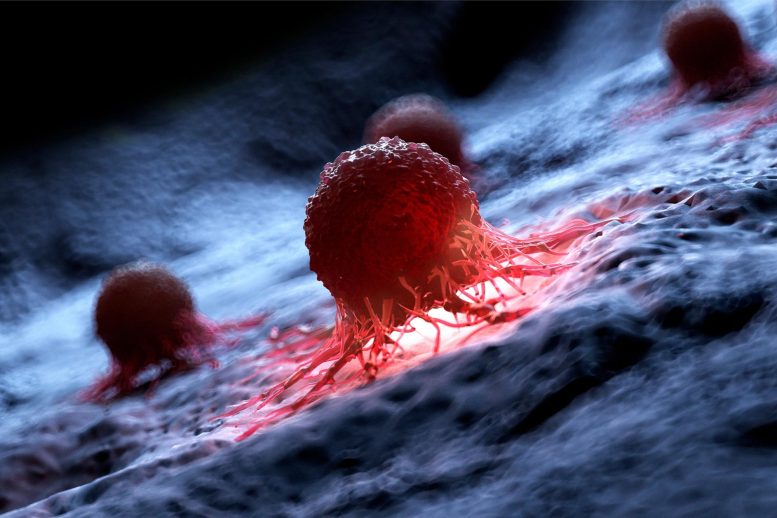
A recent study from Yale indicates that additional chromosomes in cancer cells are essential for the growth of tumors. Removing these extra chromosomes inhibits tumor formation. The findings, said the researchers, indicate that selectively targeting extra chromosomes may offer a new route for treating cancer.
The study was recently published in the journal Science.
Human cells typically have 23 pairs of chromosomes; extra chromosomes are an anomaly known as aneuploidy.
“If you look at normal skin or normal lung tissue, for example, 99.9% of the cells will have the right number of chromosomes,” said Jason Sheltzer, assistant professor of surgery at Yale School of Medicine and senior author of the study. “But we’ve known for over 100 years that nearly all cancers are aneuploid.”
However, it was unclear what role extra chromosomes played in cancer — for instance, whether they cause cancer or are caused by it.
A New Gene-Editing Approach to Remove Extra Chromosomes
“For a long time, we could observe aneuploidy but not manipulate it. We just didn’t have the right tools,” said Sheltzer, who is also a researcher at Yale Cancer Center. “But in this study, we used the gene-engineering technique CRISPR to develop a new approach to eliminate entire chromosomes from cancer cells, which is an important technical advance. Being able to manipulate aneuploid chromosomes in this way will lead to a greater understanding of how they function.”
The study was co-led by former lab members Vishruth Girish, now an M.D.-Ph.D. student at Johns Hopkins School of Medicine, and Asad Lakhani, now a postdoctoral researcher at Cold Spring Harbor Laboratory.
Using their newly developed approach — which they dubbed Restoring Disomy in Aneuploid cells using CRISPR Targeting, or ReDACT — the researchers targeted aneuploidy in melanoma, gastric cancer, and ovarian cell lines. Specifically, they removed an aberrant third copy of the long portion — also known as the “q arm” — of chromosome 1, which is found in several types of cancer, is linked to disease progression, and occurs early in cancer development.
“When we eliminated aneuploidy from the genomes of these cancer cells, it compromised the malignant potential of those cells and they lost their ability to form tumors,” said Sheltzer.
Based on this finding, the researchers proposed cancer cells may have an “aneuploidy addiction” — a name referencing earlier research that discovered that eliminating oncogenes, which can turn a cell into a cancer cell, disrupts cancers’ tumor-forming abilities. This finding led to a model of cancer growth called “oncogene addiction.”
Overexpression of Genes Creates a Weak Spot
When investigating how an extra copy of chromosome 1q might promote cancer, the researchers found that multiple genes stimulated cancer cell growth when they were overrepresented — because they were encoded on three chromosomes instead of the typical two.
This overexpression of certain genes also pointed the researchers to a vulnerability that might be exploited to target cancers with aneuploidy.
Previous research has shown that a gene encoded on chromosome 1, known as UCK2, is required to activate certain drugs. In the new study, Sheltzer and his colleagues found that cells with an extra copy of chromosome 1 were more sensitive to those drugs than were cells with just two copies, because of the overexpression of UCK2.
Further, they observed that this sensitivity meant that the drugs could redirect cellular evolution away from aneuploidy, allowing for a cell population with normal chromosome numbers and, therefore, less potential to become cancerous. When researchers created a mixture with 20% aneuploid cells and 80% normal cells, aneuploid cells took over: after nine days, they made up 75% of the mixture. But when the researchers exposed the 20% aneuploid mixture to one of the UCK2-dependent drugs, the aneuploid cells comprised just 4% of the mix nine days later.
Exploiting Aneuploidy to Target Cancer Cells
“This told us that aneuploidy can potentially function as a therapeutic target for cancer,” said Sheltzer. “Almost all cancers are aneuploid, so if you have some way of selectively targeting those aneuploid cells, that could, theoretically, be a good way to target cancer while having minimal effect on normal, non-cancerous tissue.”
More research needs to be done before this approach can be tested in a clinical trial. But Sheltzer aims to move this work into animal models, evaluate additional drugs and other aneuploidies, and team up with pharmaceutical companies to advance toward clinical trials.
“We’re very interested in clinical translation,” said Sheltzer. “So we’re thinking about how to expand our discoveries in a therapeutic direction.”
Reference: “Oncogene-like addiction to aneuploidy in human cancers” by Vishruth Girish, Asad A. Lakhani, Sarah L. Thompson, Christine M. Scaduto, Leanne M. Brown, Ryan A. Hagenson, Erin L. Sausville, Brianna E. Mendelson, Pranav K. Kandikuppa, Devon A. Lukow, Monet Lou Yuan, Eric C. Stevens, Sophia N. Lee, Klaske M. Schukken, Saron M. Akalu, Anand Vasudevan, Charles Zou, Barbora Salovska, Wenxue Li, Joan C. Smith, Alison M. Taylor, Robert A. Martienssen, Yansheng Liu, Ruping Sun and Jason M. Sheltzer, 6 July 2023, Science.
DOI: 10.1126/science.adg4521
Never miss a breakthrough: Join the SciTechDaily newsletter.
Follow us on Google and Google News.