
Close Menu
    Facebook X (Twitter) Instagram
    SciTechDaily
    • Biology
    • Chemistry
    • Earth
    • Health
    • Physics
    • Science
    • Space
    • Technology
    Facebook X (Twitter) Pinterest YouTube RSS
    SciTechDaily
    Home»Science»Nanoparticle Delivers a Combination of Therapeutic Agents to Tumor Sites
    Science

    Nanoparticle Delivers a Combination of Therapeutic Agents to Tumor Sites

    By Eric Gershon, Yale UniversityJuly 16, 2012No Comments3 Mins Read
    Facebook Twitter Pinterest Telegram LinkedIn WhatsApp Email Reddit
    Share
    Facebook Twitter LinkedIn Pinterest Telegram Email Reddit
    Nanolipogel Immunotherapy
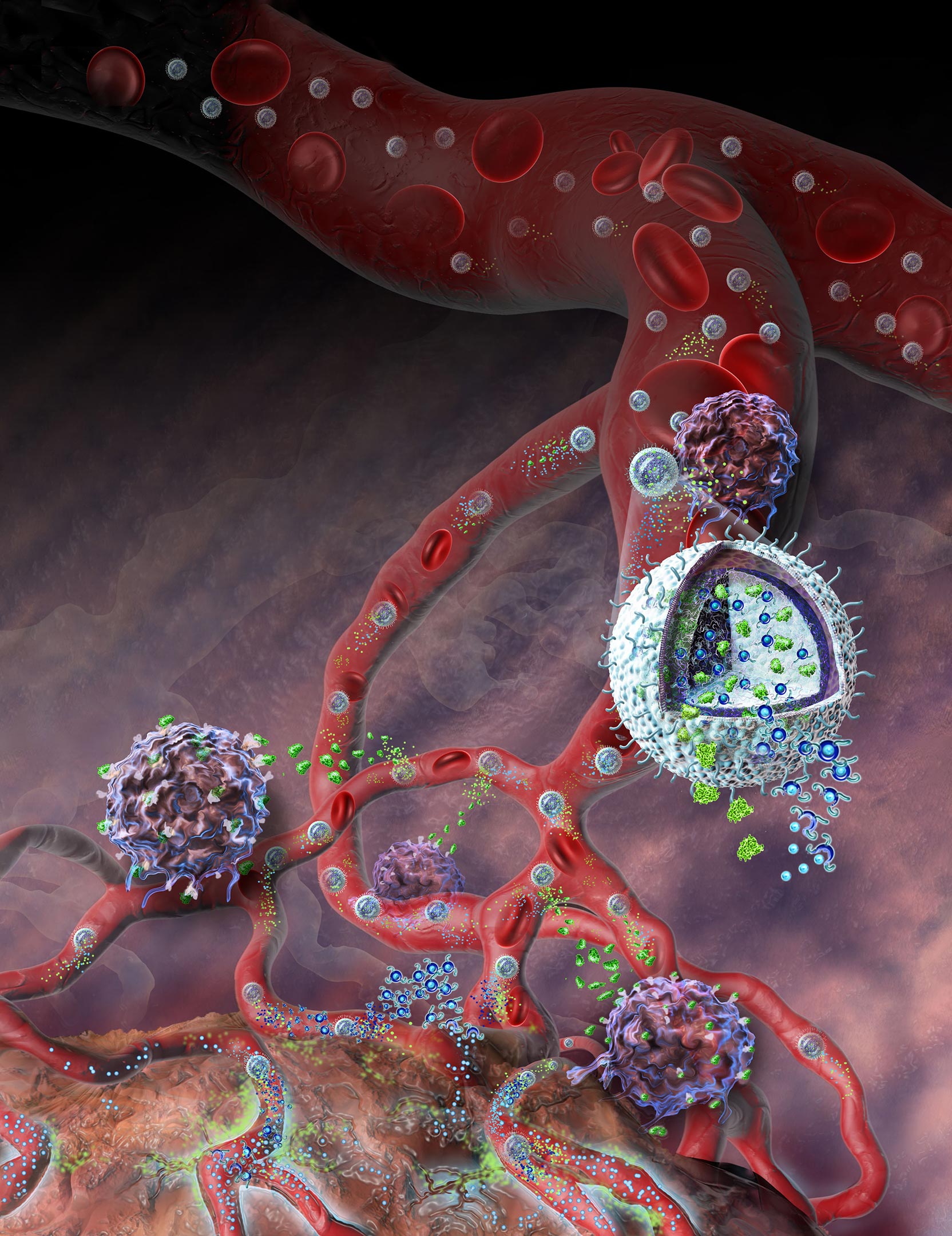
    This illustration depicts a nanolipogel administering its immunotherapy cargo. The light-blue spheres within the blood vessels and the cutaway sphere in the foreground are the nanolipogels. Credit: Illustration by Nicolle Rager Fuller, NSF

    Developed by a team of scientists at Yale, a new biodegradable nanoparticle, called a nanogel, delivers a combination of two therapeutic agents to tumor sites, significantly delaying tumor growth and increasing the survival rate of mice during testing.

    Yale University scientists have developed a new mechanism for attacking cancerous tumors that intensifies the body’s immune response while simultaneously weakening the tumor’s ability to resist it.

    “We believe this is a paradigm-changing immunotherapeutic method for cancer therapy,” said Tarek M. Fahmy, a bioengineer at Yale and the project’s principal investigator. “In essence, it’s a one-two punch strategy that seems to work well for melanoma and may work even better with other cancers.”

    The researchers report results on July 15 online in the journal Nature Materials. Dr. Richard A. Flavell of Yale School of Medicine and the Howard Hughes Medical Institute collaborated on the project.

    Tumors — in this case metastatic melanomas, or spreading skin cancers — are adept at overcoming their host’s natural defenses, in part by emitting agents that disrupt production and operation of the immune system.

    The Yale team developed a new biodegradable nanoparticle that delivers a combination of two very different therapeutic agents to tumor sites, gradually releasing the agents into the tumor vasculature. One agent, a large soluble protein called a cytokine, stimulates the body’s innate immune response. The other, a small-molecule inhibitor, interferes with the tumor’s ability to suppress the immune response. Other drug combinations are possible.

    In tests on live mice, the double-loaded particle, called a nanogel, significantly delayed tumor growth and increased survival, the researchers report. They administered the nanogels intravenously and, in separate experiments, directly into the tumors. Further animal tests are planned.

    The main challenge researchers faced was devising a particle that enabled gradual, sustained release of two therapeutic agents with very different properties: the protein, which readily dissolves in the body, and the small-molecule drug, which doesn’t. Researchers describe the materials and unique structure of their solution in the Nature Materials paper.

    They exclusively used components already approved by the U.S. Food and Drug Administration. This could potentially expedite future experiments with other ingredients and human trials, they said.

    Reference: “Combination delivery of TGF-β inhibitor and IL-2 by nanoscale liposomal polymeric gels enhances tumour immunotherapy” by Jason Park, Stephen H. Wrzesinski, Eric Stern, Michael Look, Jason Criscione, Ragy Ragheb, Steven M. Jay, Stacey L. Demento, Atu Agawu, Paula Licona Limon, Anthony F. Ferrandino, David Gonzalez, Ann Habermann, Richard A. Flavell and Tarek M. Fahmy, 15 July 2012, Nature Materials.
    DOI: 10.1038/nmat3355

    Other authors are Jason Park, Stephen H. Wrzesinski, Eric Stern, Michael Look, Jason Criscione, Ragy Ragheb, Steven M. Jay, Stacey L. Demento, Atu Agawu, Paula Licona Limon, Anthony F. Ferrandino, David Gonzalez, and Ann Habermann, all of Yale.

    Support for the project was provided by the National Institutes of Health; the National Science Foundation; Yale University; the Howard Hughes Medical Institute; and the PEW Charitable Trust.

    Never miss a breakthrough: Join the SciTechDaily newsletter.
    Follow us on Google and Google News.

    Biomedical Engineering Cancer Immune System Nanoparticles Tumor Yale University
    Share. Facebook Twitter Pinterest LinkedIn Email Reddit

    Related Articles

    ‘Sticky’ Nanoparticles Provide More Precise Drug Delivery

    Drug-Loaded Nanoparticles Offer New Approach to Treating Brain Cancer

    Using Chitosan to Remove Arsenic From Water Supplies

    New Antibody Drug Boosts the Immune System’s Capacity to Fight Cancer

    Nucleic Acid Nanoparticles to Target Genes that Promote Tumor Growth

    Nanoparticles Stop Lymphoma in Mice

    A Potential Therapeutic Target for Treating Pulmonary Fibrosis

    Cancer Study Reveals Limitations When Using Angiogenesis Inhibitors and Nanomedicines

    Immune System May Trigger Melanoma Growth

    Leave A Reply Cancel Reply

    • Facebook
    • Twitter
    • Pinterest
    • YouTube

    Don't Miss a Discovery

    Subscribe for the Latest in Science & Tech!

    Trending News

    Largest-Ever Study Finds Medicinal Cannabis Ineffective for Anxiety, Depression, PTSD

    250-Million-Year-Old Egg Solves One of Evolution’s Biggest Mysteries

    Living With Roommates Might Be Changing Your Gut Microbiome Without You Knowing

    Century-Old Cleaning Chemical Linked to 500% Increased Risk of Parkinson’s Disease

    What if Your Memories Never Happened? Physicists Take a New Look at the Boltzmann Brain Paradox

    One of the Universe’s Largest Stars May Be Getting Ready To Explode

    Scientists Discover Enzyme That Could Supercharge Ozempic-Like Weight Loss Drugs

    Popular Sweetener Linked to DNA Damage – “It’s Something You Should Not Be Eating”

    Follow SciTechDaily
    • Facebook
    • Twitter
    • YouTube
    • Pinterest
    • Newsletter
    • RSS
    SciTech News
    • Biology News
    • Chemistry News
    • Earth News
    • Health News
    • Physics News
    • Science News
    • Space News
    • Technology News
    Recent Posts
    • What Did Prehistoric Europeans Eat? Scientists Uncover Surprising Answers
    • Scientists Say This Overlooked Organ Could Hold the Key to Longer Life
    • Want Less Stress? Landmark Study Points to a Simple Habit
    • Scientists Reveal Eating Fruits and Vegetables May Increase Your Risk of Lung Cancer
    • AI Reveals Explosive Growth of Floating Algae Across the World’s Oceans
    Copyright © 1998 - 2026 SciTechDaily. All Rights Reserved.
    • Science News
    • About
    • Contact
    • Editorial Board
    • Privacy Policy
    • Terms of Use

    Type above and press Enter to search. Press Esc to cancel.