
Close Menu
    Facebook X (Twitter) Instagram
    SciTechDaily
    • Biology
    • Chemistry
    • Earth
    • Health
    • Physics
    • Science
    • Space
    • Technology
    Facebook X (Twitter) Pinterest YouTube RSS
    SciTechDaily
    Home»Biology»Yale Study Shows Gut Bacteria Aggressively Protect Their Territory
    Biology

    Yale Study Shows Gut Bacteria Aggressively Protect Their Territory

    By Bill Hathaway, Yale UniversityMarch 8, 2016No Comments3 Mins Read
    Facebook Twitter Pinterest Telegram LinkedIn WhatsApp Email Reddit
    Share
    Facebook Twitter LinkedIn Pinterest Telegram Email Reddit
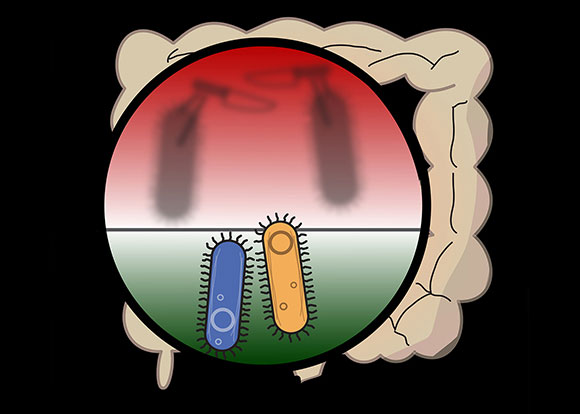
    Study Shows Friendly Bacteria Aggressively Protect Their Territory
    Study shows friendly bacteria aggressively protect their territory.

    A newly published study from Yale University details how human gut bacteria take on many tasks crucial to health.

    Bacterially speaking, it gets very crowded in the human gut, with trillions of cells jostling for a position to carry out a host of specialized and often crucial tasks. A new Yale study, published the week of March 7 in the journal of the Proceedings of the National Academy of Sciences suggests these “friendly” bacteria aggressively stake out their territory, injecting lethal toxins into any other cells that dare bump into them.

    “These bacteria are friendly to us, but possess an elaborate arsenal to protect their space,” said Aaron Wexler of the Department of Microbial Pathogenesis at the Microbial Sciences Institute at West Campus and lead author of the study. “We’ve come to view this as a way bacteria check up on their neighbors — as if asking ‘Are you the same as me?’”

    Gut bacteria have co-evolved in mammals to take on many tasks crucial to health. While we provide the bacteria with nutrients and a warm place to live, they harvest indigestible parts of our diet, produce vitamins we can’t make, fend off dangerous pathogens, and fine-tune our immune systems. Bacteria also help each other — for instance some have evolved to consume byproducts of other species.

    Wexler and senior author Andrew Goodman wanted to explore how these cells manage to function together packed into such close proximity. To their surprise, they found bacteria were in almost constant warfare with each other.

    They found members of the phylum Bacteroidetes — one of the major groups of bacteria in the gut — have developed mechanisms to “hand-deliver” toxins into neighboring cells and to defend against toxins injected by similar cells. Immunity proteins produced within the bacteria provide defenses against these toxins and ensure co-existence with similar cells. For reasons not well understood, only a subset of members within a given species possesses these defenses.

    “Even in the same species the arsenals can be different,” Goodman said. “They are defining who is who at a much finer level than species. It seems to be a way to keep competitors at arm’s length.”

    Understanding how these toxins work may one day have clinical relevance, the authors say, given an increased understanding of how the disruption of the microbiome can play a role in cancer, obesity, and autoimmune diseases.

    Primary funding for the research came from the National Institutes of Health, the Pew Scholars Program, and the Burroughs Wellcome Fund.

    The Yale team worked with colleagues from the University of Washington, University of Texas-Austin, University of Maryland, and Memorial Sloan Kettering Cancer Center.

    Reference: “Human symbionts inject and neutralize antibacterial toxins to persist in the gut” by Aaron G. Wexler, Yiqiao Bao, John C. Whitney, Louis-Marie Bobay, Joao B. Xavier, Whitman B. Schofield, Natasha A. Barry, Alistair B. Russell, Bao Q. Tran, Young Ah Goo, David R. Goodlett, Howard Ochman, Joseph D. Mougous and Andrew L. Goodman, 8 March 2016, PNAS.
    DOI: 10.1073/pnas.1525637113

    Never miss a breakthrough: Join the SciTechDaily newsletter.
    Follow us on Google and Google News.

    Bacteria Cell Biology Pathology University of Maryland University of Texas Yale University
    Share. Facebook Twitter Pinterest LinkedIn Email Reddit

    Related Articles

    Viruses Are Both the Villains and Heroes of Life As We Know It – Nature’s Powerhouses for Genetic Innovation

    Natural Sorting Mechanism Allows Bacteria to Preserve Diversity

    Biologists Develop Breakthrough RNA-Based Therapy to Target West Nile Virus

    Yale Researchers Identify Gene That Regulates the Growth of Melanoma

    Scientists Uncover a Pathway for Silencing Tumor Suppressor Genes

    Cancer Scientists Prove Long-Standing Theory on How Cancer Spreads

    Optogenetics Regulates Metabolic Activity in the Membranes of Cells

    New Imaging Technique Reveals Possible Plan of Attack for Bacterial Diseases

    Human Presence Increases Indoor Bacteria

    Leave A Reply Cancel Reply

    • Facebook
    • Twitter
    • Pinterest
    • YouTube

    Don't Miss a Discovery

    Subscribe for the Latest in Science & Tech!

    Trending News

    Scientists Discover Game-Changing New Way To Treat High Cholesterol

    This Small Change to Your Exercise Routine Could Be the Secret to Living Longer

    Scientists Discover 430,000-Year-Old Wooden Tools, Rewriting Human History

    AI Could Detect Early Signs of Alzheimer’s in Under a Minute – Far Before Traditional Tests

    What if Dark Matter Has Two Forms? Bold New Hypothesis Could Explain a Cosmic Mystery

    This Metal Melts in Your Hand – and Scientists Just Discovered Something Strange

    Beef vs. Chicken: Surprising Results From New Prediabetes Study

    Alzheimer’s Breakthrough: Scientists Discover Key Protein May Prevent Toxic Protein Clumps in the Brain

    Follow SciTechDaily
    • Facebook
    • Twitter
    • YouTube
    • Pinterest
    • Newsletter
    • RSS
    SciTech News
    • Biology News
    • Chemistry News
    • Earth News
    • Health News
    • Physics News
    • Science News
    • Space News
    • Technology News
    Recent Posts
    • Revolutionary Imaging Technique Unlocks Secrets of Matter at Extreme Speeds
    • Where Does Mass Come From? Scientists Find Evidence of a New Exotic Nuclear State
    • Quantum Breakthrough: Unhackable Keys Sent Over 120 km Using Quantum Dots
    • Researchers Discover Unknown Beetle Species Just Steps From Their Lab
    • Jellyfish Caught Feasting on Exploding Sea Worms for the First Time
    Copyright © 1998 - 2026 SciTechDaily. All Rights Reserved.
    • Science News
    • About
    • Contact
    • Editorial Board
    • Privacy Policy
    • Terms of Use

    Type above and press Enter to search. Press Esc to cancel.