
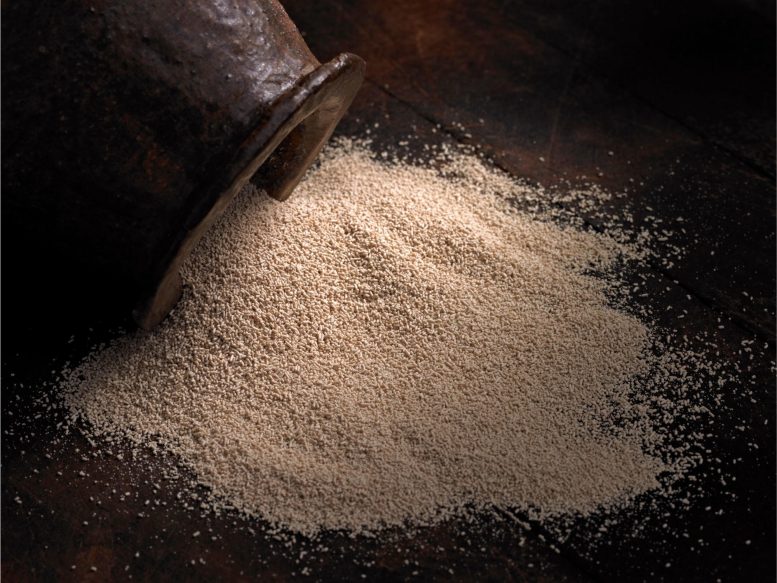
A recently discovered phenomenon known as latecomer killing describes how yeast kills its own clones and other nearby microorganisms to survive when starved of glucose.
Yeast is not the simple single-celled microorganism we always believed it was, but a competitive killer. When yeast is starved of glucose, it releases a toxin that can kill any other microorganisms that have entered its habitat, even clones of itself. This previously unknown venomous phenomenon adds to our knowledge of unicellular microorganism behavior and the evolution of unicellular to multicellular organisms. It also has potentially valuable uses in the food industry.
During the pandemic, bread baking gained popularity as a new pastime, so nowadays you will probably discover a small packet of dried yeast hidden away in many kitchen cabinets. This little living fungus has been an essential component of our diet for thousands of years, allowing us to enjoy fluffy bread, sweet wine, and frothy beer. Yeast was previously believed to be a simple unicellular (single-cell) microorganism, but now researchers at the University of Tokyo have shown it has a murderous survival strategy.

Latecomer Killing: A Surprising Phenomenon
“In the critical survival situation of glucose starvation, yeasts release toxins into their habitat which kill other microorganisms while the yeast itself acquires resistance,” explained Assistant Professor Tetsuhiro Hatakeyama from the Graduate School of Arts and Sciences. “We have called this phenomenon latecomer killing. We were even more surprised to find that the toxins produced by yeasts can also kill their nonadapted clones, so they are at risk of killing not only invading microorganisms but also their own offspring. Such seemingly risky and almost suicidal behavior had not previously been found in a single-celled organism or even considered to exist.”
Although many bacteria and fungi display cooperative kinds of behavior, this study is the first prominent finding of competitiveness in clonal cells of unicellular organisms. This has significant implications for our knowledge of microorganism ecology, as well as why certain microorganisms grow during fermentation while others do not. To make this discovery, the researchers cultivated clonal cells (derived from the same parental cell) separately under glucose-limited and glucose-rich conditions. When the cells were combined, the growth patterns revealed that yeast cells that had already adapted to glucose starvation could poison latecomers while retaining food resources for themselves.

“Our research reveals a surprisingly selfish side to yeast behavior,” said Hatakeyama. “The phenomenon we discovered is similar to a thought experiment proposed by the ancient Greek philosopher Carneades of Cyrene, called the plank of Carneades: If a sailor escapes from a shipwreck by holding on to a plank that is capable of supporting barely one person, and then pushes away another sailor who comes after him, will he be charged with murder?”
Insights Into Evolutionary Strategy and Lineage Selection
The researchers suggest that this strategy may help yeast avoid mass starvation of the population, while also aiding selection of toxin-producing offspring that are more likely to continue their lineage. The strategy was observed in several different types of yeast — initially taken from beer, bread, and wine — which could mean that this phenomenon may occur more widely across this diverse species.
This discovery could be used to develop useful growth control mechanisms for economically important species of yeast, such as those used in the food industry. Although not included in this study, it may also pave the way to better controlling types of yeast which can negatively affect human and animal health. The team would next like to explore the implications of this discovery for cell evolution.
“For the development of multicellular organisms, not only mutual activation of cellular growth but also mutual inhibition of cellular growth or programmed cell death in clonal cells is required,” explained Hatakeyama. “Fungi are known to tend to an evolutionary transition between unicellularity and multicellularity more readily than other organisms, so we would like to unravel the relationship between the latecomer killing and the evolution of multicellular organisms. We hope this research will make a significant contribution to our understanding of ecosystem development and evolutionary transitions.”
Reference: “Autotoxin-mediated latecomer killing in yeast communities” by Arisa H. Oda, Miki Tamura, Kunihiko Kaneko, Kunihiro Ohta and Tetsuhiro S. Hatakeyama, 7 November 2022, PLOS Biology.
DOI: 10.1371/journal.pbio.3001844
The study was funded by the Osumi Foundation for Basic Sciences, the Sumitomo Foundation, the Grant-in-Aid for Young Scientists, the Grant-in-Aid for Scientific Research on Innovative Areas “Constraints and Directions of Evolution”, the Japan Creative Research Promotion Agency, and the Japan Agency for Medical Research and Development.
Never miss a breakthrough: Join the SciTechDaily newsletter.
Follow us on Google and Google News.
3 Comments
Are you sure that fungi were previously believed to be a simple unicellular (single-cell) microorganism?
“Fungi are unicellular or multicellular thick-cell-walled heterotroph decomposers that eat decaying matter…”
the article says yeast, not fungi
Out of curiosity is this all yeast even Candida auris