
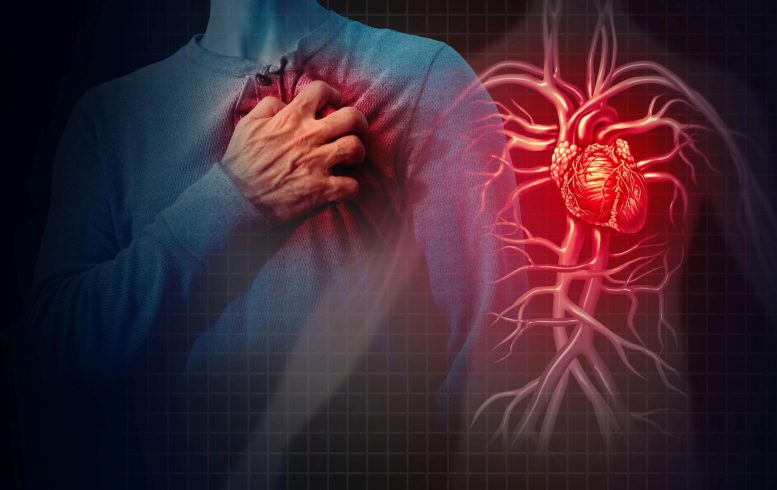
Researchers linked arrhythmogenic cardiomyopathy to weakened cardiac cell adhesion caused by genetic mutations.
Arrhythmogenic cardiomyopathy, a heart disease that particularly affects young athletes, can result in sudden death. The University of Basel has recently genetically modified mice that develop a disease comparable to that found in humans. The team was able to identify previously undiscovered mechanisms and potential treatment targets as a result.
Fans of the soccer team Sevilla FC will never forget the August 2007 game when 22-year-old Antonio Puerta went into cardiac arrest, collapsed on the field, and eventually passed away in the hospital. The athlete was later found to be suffering from a condition known as arrhythmogenic cardiomyopathy.
This inherited disease affects one in every 5,000 individuals, with males being more impacted than women. “Arrhythmogenic cardiomyopathy leads to arrhythmia with a loss of cardiac muscle cells, deposits of connective tissue, and fat within the cardiac muscle. This can cause sudden cardiac death, often during exercise,” says Volker Spindler, anatomist and head of the Cell Adhesion group at the University of Basel’s Department of Biomedicine.
Today, it is recognized that a number of gene mutations can trigger the condition. There is no treatment, even with an early diagnosis; only symptom management options are available.
“Patients are advised to avoid any competitive or endurance sports and have to take medications such as beta-blockers. Where appropriate, a catheter ablation may be performed or an implantable defibrillator may be used” says the cardiologist Gabriela Kuster, who heads the Myocardial Research group at the Department of Biomedicine. Sometimes the only option is a heart transplant.
Cardiac Muscle Cells Lose Their Stickiness
The starting point for the project was the notion that many of the mutations affect structures known as the desmosomes. These are protein clusters on the surface of cardiac muscle cells that ensure a tight connection between the cells. “You can imagine these clusters to act like a piece of Velcro,” says the physician Dr. Camilla Schinner, the first author of the study just published in the journal Circulation. This led to the theory that the mutations reduce adhesion between the cells, thus weakening the cardiac muscle.
To test this hypothesis, Spindler’s team introduced a mutation similar to that found in patients into the genome of mice. The cardiac function of these animals was then examined by Kuster’s group. The result: the genetically modified animals showed a heart disease with arrhythmia that resembled arrhythmogenic cardiomyopathy in humans. In addition, microscopic and biochemical analysis indeed showed reduced adhesion between the cardiac muscle cells. The researchers also observed the scarring of the cardiac muscle typical for this disease.
Preventing Cardiac Tissue Damage
Their next step was to investigate how diseased cardiac muscle differed from healthy conditions at the molecular level. Mice with the mutation showed an increased amount of a particular protein at the Velcro-like structures of the heart muscle cells. This leads, via a series of events, to connective tissue deposition and scarring of the heart. The addition of a substance that blocks this cascade prevented disease progression – which is why Spindler here sees a potential new treatment approach.
“Nevertheless, there is still a long way to go until an application in humans may be considered,” he points out. “But we now have better options to study the disease in more detail to improve our understanding of the underlying mechanisms.”
Reference: “Defective Desmosomal Adhesion Causes Arrhythmogenic Cardiomyopathy by Involving an Integrin-αVβ6/TGF-β Signaling Cascade” by Camilla Schinner, Lifen Xu, Henriette Franz, Aude Zimmermann, Marie-Therès Wanuske, Maitreyi Rathod, Pauline Hanns, Florian Geier, Pawel Pelczar, Yan Liang, Vera Lorenz, Chiara Stüdle, Piotr I. Maly, Silke Kauferstein, Britt M. Beckmann, Farah Sheikh, Gabriela M. Kuster and Volker Spindler, 21 October 2022, Circulation.
DOI: 10.1161/CIRCULATIONAHA.121.057329
Never miss a breakthrough: Join the SciTechDaily newsletter.
Follow us on Google and Google News.
1 Comment
Pfizer!!!