
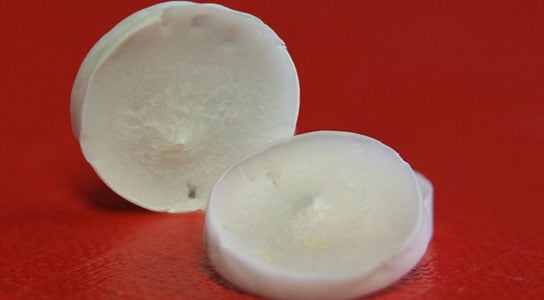
Scientists at the Max Planck Institute for Heart and Lung Research are trying to repair damaged cardiac tissue by growing replacement tissue in a laboratory. By using the silk produced by a tropical silkworm, researchers created a three-dimensional scaffold that they were able load cardiac muscle cells into. They hope this research will lead to artificial cardiac tissue that will restore complete cardiac function in people suffering from heart muscle damage.
Damaged human heart muscle cannot be regenerated. Scar tissue grows in place of the damaged muscle cells. Scientists from the Max Planck Institute for Heart and Lung Research in Bad Nauheim are seeking to restore complete cardiac function with the help of artificial cardiac tissue. They have succeeded in loading cardiac muscle cells onto a three-dimensional scaffold, created using the silk produced by a tropical silkworm.
Of all the body’s organs, the human heart is probably the one most primed for performance and efficiency. Decade after decade, it continues to pump blood around our bodies. However, this performance optimization comes at a high price: over the course of evolution, almost all of the body’s own regeneration mechanisms in the heart have become deactivated. As a result, a heart attack is a very serious event for patients; dead cardiac cells are irretrievably lost. The consequence of this is a permanent deterioration in the heart’s pumping power and in the patient’s quality of life.
In their attempt to develop a treatment for the repair of cardiac tissue, scientists are pursuing the aim of growing replacement tissue in the laboratory, which could then be used to produce replacement patches for the repair of damaged cardiac muscle. The reconstruction of a three-dimensional structure poses a challenge here. Experiments have already been carried out with many different materials that could provide a scaffold substance for the loading of cardiac muscle cells.
“Whether natural or artificial in origin, all of the tested fibers had serious disadvantages,” says Felix Engel, Research Group Leader at the Max Planck Institute for Heart and Lung Research in Bad Nauheim. “They were either too brittle, were attacked by the immune system, or did not enable the heart muscle cells to adhere correctly to the fibers.” However, the scientists have now found a possible solution in Kharagpur, India.
At the university there, coin-sized disks are being produced from the cocoon of the tasar silkworm (Antheraea mylitta). According to Chinmoy Patra, an Indian scientist who now works in Engel’s laboratory, the fiber produced by the tasar silkworm displays several advantages over the other substances tested. “The surface has protein structures that facilitate the adhesion of heart muscle cells. It’s also coarser than other silk fibers.” This is the reason why the muscle cells grow well on it and can form a three-dimensional tissue structure. “The communication between the cells was intact and they beat synchronously over a period of 20 days, just like real heart muscle,” says Engel.
Despite these promising results, clinical application of the fiber is not currently on the agenda. “Unlike in our study, which we carried out using rat cells, the problem of obtaining sufficient human cardiac cells as starting material has not yet been solved,” says Engel. It is thought that the patient’s own stem cells could be used as starting material to avoid triggering an immune reaction. However, exactly how the conversion of the stem cells into cardiac muscle cells works remains a mystery.
Reference: “Silk protein fibroin from Antheraea mylitta for cardiac tissue engineering” by Chinmoy Patra, Sarmistha Talukdar, Tatyana Novoyatleva, Siva R. Velagala, Christian Mühlfeld, Banani Kundu, Subhas C. Kundu and Felix B. Engel, 10 January 2012, Biomaterials.
DOI: 10.1016/j.biomaterials.2011.12.036
Never miss a breakthrough: Join the SciTechDaily newsletter.
Follow us on Google and Google News.