
Close Menu
    Facebook X (Twitter) Instagram
    SciTechDaily
    • Biology
    • Chemistry
    • Earth
    • Health
    • Physics
    • Science
    • Space
    • Technology
    Facebook X (Twitter) Pinterest YouTube RSS
    SciTechDaily
    Home»Biology»Adanson’s Jumping Spiders Hunt Using Unusual Depth Perception
    Biology

    Adanson’s Jumping Spiders Hunt Using Unusual Depth Perception

    By SciTechDailyJanuary 28, 2012No Comments2 Mins Read
    Facebook Twitter Pinterest Telegram LinkedIn WhatsApp Email Reddit
    Share
    Facebook Twitter LinkedIn Pinterest Telegram Email Reddit
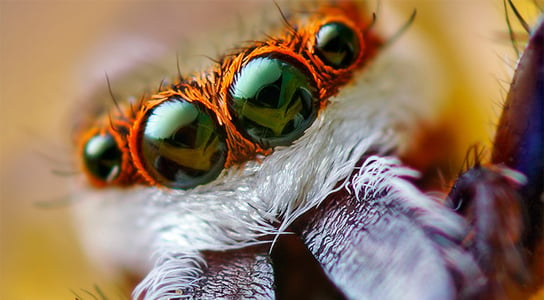
    spider-four-eyes-front
    Adult Male Hentzia palmarum Jumping Spider

    Thanks to their keen vision, jumping spiders have been able to get the advantage on their prey in the invertebrate world. However, scientists have been puzzled how the spiders’ miniature nervous system manages such sophisticated perception.

    A study of Adanson’s jumping spider, Hasarius adansoni, has shown that these spiders have an unusual form of depth perception, which allows them to precisely gauge the distance to objects.
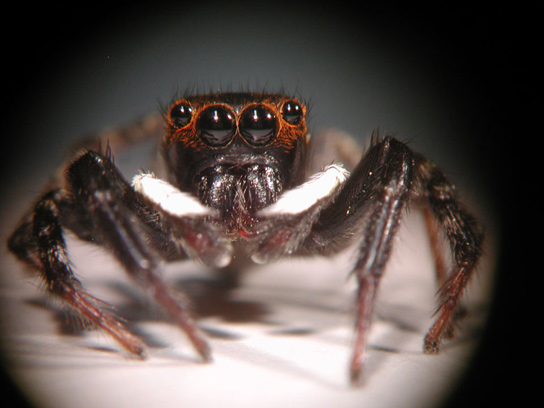
    adanson-jumping-spider

    Like other jumping spiders, Adanson’s spider eight eyes, but the two big front eyes have the sharpest vision. These eyes have a lens that projects images onto their retinas, but the spiders have not one but four distinct layers of light-sensitive cells. Whenever an object is on the base layer, it is out of focus on the next layer, which scientists thought would make their vision blurrier rather than sharper.

    A team of biologists led by Akihisa Terakita, Mistumasa Koyanagi, and Takashi Nagata of Osaka City University in Japan, discovered that the out of focus layer helped spiders figure out the distance to objects. They published their findings in Science. They discovered that the bottom layers are red-green colorblind. They tested this out by dabbing black paint on the spiders’ secondary six eyes, and proceeded to see how their depth perception worked under red and green lights. Under red light, the spiders fell short.

    In either lighting, the spider’s eye focuses on a sharp image on the first layer of the retina. The lens at the front of the eye bends green light more sharply than red, the image on the second layer turned out fuzzier in green light. The less blurry red images tricked the spiders into thinking the objects were closer than they appeared, suggesting that they used the secondary image to judge distances.

    The next step involves discovering how their brains compare the clear and fuzzy images to get a sense of distance.

    Reference: “A Clearer View from Fuzzy Images” by Marie E. Herberstein and Darrel J. Kemp, 27 January 2012, Science.
    DOI: 10.1126/science.1216887

    Never miss a breakthrough: Join the SciTechDaily newsletter.
    Follow us on Google and Google News.

    3d Depth Perception Entomology Osaka Metropolitan University Popular Senses Spiders Vision
    Share. Facebook Twitter Pinterest LinkedIn Email Reddit

    Related Articles

    Toxic Masculinity: Solving the Puzzle of Why Male Funnel-Web Spiders Are So Deadly

    Spider Building Spider Decoys Discovered in Peruvian Amazon

    3D X-Ray Reveals Fibers That Control Heart Rhythm

    Cost-Effective 3-D RNA Modeling Technique

    Haemaphysalis Flava Hardy Enough to Survive Vacuum and Electron Beam

    3-D Image Shows How DNA Packs Itself into a “Fractal Globule”

    European Cave Spiders Produce Extremely Stretchable Silk

    Researchers Use Computer Simulations to Better Understand Spider Silk

    Bearing Gifts Equals More Sex Even With Spiders

    Leave A Reply Cancel Reply

    • Facebook
    • Twitter
    • Pinterest
    • YouTube

    Don't Miss a Discovery

    Subscribe for the Latest in Science & Tech!

    Trending News

    Hair Loss May Be an Overlooked Side Effect of Ozempic and Mounjaro

    Scientists Develop a Groundbreaking Chip That Operates at Brain-Like Speed

    Viagra May Block a Hidden Pathway Cancer Cells Need To Spread

    How Brown Tree Snakes Became an Unstoppable Invasive Species

    Earth’s First Complex Organisms May Hold Clues to Life Beyond Our Planet

    A 25,000-Year-Old Ritual Tradition Was Hidden Beneath This Cave Floor

    Plant Compounds in Berries, Tea, and Cocoa May Support Healthy Brain Aging

    Scientists Turn an Old Antibiotic Back Into a Superbug Killer

    Follow SciTechDaily
    • Facebook
    • Twitter
    • YouTube
    • Pinterest
    • Newsletter
    • RSS
    SciTech News
    • Biology News
    • Chemistry News
    • Earth News
    • Health News
    • Physics News
    • Science News
    • Space News
    • Technology News
    Recent Posts
    • Underwater Cameras Expose the Secret Lives of Whale Sharks
    • A Massive Study Reveals the Brain Is Far More Flexible Than We Thought
    • Why Dreaming Leaves the Brain Running Low on Energy
    • Quantum Photons Survive a 24-Kilometer Journey Through Chicago’s Busy Internet
    • Quantum Computing’s “Dark Horse” Just Cleared a Major Hurdle
    Copyright © 1998 - 2026 SciTechDaily. All Rights Reserved.
    • Science News
    • About
    • Contact
    • Editorial Board
    • Privacy Policy
    • Terms of Use

    Type above and press Enter to search. Press Esc to cancel.