
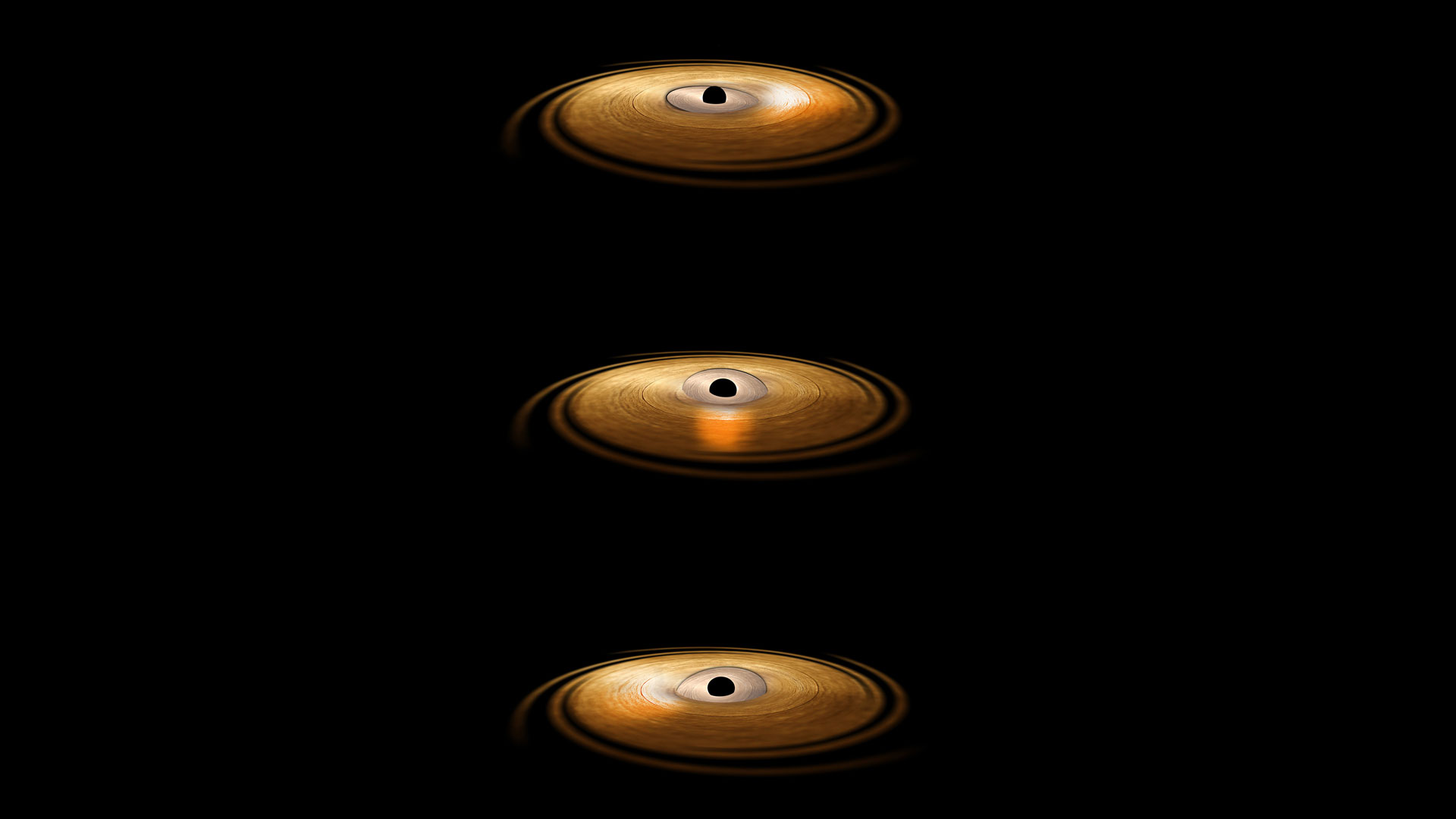
Using data from XMM-Newton and NuSTAR, astronomers have proved the existence of a “gravitational vortex” around a black hole.
This new discovery, aided by NASA’s Nuclear Spectroscopic Telescope Array (NuSTAR) mission, solves a mystery that has eluded astronomers for more than 30 years, and will allow them to map the behavior of matter very close to black holes. It could also open the door to future investigations of Albert Einstein’s general relativity.
Matter falling into a black hole heats up as it plunges to its doom. Before it passes into the black hole and is lost from view forever, it can reach millions of degrees. At that temperature, it shines X-rays into space.
In the 1980s, pioneering astronomers using early X-ray telescopes discovered that the X-rays coming from stellar-mass black holes in our galaxy flicker. The changes follow a set pattern. When the flickering begins, the dimming and re-brightening can take 10 seconds to complete. As the days, weeks, and months progress, the period shortens until the oscillation takes place 10 times every second. Then, the flickering suddenly stops altogether.
The phenomenon was dubbed the Quasi Periodic Oscillation (QPO). “It was immediately recognized to be something fascinating because it is coming from something very close to a black hole,” said Adam Ingram, University of Amsterdam, the Netherlands, who began working to understand QPOs for his doctoral thesis in 2009.
During the 1990s, astronomers had begun to suspect that the QPOs were associated with a gravitational effect predicted by Einstein’s general relativity: that a spinning object will create a kind of gravitational vortex.
“It is a bit like twisting a spoon in honey. Imagine that the honey is space and anything embedded in the honey will be “dragged” around by the twisting spoon,” explained Ingram. “In reality, this means that anything orbiting a spinning object will have its motion affected.” In the case of an inclined orbit, it will “precess.” This means that the whole orbit will change orientation around the central object. The time for the orbit to return to its initial condition is known as a precession cycle.
In 2004, NASA launched Gravity Probe B to measure this so-called Lense-Thirring effect around Earth. After painstaking analysis, scientists confirmed that the spacecraft would turn through a complete precession cycle once every 33 million years.
Around a black hole, however, the effect would be much more noticeable because of the stronger gravitational field. The precession cycle would take just a matter of seconds or less to complete. This is so close to the periods of the QPOs that astronomers began to suspect a link.
Ingram began working on the problem by looking at what happened in the flat disc of matter surrounding a black hole. Known as an accretion disc, it is the place where material gradually spirals inwards toward the black hole. Scientists had already suggested that, close to the black hole, the flat accretion disc puffs up into a hot plasma, in which electrons are stripped from their host atoms. Termed the hot inner flow, it shrinks in size over weeks and months as it is eaten by the black hole. Together with colleagues, Ingram published a paper in 2009 suggesting that the QPO is driven by the Lense-Thirring precession of this hot flow. This is because the smaller the inner flow becomes, the closer to the black hole it would approach and so the faster its Lense-Thirring precession cycle would be. The question was: how to prove it?
“We have spent a lot of time trying to find smoking gun evidence for this behavior,” said Ingram.
The answer is that the inner flow is releasing high-energy radiation that strikes the matter in the surrounding accretion disc, making the iron atoms in the disc shine like a fluorescent light tube. The iron releases X-rays of a single wavelength — referred to as “a spectral line.”
Because the accretion disc is rotating, the iron line has its wavelength distorted by the Doppler effect. Line emission from the approaching side of the disc is squashed — blue shifted — and line emission from the receding disc material is stretched — red shifted. If the inner flow really is precessing, it will sometimes shine on the approaching disc material and sometimes on the receding material, making the line wobble back and forth over the course of a precession cycle.
Seeing this wobbling is where XMM-Newton came in. Ingram and colleagues from Amsterdam, Cambridge, Southampton, and Tokyo applied for a long-duration observation that would allow them to watch the QPO repeatedly. They chose black hole H 1743-322, which was exhibiting a four-second QPO at the time. They watched it for 260,000 seconds with XMM-Newton. They also observed it for 70,000 seconds with NASA’s NuSTAR X-ray observatory.
“The high-energy capability of NuSTAR was very important,” Ingram said. “NuSTAR confirmed the wobbling of the iron line, and additionally saw a feature in the spectrum called a ‘reflection hump’ that added evidence for precession.”
After a rigorous analysis process of adding all the observational data together, they saw that the iron line was wobbling in accordance with the predictions of general relativity. “We are directly measuring the motion of matter in a strong gravitational field near to a black hole,” says Ingram.
This is the first time that the Lense-Thirring effect has been measured in a strong gravitational field. The technique will allow astronomers to map matter in the inner regions of accretion discs around black holes. It also hints at a powerful new tool with which to test general relativity.
Einstein’s theory is largely untested in such strong gravitational fields. So if astronomers can understand the physics of the matter that is flowing into the black hole, they can use it to test the predictions of general relativity as never before – but only if the movement of the matter in the accretion disc can be completely understood.
“If you can get to the bottom of the astrophysics, then you can really test the general relativity,” says Ingram. A deviation from the predictions of general relativity would be welcomed by a lot of astronomers and physicists. It would be a concrete signal that a deeper theory of gravity exists.
Larger X-ray telescopes in the future could help in the search because they are more powerful and could more efficiently collect X-rays. This would allow astronomers to investigate the QPO phenomenon in more detail. But for now, astronomers can be content with having seen Einstein’s gravity at play around a black hole.
“This is a major breakthrough since the study combines information about the timing and energy of X-ray photons to settle the 30-year debate around the origin of QPOs. The photon-collecting capability of XMM-Newton was instrumental in this work,” said Norbert Schartel, ESA Project Scientist for XMM-Newton.
Reference: “A quasi-periodic modulation of the iron line centroid energy in the black hole binary H 1743-322” by Adam Ingram, Michiel van der Klis, Matthew Middleton, Chris Done, Diego Altamirano, Lucy Heil, Phil Uttley and Magnus Axelsson, 25 May 2016, MNRAS.
DOI: 10.1093/mnras/stw1245
arXiv:1607.02866
Never miss a breakthrough: Join the SciTechDaily newsletter.
Follow us on Google and Google News.
5 Comments
In search of black holes astrophysicists are relying on indirect observations. Only the measurement of the event horizon of a black hole directly would be a direct evidence. However nobody done it yet, so for now an existence of BH is a hypothesis.
Any theory is never perfectly “proven” since “theoretically”, people make mistakes and could be wrong in thinking they have proved it. However, the BH “theory” is really well-tested. Could it be wrong? Sure. So could Newton’s Laws of Motion. Still, I wouldn’t bet against them.
Who said that Black Hole is an Hypothesis? What other explanation can you give for the energy of Black Hole to sling around all the galaxies and stars about it ? Even Dalton Atomic Theory also was only a hypothesis. Could it be ignored then ? Dalton did not live to see the discovery of proton which came later from Alpha scattering. Bohr also made a theory with the algebra known to him at that time. Has it not come true? Darwin’s theory of evolution is once again a theory but could not be discarded. To prove the theory of evolution he should have lived for a million years in his experiment to show that animals change their metamorphosis. But later discovery of DNA and its mutations hold the theory to be good. A hypothesis can be dismissed only if it is proved otherwise. Thank You.
Could this be why Jupiter’s Great Red Spot has lasted so long? Could other gas giants have a similar kind of storm located near the Equator, and always there? Could Uranus, or Neptune be sporting a similar vortex that might not be that visible? Interesting.
No discussion about the electro magnetic fields that would be generated by the stripping of electrons from atoms (positrons) spiraling in the gravitational field at the outer most interface of the event horizon. Certainly, rotating black hole horizons must have magnetic fields associated with them. The spiraling of the electrons would increase in velocity as they followed the more densified magnetic fields into the blackhole and generated x-rays as the frequency of rotation increased. This effect would mimic how microwaves are generated while spiralling in the magnetic fields in a magnetron.