
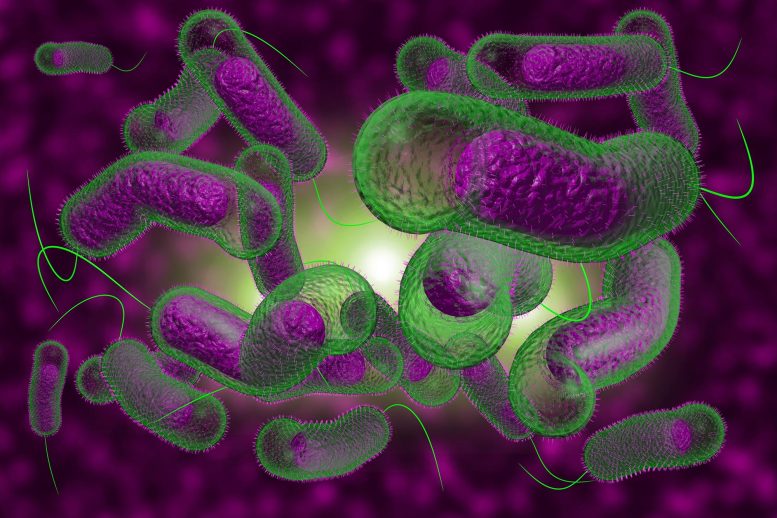
Researchers at Harvard Medical School and the California Institute of Technology teamed up to image the T6SS system working in real-time to prove their hypothesis that cholera’s T6SS tactic mirrors the system that phage viruses use to inject their genetic material into bacteria for replication.
Bacteria live in a state of perpetual warfare, with different species battling for dominion over their competitors and when pathogen, over their infected host. New research suggests that the human pathogen Vibrio cholerae, which causes the disease cholera, kills off its microbial rivals by jabbing them with a spring-loaded poison dagger. Were it not for that defense, called the Type 6 secretion system (T6SS), V. cholerae might not out-compete its neighbors to sicken millions of people every year.
The results were published online on February 26 in the journal Nature.
The research began with a hypothesis that cholera’s T6SS tactic mirrors the system that phage viruses—viruses that infect bacteria—use to inject their genetic material into bacteria for replication. But this hypothesis was grounded in biochemical evidence, in that the phage and T6SS components appeared to have similar protein structures. The only way to confirm the hypothesis was to watch the T6SS system in action. So John Mekalanos, chair of the Department of Microbiology and Immunobiology at Harvard Medical School, and Grant Jensen, an associate professor of biology at the California Institute of Technology, teamed up to image the T6SS system working in real-time.
“These images are striking,” said Mekalanos. “They’re revealing how a beautiful nano-machine really works, and they’re also providing new insights about how V. cholerae kills other bacteria and human host cells.”
Mekalanos and post-doctoral fellow, Marek Basler, started with fluorescence microscopy: They fused a T6SS protein, VipA, to a fluorescent probe, which they expressed in V. cholerae cells. As this probe diffused in the cell interior, T6SS machinery began to glow as if it were wrapped in green Christmas lights. What the researchers saw was a long tubular structure forming and then suddenly collapsing to half its size in less than five milliseconds. The same structure was then rebuilt within seconds into an extended form at another position in the same cell. That process repeated itself again and again, indicating the cell wasn’t harmed by it.
“Like the action film assassin Machete, this bacterial killer is loaded with many daggers,” said Mekalanos.
At the California Institute of Technology, Jensen and post-doctoral fellow Martin Pilhofer continued the research with electron cryomicroscopy, in which cells are imaged slice by slice. The combined data from those slices generated a three-dimensional rendering of the cell, revealing that in its extended conformation, the T6SS sheath is “loaded” with an internal structure—the poison dagger—while the collapsed sheath is empty. Mekalanos and Jensen propose that by contracting, the sheath ejects the dagger, which punctures through V. cholerae’s outer membrane, and then into adjacent prey or host cells.
The two methods are complementary, in that fluorescent microscopy supplies “movies” of the apparatus functioning inside living bacteria in real time, while electron cryomicroscopy supplies static, high-resolution snapshots of T6SS components and transitional states in its structure.
The images support an assumption that the T6SS and phage sheath systems are linked by evolution, although it’s not clear which of them came first. The two systems also differ in key ways, however. Phage systems, for instance, deliver just one payload, while the T6SS system can assemble, shoot, disassemble, reform, and then shoot again, repeatedly. “It’s not a one-trick pony,” Mekalanos said.
Also, the actual injection process utilized by phage has never been imaged in real time, so watching the speed of T6SS contraction suggests that phage sheath contraction must be extraordinarily fast as well.
Jensen emphasized that the resolution achieved in this study likely hasn’t been exceeded anywhere else. Future research, he said, will aim to determine how, or if, T6SS actually punctures other cells and also compare the structure and function of different T6SS systems in other bacteria.
“Someday, we’d like to be able to re-engineer and repurpose T6SS systems to perform tasks of our choosing,” said Jensen. “For instance, inserting toxins into cancer cells.”
Mekalanos also said the findings might have biomedical implications. “We know that T6SS is important for the virulence of several bacterial species,” he said. “So this could be a useful model system to look for drugs that inhibit T6SS activity.”
Reference: “Type VI secretion requires a dynamic contractile phage tail-like structure” by M. Basler, M. Pilhofer, G. P. Henderson, G. J. Jensen and J. J. Mekalanos, 26 February 2012, Nature.
DOI: 10.1038/nature10846
This research was funded by the National Institute of Allergy and Infectious Disease and the Howard Hughes Medical Institute.
Never miss a breakthrough: Join the SciTechDaily newsletter.
Follow us on Google and Google News.