
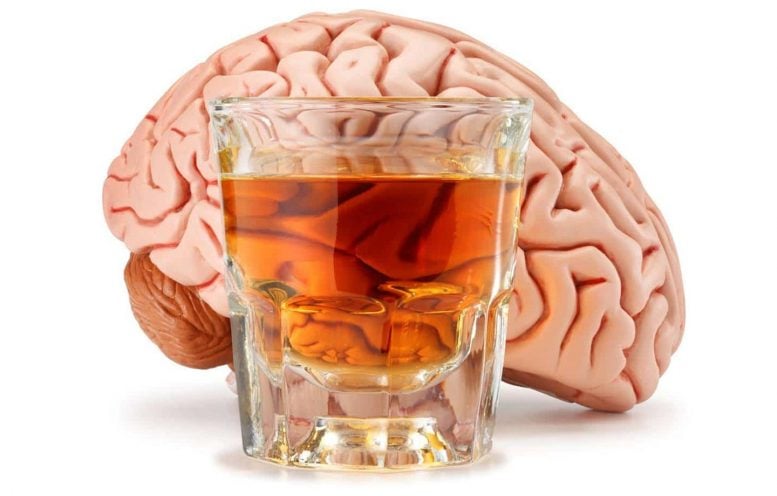
A newly published study involving mice reveals that heavy alcohol use actually rewires brain circuitry, making it harder for alcoholics to recover psychologically following a traumatic experience.
Doctors have long recognized a link between alcoholism and anxiety disorders such as post-traumatic stress disorder (PTSD). Those who drink heavily are at increased risk for traumatic events like car accidents and domestic violence, but that only partially explains the connection. New research using mice reveals heavy alcohol use actually rewires brain circuitry, making it harder for alcoholics to recover psychologically following a traumatic experience.
“There’s a whole spectrum to how people react to a traumatic event,” said study author Thomas Kash, PhD, assistant professor of pharmacology at the University of North Carolina School of Medicine. “It’s the recovery that we’re looking at — the ability to say ‘this is not dangerous anymore.’ Basically, our research shows that chronic exposure to alcohol can cause a deficit with regard to how our cognitive brain centers control our emotional brain centers.”
The study, which was published online on September 2, 2012, by the journal Nature Neuroscience, was conducted by scientists at the National Institute on Alcohol Abuse and Alcoholism (NIAAA) and UNC’s Bowles Center for Alcohol Studies.
“A history of heavy alcohol abuse could impair a critical mechanism for recovering from a trauma, and in doing so put people at greater risk for PTSD,” said NIAAA scientist Andrew Holmes, PhD, the study’s senior author. “The next step will be to test whether our preclinical findings translate to patients currently suffering from comorbid PTSD and alcohol abuse. If it does, then this could lead to new thinking about how we can better treat these serious medical conditions.”
Over the course of a month, the researchers gave one group of mice doses of alcohol equivalent to double the legal driving limit in humans. A second group of mice was given no alcohol. The team then used mild electric shocks to train all the mice to fear the sound of a brief tone.
When the tone was repeatedly played without the accompanying electric shock, the mice with no alcohol exposure gradually stopped fearing it. The mice with chronic alcohol exposure, on the other hand, froze in place each time the tone was played, even long after the electric shocks had stopped.
The pattern is similar to what is seen in patients with PTSD, who have trouble overcoming fear even when they are no longer in a dangerous situation.
The researchers traced the effect to differences in the neural circuitry of the alcohol-exposed mice. Comparing the brains of the mice, researchers noticed nerve cells in the prefrontal cortex of the alcohol-exposed mice actually had a different shape than those of the other mice. In addition, the activity of a key receptor, NMDA, was suppressed in the mice given heavy doses of alcohol.
Holmes said the findings are valuable because they pinpoint exactly where alcohol causes damage that leads to problems overcoming fear. “We’re not only seeing that alcohol has detrimental effects on a clinically important emotional process, but we’re able to offer some insight into how alcohol might do so by disrupting the functioning of some very specific brain circuits,” said Holmes.
Understanding the relationship between alcohol and anxiety at the molecular level could offer new possibilities for developing drugs to help patients with anxiety disorders who also have a history of heavy alcohol use. “This study is exciting because it gives us a specific molecule to look at in a specific brain region, thus opening the door to discovering new methods to treat these disorders,” said Kash.
Reference: “Chronic alcohol remodels prefrontal neurons and disrupts NMDAR-mediated fear extinction encoding” by Andrew Holmes, Paul J Fitzgerald, Kathryn P MacPherson, Lauren DeBrouse, Giovanni Colacicco, Shaun M Flynn, Sophie Masneuf, Kristen E Pleil, Chia Li, Catherine A Marcinkiewcz, Thomas L Kash, Ozge Gunduz-Cinar and Marguerite Camp, 2 September 2012, Nature Neuroscience.
DOI: 10.1038/nn.3204
Study co-authors include Kristen Pleil, Chia Li and Catherine Marcinkiewcz of UNC and Paul Fitzgerald, Kathryn MacPherson, Lauren DeBrouse, Giovanni Colacicco, Shaun Flynn, Sophie Masneuf, Ozge Gunduz-Cinar and Marguerite Camp of NIAAA.
Never miss a breakthrough: Join the SciTechDaily newsletter.
Follow us on Google and Google News.
1 Comment
This is a very useful website and I have found good information here and I really appreciate the efforts of the writer of this essay for sharing nice ideas. Thanks!