
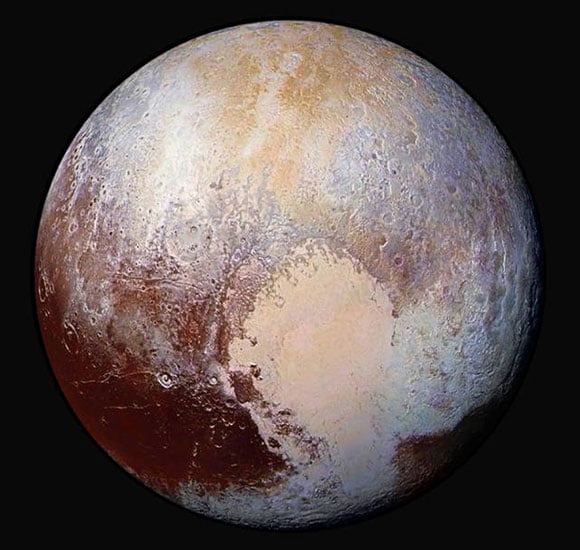
Scientists believe that the ice flows and water ice mountains revealed by New Horizons help support the idea that an interior ocean may be driving geologic activity on Pluto.
Pluto wears its heart on its sleeve, and that has scientists gleaning intriguing new facts about its geology and climate. Recent data from NASA’s New Horizons probe — which passed within 7,800 miles (12,600 kilometers) of the surface on July 14 — have revealed striking features on Pluto’s heart-shaped region that indicate the icy dwarf planet may harbor an ocean deep in its interior, according to mission scientists during a July 24 press briefing. They also provided new information about Pluto’s thin atmosphere.
“We are amazed to see Pluto as dynamic and active as it is,” said Richard Binzel, a New Horizons co-investigator and professor in MIT’s Department of Earth, Atmospheric, and Planetary Sciences. The latest images of Tombaugh Regio — the heart’s official name in honor of Pluto’s discoverer, Clyde Tombaugh — show evidence of nitrogen ice similar to Earth’s glaciers, which appear to flow around elevated islands at the heart’s edges. Until now, scientists have only seen surfaces like this on active worlds such as Earth and Saturn’s moon Enceladus. “No one dared imagine such a thick and localized buildup of geologically young ices, that even at 40 kelvins [-388 degrees Fahrenheit], have enough viscosity to create local landforms,” he said.
Flowing ice and other previously revealed features, such as 11,000-foot (3,400-meter) water ice mountains and the heart’s relatively young crater-free surface, support the idea that Pluto may have an interior ocean driving the geologic activity.
This simulated flyover of two regions on Pluto, northwestern Sputnik Planum and Hillary Montes, was created from New Horizons close-approach images. The images were acquired by the Long Range Reconnaissance Imager (LORRI) on July 14 from a distance of 48,000 miles. Features as small as one-half mile across are visible. Video: SwRI/JHUAPL/NASA
“All of the activity we see is consistent with the idea that [Pluto] has a massive rock core surrounded by an icy shell,” said William McKinnon, a New Horizons co-investigator at Washington University in St. Louis. “It increases the probability that there may still be an ocean underneath the thick layer of ice.” The researchers emphasized they don’t have any direct evidence for an interior liquid ocean, but will investigate the possibility as data continue to trickle in over the next 16 months. In any case, “things are looking good for Pluto,” McKinnon said.
He wasn’t kidding. A stunning image of Pluto released during the press conference shows the dwarf planet in silhouette surrounded by a hazy halo of light. “My jaw was on the ground when I saw this first image of an alien atmosphere in the Kuiper Belt,” said mission leader Alan Stern of the Southwest Research Institute. “It reminds us that exploration brings us more than just incredible discoveries — it brings incredible beauty.”
The haze extends at least 80 miles above the surface — five times farther than predicted — confirming Pluto’s atmosphere, which, according to surface pressure measurements, has decreased by half over the last two years. But where has it gone?
Michael Summers, a New Horizons scientist at George Mason University, explained that when methane gas in the atmosphere is exposed to ultraviolet light from the sun, it transforms into heavier hydrocarbon gasses that fall to lower, colder parts of Pluto’s atmosphere and form ice particles. The particles form a haze, which, when exposed to ultraviolet light yet again, are turned into red organic molecules that fall to the ground, forming the dwarf planet’s dark patches. “We think this is how Pluto’s surface got its reddish hue,” Summers said.
So far, only 4 to 5 percent of the data collected by the New Horizons probe during its flyby have beamed back to Earth. NASA will release additional images and information in September. The probe is currently 7.6 million miles beyond Pluto flying deeper into the Kuiper Belt, and will continue sending data through late 2016.
Never miss a breakthrough: Join the SciTechDaily newsletter.
Follow us on Google and Google News.
8 Comments
Water was once thought of as almost non existent in the Universe except on planet Earth. Now it has been found everywhere we look. Could life be the same way??
Pluto is sometimes closer to the Sun than Neptune. Is it mathematically possible that Pluto could ever collide with Neptune?
No, the gravitational fields of Pluto and Neptune push/pull on one another as they move through their orbits such that it prevents them from colliding. It is called an orbital resonance.
No, the orbit of Pluto is not on the same plane as Neptune’s. The orbits do not intersect.
Guess again mainstream science, sticking to a purely mechanical explanation worked for moon’s subject to ‘tidal heating’ such as Io, doesn’t work with Pluto though, it doesn’t have the energy input to sustain it’s atmospheric loss and recent geological activity from a uniform planetary nebulae evolutionary path. Evoking hidden and unconfirmable hypothesis [such as underground oceans] to explain anomalous observations seems to be a continuing trend among the consensus right now. There are no volcanoes, geysers, or other features indicative of internal geological processes, nor the internal heat source to explain it. External processes are the obvious choice to account for all the recent activity we observe in it’s atmosphere and surface.
Our Planetary evolutionary models need updating to include the now frequently observed interaction between planet/moon/star systems that create plasma/electrical driven chemical (H+ ions from solar wind interacting with negative ions of volatiles in the planets atmosphere) & mechanical interactions (eg. surface feature dichotomy, polygonal structures, ionic winds), and the plausible role this has on the evolution of surface features and chemical composition of planets.
Pluto is an extreme example as it enjoys an almost cometary-like orbit in an area of the heliosphere which is quite different to most planets. It’s quite possible the variable amount of atmospheric loss and recent geological activity is due to the energy and chemical reactions created and influenced by it’s highly variable and different plasma/electrical environment rather than the rather less variable and quite pitiful amount of UV radiation it receives. Charon may indicate the two objects have different histories, the two hinting how different ages and compositions of planets play an important role in how these objects interact with their environment in space and evolve over time.
First of all, Colin, there is no such thing as “mainstream science” and nobody is guessing anything. Scientists are offering ideas that might explain the observed phenomena subject to later verification. Perhaps you should write up a paper explaining your hypothesis and submit it to peer review. Perhaps there’s a Nobel Prize out there with your name on it! At the very least you might function as plucky comic relief.
Colin you need to keep the chemical reactions in your head under control before worrying about Pluto.
Hello Sir, Planet chemistry should be written only after ascertaining its location also with respect to the Sun. Water, of course is a universal ingredient in nature, But the presentation of water on any planet is subject to its distance from the Sun and age, since age brings the heat of the planet to cool down. As far as Pluto is concerned it is very far off Kuiper belt object , where extreme cold atmosphere is a rule. This cold atmosphere can even convert all the gases of the atmosphere into liquids, with the help of u-v ray of the sun, failing which they would present only a gaseous atmosphere. Here the buried ocean in the Pluto, should be some hydrocarbon liquid sea aided by water. Eventually the sea is frozen. Even our ocean water is not pure water but only brine. Thank YOu.