
Close Menu
    Facebook X (Twitter) Instagram
    SciTechDaily
    • Biology
    • Chemistry
    • Earth
    • Health
    • Physics
    • Science
    • Space
    • Technology
    Facebook X (Twitter) Pinterest YouTube RSS
    SciTechDaily
    Home»Space»Hubble Reveals That Markarian 231 is Powered by a Double Black Hole
    Space

    Hubble Reveals That Markarian 231 is Powered by a Double Black Hole

    By Robert Gutro, NASA's Goddard Space Flight CenterAugust 28, 20151 Comment3 Mins Read
    Facebook Twitter Pinterest Telegram LinkedIn WhatsApp Email Reddit
    Share
    Facebook Twitter LinkedIn Pinterest Telegram Email Reddit
    Hubble RevealsThat Mrk 231 is Powered by a Double Black Hole
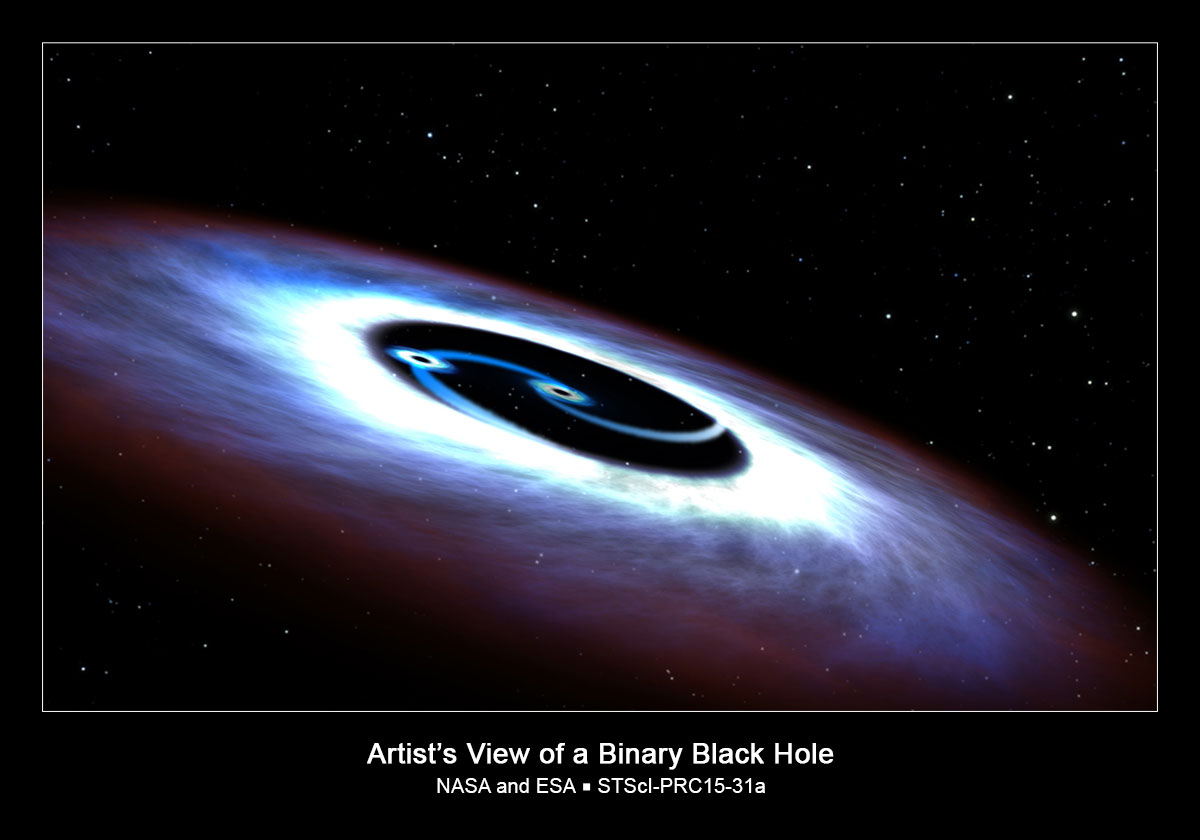
    This artistic illustration is of a binary black hole found in the center of the nearest quasar to Earth, Markarian 231. Credit: NASA, ESA, and G. Bacon (STScI)

    Using NASA’s Hubble Space Telescope, a team of astronomers discovered that Markarian 231 is powered by two central black holes furiously whirling about each other. Markarian 231 is the nearest galaxy to Earth that hosts a quasar, located 581 million light-years away.

    The finding suggests that quasars—the brilliant cores of active galaxies – may commonly host two central supermassive black holes, which fall into orbit about one another as a result of the merger between two galaxies. Like a pair of whirling skaters, the black-hole duo generates tremendous amounts of energy that makes the core of the host galaxy outshine the glow of its population of billions of stars, which scientists then identify as quasars.

    Scientists looked at Hubble archival observations of ultraviolet radiation emitted from the center of Markarian 231 (Mrk 231) to discover what they describe as “extreme and surprising properties.”

    If only one black hole were present in the center of the quasar, the whole accretion disk made of surrounding hot gas would glow in ultraviolet rays. Instead, the ultraviolet glow of the dusty disk abruptly drops off toward the center. This provides observational evidence that the disk has a big donut hole encircling the central black hole. The best explanation for the donut hole in the disk, based on dynamical models, is that the center of the disk is carved out by the action of two black holes orbiting each other. The second, smaller black hole orbits in the inner edge of the accretion disk, and has its own mini-disk with an ultraviolet glow.

    “We are extremely excited about this finding because it not only shows the existence of a close binary black hole in Mrk 231, but also paves a new way to systematically search binary black holes via the nature of their ultraviolet light emission,” said Youjun Lu of the National Astronomical Observatories of China, Chinese Academy of Sciences.

    “The structure of our universe, such as those giant galaxies and clusters of galaxies, grows by merging smaller systems into larger ones, and binary black holes are natural consequences of these mergers of galaxies,” added co-investigator Xinyu Dai of the University of Oklahoma.

    The central black hole is estimated to be 150 million times the mass of our sun, and the companion weighs in at 4 million solar masses. The dynamic duo completes an orbit around each other every 1.2 years.

    The lower-mass black hole is the remnant of a smaller galaxy that merged with Mrk 231. Evidence of a recent merger comes from the host galaxy’s asymmetry, and the long tidal tails of young blue stars.

    The result of the merger has been to make Mrk 231 an energetic starburst galaxy with a star formation rate 100 times greater than that of our Milky Way galaxy. The infalling gas fuels the black holes’ “engine”, triggering outflows and gas turbulence that incites a firestorm of star birth.

    The binary black holes are predicted to spiral together and collide within a few hundred thousand years.

    Mrk 231 is located 600 million light-years away.

    The results were published in the August 14, 2015 edition of The Astrophysical Journal.

    Reference: “A probable Milli-Parsec Supermassive Binary Black Hole in the Nearest Quasar Mrk 231” by Chang-Shuo Yan, Youjun Lu, Xinyu Dai and Qingjuan Yu, 14 August 2015, The Astrophysical Journal.
    DOI: 10.1088/0004-637X/809/2/117
    arXiv: 1508.06292

    Never miss a breakthrough: Join the SciTechDaily newsletter.
    Follow us on Google and Google News.

    Astronomy Astrophysics Black Hole Hubble Space Telescope NASA Popular Quasars
    Share. Facebook Twitter Pinterest LinkedIn Email Reddit

    Related Articles

    The Big Bang’s Dark Legacy Revealed by Hubble: Unexpected Black Holes

    Star Swarms Reveal a Hidden Beast: NASA’s Hubble Hunts for Black Hole Close to Earth

    Hubble Finds Phantom Imprint in Space Revealing Black Hole Roaming Our Milky Way Galaxy

    Scouting Active Supermassive Black Holes With NASA’s Webb Space Telescope

    Gas Far Outside of Our Galaxy Illuminated by Enormous Burst of Energy Unleashed by Milky Way’s Black Hole

    OwO What’s This? Astronomers Study Galactic Bulge for Clues to Black Hole Mystery

    5,000 Light Year Long Jet of Superheated Gas Ejected From a Supermassive Black Hole

    Hubble and VLA View Elliptical Galaxy Hercules A

    Scientists Search for Quasar’s “Missing” Galaxy

    1 Comment

    1. Nelson Simonson on August 31, 2015 4:49 am

      What is the likelihood of finding three or more black holes orbiting each other? Is there any theoretical evidence that this is possible?

      Reply
    Leave A Reply Cancel Reply

    • Facebook
    • Twitter
    • Pinterest
    • YouTube

    Don't Miss a Discovery

    Subscribe for the Latest in Science & Tech!

    Trending News

    Even Occasional Binge Drinking May Triple Liver Damage Risk

    Liftoff! NASA’s Artemis II Launch Sends Astronauts Around the Moon for First Time in 50 Years

    Scientists Discover New Way To Eliminate “Zombie Cells” Driving Aging

    This New Quantum Theory Could Change Everything We Know About the Big Bang

    This One Vitamin May Help Protect Your Brain From Dementia Years Later

    Stopping Weight-Loss Drugs Like Ozempic Can Quickly Erase Heart Benefits

    A 500-Million-Year-Old Surprise Is Forcing Scientists to Rethink Spider Evolution

    Coffee and Blood Pressure: What You Need To Know Before Your Next Cup

    Follow SciTechDaily
    • Facebook
    • Twitter
    • YouTube
    • Pinterest
    • Newsletter
    • RSS
    SciTech News
    • Biology News
    • Chemistry News
    • Earth News
    • Health News
    • Physics News
    • Science News
    • Space News
    • Technology News
    Recent Posts
    • Tiny 436-Million-Year-Old Fish Fossil Rewrites the Origins of Vertebrates
    • 1,800 Miles Down: Scientists Uncover Mysterious Movements at the Edge of Earth’s Core
    • Scientists Uncover Earth’s Hidden “Gold Kitchen” Beneath the Ocean Floor
    • You Don’t Need To Be Rich: New Study Reveals a Simple Life Is the Real Secret to Happiness
    • “Crazy Dice” Help Scientists Prove Only One 150-Year-Old Theory About Randomness Works
    Copyright © 1998 - 2026 SciTechDaily. All Rights Reserved.
    • Science News
    • About
    • Contact
    • Editorial Board
    • Privacy Policy
    • Terms of Use

    Type above and press Enter to search. Press Esc to cancel.