
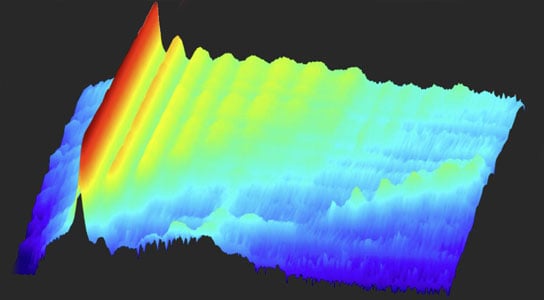
By targeting super-thin aluminum with X-rays at LCLS, scientists were able to analyze and pinpoint how much energy it takes to knock electrons from highly charged atoms in a dense plasma, providing possible insight into nuclear fusion and the inner workings of stars.
The first controlled studies of extremely hot, dense matter have overthrown the widely accepted 50-year-old model used to explain how ions influence each other’s behavior in a dense plasma. The results should benefit a wide range of fields, from research aimed at tapping nuclear fusion as an energy source to understanding the inner workings of stars.
The study also demonstrates the unique capabilities of the Linac Coherent Light Source (LCLS) X-ray laser at the U.S. Department of Energy (DOE)’s SLAC National Accelerator Laboratory. While researchers have created extremely hot and dense plasmas before, LCLS allows them to measure the detailed properties of these states and test a fundamental class of plasma physics for the first time ever.
Plasma is sometimes referred to as the fourth state of matter – alongside solid, liquid, and gas – and in this case, it was hundreds of times hotter than the surface of the sun (2 million kelvins or 3.6 million degrees Fahrenheit). These measurements, reported by an international team of researchers and published this week in Physical Review Letters, contradict the prevailing model that scientists have used for a half-century to understand the conditions inside plasmas.
“We don’t think this could have been done elsewhere,” said Justin Wark, leader of a group at Oxford University that participated in the study. “Having an X-ray laser is key.”
The international research team, which made the plasma by targeting super-thin aluminum with X-rays at LCLS, reported its initial results in January. Now, in a second study based on a new analysis of data from the same experiment, the group tackled another question: How are atoms in such a hot, dense plasma affected by their environment?
The researchers were able to pinpoint how much energy it takes to knock electrons from highly charged atoms in a dense plasma. “That’s a question no one’s been able to test properly before,” said Orlando Ciricosta of Oxford University and lead author of the study, which included scientists from three DOE national laboratories.
The LCLS offers a unique test bed for these studies: It provides a very controlled environment for measuring extreme phenomena, a laser beam with finely tuned energies and a way to precisely measure the properties of a plasma at a specific solid density.
The new analysis gives insight into the sorts of plasmas scientists need to create in some experimental approaches to fusion, the process that powers stars, in which the cores of super-condensed atoms combine and release massive amounts of energy. The research may lead to improved modeling for certain aspects of fusion, as it gives detailed information about the process where tightly packed atoms begin to lose their autonomy as the orbits of their associated electrons overlap.
Scientists use complicated algorithms that may include millions of lines of code to simulate the behavior of superheated matter and build better models of how fusion works.
“Even very sophisticated computer codes used to simulate dense plasmas usually employ an old model from 1966 to simulate the effects of the plasma environment,” Ciricosta said. “Our work at the LCLS has shown that this widely used model does not fit the data. In an extraordinary twist of fate, it turns out that an even earlier approach from 1963 does a far better job.”
Wark said he expects the findings will have “significant impact” in the plasma physics community, as the 1963 model can be easily applied to improve existing simulations in a range of fields. However, the complete physics is still far from clear, and he cautioned that more testing and refinement may be necessary.
“We’re not going to claim any current model works under all conditions and works for everything,” he said. “We would really like people to go and revisit this problem, to see if they can come up with something even more sophisticated.”
Reference: “Direct Measurements of the Ionization Potential Depression in a Dense Plasma” by O. Ciricosta et al., 6 August 2012, Physical Review Letters.
DOI: 10.1103/PhysRevLett.109.065002
Wark’s team included researchers from Oxford; SLAC; Lawrence Berkeley National Laboratory; Lawrence Livermore National Laboratory; University of California – Berkeley; the International Atomic Energy Agency in Austria; the Plasma Physics Department at AWE in the United Kingdom; the Institute of Physics ASCR in the Czech Republic; and DESY and the Friedrich-Schiller University in Germany.
Never miss a breakthrough: Join the SciTechDaily newsletter.
Follow us on Google and Google News.