
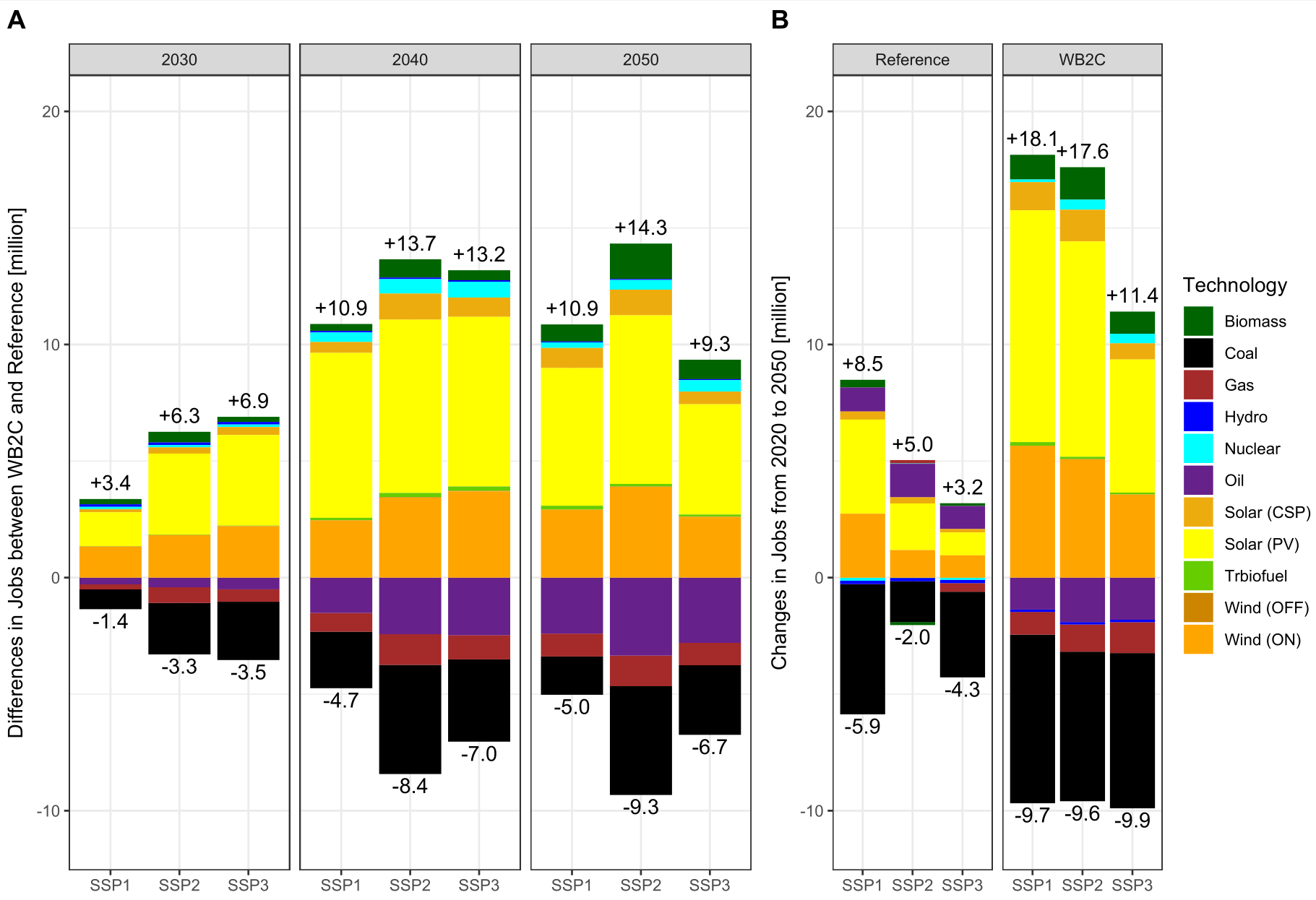
Climate action could add 8 million energy jobs by 2050, driven by renewable growth and fossil job declines.
Researchers created a global dataset of job footprints in 50 countries and used a model to investigate how trying to meet the Paris Agreement global climate target of staying well below 2°C (3.6°F) would affect energy sector jobs. They found that action to reach said target would increase net jobs by about 8 million by 2050, primarily due to gains in the solar and wind industries. The analysis was published on July 23, 2021, in the journal One Earth.
“Currently, an estimated 18 million people work in the energy industries — a number that is likely to increase, not decrease, to 26 million or by over 50% if we reach our global climate targets,” says corresponding author Johannes Emmerling, an environmental economist at the RFF-CMCC European Institute on Economics and the Environment in Italy. “Manufacturing and installation of renewable energy sources could potentially become about one third of the total of these jobs, for which countries can also compete in terms of location.”
The study conducted by Emmerling and colleagues is the first based on a comprehensive dataset of over 50 countries, including major fossil fuel producing economies. The team combined this dataset with an integrated assessment model to make job projections. The model helps see how the development of humans and the choices societies make affect each other. Almost all previous analyses relied on jobs data for OECD countries and generalized the results for the rest of the world using a multiplier.
“The energy transition is increasingly being studied with very detailed models, spatial resolutions, timescales, and technological details,” says Emmerling. “Yet, the human dimension, energy access, poverty, and also distributional and employment implications are often considered at a high level of detail. We contributed to this gap by collecting and applying a large dataset across many countries and technologies that can also be used in other applications.”
Renewables Set to Dominate Energy Jobs
In the researcher’s model, of the total jobs in 2050, 84% would be in the renewables sector, 11% in fossil fuels, and 5% in nuclear. While fossil fuel extraction jobs, which constitute 80% of current fossil fuel jobs, would rapidly decline, these losses will be compensated by gains in solar and wind manufacturing jobs.
“Extraction sector jobs are more susceptible to decarbonization, so there needs to be just transition policies in place,” says first author Sandeep Pai, who recently graduated with a Ph.D. in Resources, Environment, and Sustainability at The University of British Columbia. “For example, the mobility of manufacturing jobs will be useful in areas where decarbonization is rife. In many cases, fossil fuel workers also hold political influence because of their history and high rates of unionization among others, so as we move to low carbon sources, it is important to have a plan in place for the general acceptability of climate policies.”
The researcher’s next goal is to explore the shifts in skill levels, education requirements, and wages that may result from trying to meet the global climate target of the Paris Agreement. They also anticipate that, since this is accessible to all these different groups around the world, it will inspire other data analysts to use it for running multiple scenarios, further clarifying the extent of jobs.
Reference: “Meeting well-below 2°C target would increase energy sector jobs globally” by Sandeep Pai, Johannes Emmerling, Laurent Drouet, Hisham Zerriffi and Jessica Jewell, 23 July 2021, One Earth.
DOI: 10.1016/j.oneear.2021.06.005
This work was supported by the “Contractions project” funded by the Norwegian Research Council and the European Union’s Horizon 2020 research and innovation program.
Never miss a breakthrough: Join the SciTechDaily newsletter.
Follow us on Google and Google News.
5 Comments
Maybe so, but one job placing panels on a roof yields no where near as many btus as one job mining coal. The roof top job is also likely more dangerous than a modern long wall operation job.
BTUs don’t matter much if the earth becomes so polluted / hot it can’t sustain human life anymore.
I’ll say only one thing. Greenwashing.
Per capita primary energy use is 300GJ/yr in the US.
One 250W solar panel makes only 1.1GJ/yr in the US NW and solar generation is 5 times better in summer than winter with spring and fall in the middle so 1,3,5,3 as total 12 blocks, so winter has lost 2 units to summer. So 1/6 of all solar production is 6 months away from when it is most needed.
This is not a good story, every citizen would need several hundred panels to cover their entire energy footprint if all solar and it will have to be considerably over provisioned to cover winter which will only get 1/3 of need. If over provisioning is about 60% and the super excess of extended summer is converted to chemical energy (forget about long term battery storage) the now smaller loss of winter can be covered from the stored chemical energy from summer. This makes for a very complicated system with losses in electrical to chemical and back to electrical repacing the intermittency problem. But the chemical industry will only be turning solar into hydrogen ouside of winter, so their capacity factor will be lower too. And the hydrogen will likely have to be fed into other energy consuming processes to make more stable fuels which could be used as is rather than turned back to electricty so we stay on a mixed electric chemical path rather than head towards a pure electric path.
People don’t get that intermitency is vastly harder to solve than having baseload, indeed the greens have decalred that baseload or even load following is old school, and complexity in energy storage is good. That is just plain wrong. The real devil is that the greens are hiding behind natural gas pretneding that all solar on the grid is good but ignoring the nat gas the fills in the gaps. In Germany they hide behind brown coal, no CO2 reductions for them.
Well BP is proud to talk up it’s green creds on TV when it talks about Ridgemont high wind turbines in the windiest part of the US where there is always wind, except when there isn’t. Turns out the capacity factor of wind is only 28% with 72% of the energy coming from BP’s favorite source, nat gas. It’s right on the website, but it was not on the TV ads. So greenwashing everywhere. They did it again for London solar array, UK solar capacity factor is terrible only 11% so rated power output would be avg 11% of the peak nameplate.
If Molten salt nuclear ever gets going though it won’t provide that many jobs relative to solar but would provides orders of magnitude more energy per job provided and that is a good thing.
What is the polution and energy cost of manufacturing new solar panels, instead of using the existing electric generation that has already been built? Does 1 square meter of solar panel produce more electricity than 1 square meter of solar corn crops? Which absorbs more CO2, plant crops or solar panels? What are the polution costs and losses of storing solar energy in a battery compared to storing solar energy in a corn silo? Why not ban Air Conditioning and limit electrical demand? Does Air Conditioning pollution increase global warming, and then global warming increases demand for AC? Does walking, bike riding and taking the bus reduce electrical demand, pollution, and warming? Is reducing consumption and removing the luxury of charging your battery car an option?