
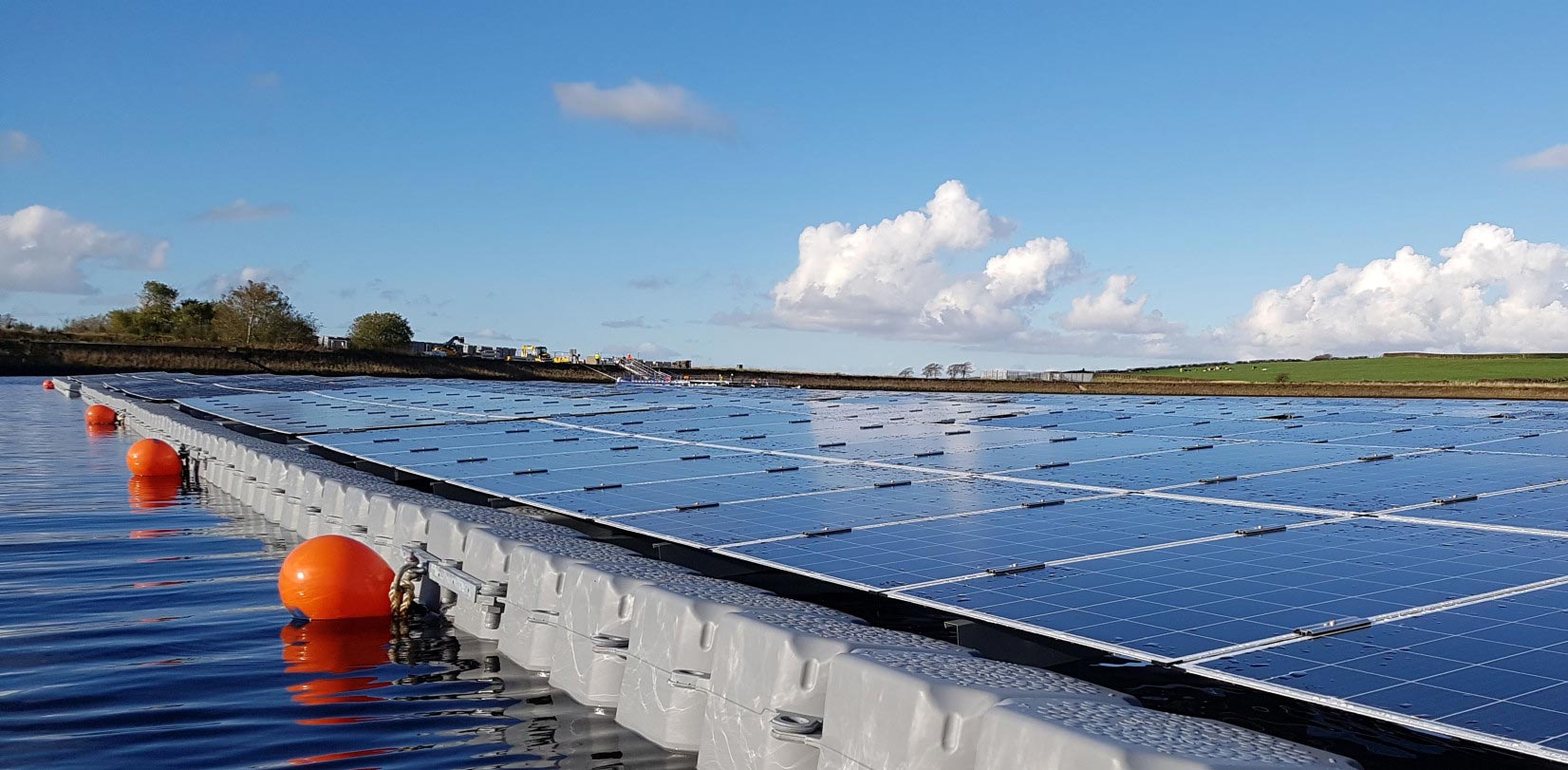
Scientists from Lancaster University and the University of Stirling have completed the first detailed modeling of the environmental effects of floating solar installations on bodies of water.
Floating solar farms could help to protect lakes and reservoirs from some of the harms of climate change, a new study suggests.
However, given the complex nature of water bodies and differing designs of solar technologies, there could also be detrimental ecosystem impacts of deploying floating solar arrays.
Conventional solar farms are controversial due to the amount of land they take up. This is leading to increasing interest in floating solar farms — making use of the additional space that bodies of water provide.
So far, there are three commercial-size floating solar arrays in the UK, and hundreds more across the world. The number of installations is likely to grow significantly in coming decades as demand rises for renewable energy sources with more countries committing to net zero carbon targets.
However, little is known about the impacts — both positive and negative — these floating solar farms are having on the lakes and reservoirs they are installed on — until now.
Scientists from Lancaster University and the University of Stirling have completed the first detailed modeling of the environmental effects of floating solar installations on bodies of water.
“As demand for land increases, water bodies are increasingly being targeted for renewable energy. Deployment of solar on water increases electricity production, but it is critical to know if there will be any positive or negative environmental consequences,” said Mr. Giles Exley, PhD researcher and lead author from Lancaster University.
“Given the relative immaturity of floating solar farms, it is important to further scientific evidence of the impacts. Our results provide initial insight of the key effects that will help inform water body manager and policymaker decisions.”
The research team undertook computer modeling using the MyLake simulation program and data collected by the UK’s Centre for Ecology and Hydrology from England’s largest lake, Windermere. Although the researchers believe it is unlikely floating solar farms will be deployed on Windermere, it presents a rich data-set as it is one of the most comprehensively studied lakes in the world.
Their results show that floating solar arrays can cool water temperatures by shading the water from the sun. At scale, this could help to mitigate against harmful effects caused by global warming, such as blooms of toxic blue green algae, and increased water evaporation, which could threaten water supply in some regions.
The scientists found that floating solar installations also reduce the duration of ‘stratification’ — this is where the sun heats the water, forming distinct layers of water at different temperatures. This tends to happen more in the warmer summer months and can result in the bottom layer of water becoming deoxygenated, which deteriorates water quality — an obvious issue for supplies of drinking water. However, the picture is complex and there are also conditions under which stratification, and therefore detrimental water quality impacts, could increase if floating solar farms are deployed.
Mr. Exley said: “The effects of floating solar on the temperature of the water body and stratification, both of which are major drivers of biological and chemical processes, could be comparable in magnitude to the changes lakes will experience with climate change. Floating solar could help to mitigate against the negative effects global warming will have on these bodies of water.”
“However, there are also real risks of detrimental impacts, such as deoxygenation causing undesirable increases in nutrient concentrations and killing fish. We need to do more research to understand the likelihood of both positive and negative impacts.”
The effects on water temperature increased the larger the solar installation, with small arrays of less than ten percent of the lake surface generally having minimal impacts. However, this model concentrated on one lake. Further studies will be needed to determine the optimum size array, and design, and their effects for individual lakes and reservoirs — all of which have unique characteristics. Different designs of solar installations also have different shading and sheltering effects for the sun and wind.
Arrays covering more than 90 percent of a lake could increase the chances of the lake freezing over in winter, the study found — though these effects would also be specific to the body of water and design of the installation and require further studying.
Field studies and further modeling work to build on these initial findings is ongoing.
Reference: “Floating photovoltaics could mitigate climate change impacts on water body temperature and stratification” by Giles Exley, Alona Armstrong, Trevor Page and Ian D. Jones, 4 March 2021, Solar Energy.
DOI: 10.1016/j.solener.2021.01.076
Never miss a breakthrough: Join the SciTechDaily newsletter.
Follow us on Google and Google News.
4 Comments
… yeah, the heat would not come to the bottom of the lake, after all. An easy cheat…
The big problem, is that solar energy sites CAUSE global warming. A study was done on covering just 20% of the Sahara desert, and it showed a local temperature rise of about 2°F, but would raise the global temperature by over 1.5° F, and the polar caps by over 2°F. They also cause more draughts due to the heat generated by the panels.
So, no, solar power ISN’T the solution.
… yeah, the solar power is bad,… if you are on the nuclear power panel,… really…
https://redhotchilipeppers.com/