
Close Menu
    Facebook X (Twitter) Instagram
    SciTechDaily
    • Biology
    • Chemistry
    • Earth
    • Health
    • Physics
    • Science
    • Space
    • Technology
    Facebook X (Twitter) Pinterest YouTube RSS
    SciTechDaily
    Home»Biology»Molecular Code for How PPR Proteins Recognize their RNA Targets Discovered
    Biology

    Molecular Code for How PPR Proteins Recognize their RNA Targets Discovered

    By University of Western AustraliaAugust 17, 2012No Comments3 Mins Read
    Facebook Twitter Pinterest Telegram LinkedIn WhatsApp Email Reddit
    Share
    Facebook Twitter LinkedIn Pinterest Telegram Email Reddit
    scientists have cracked a code underlying recognition of RNA molecules
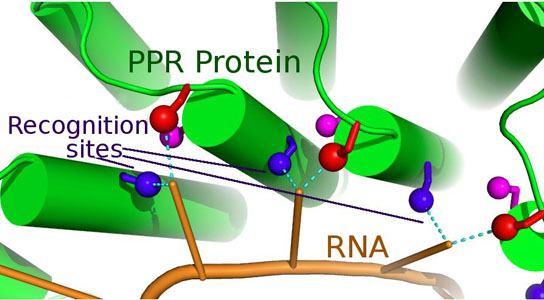
    A molecular model of a PPR protein recognizing a specific RNA molecule. The identity of specific amino acid residues in the protein (colored sticks) determines the sequence of the RNA molecule it can bind. Credit: Charlie Bond

    A team of scientists has cracked a code underlying recognition of RNA molecules by a superfamily of RNA-binding proteins called pentatricopeptide repeat (PPR) proteins, providing a significant step toward the prediction of native binding sites of the enormous number of PPR proteins found in nature.

    Scientists have cracked a molecular code that may open the way to destroying or correcting defective gene products, such as those that cause genetic disorders in humans.

    The code determines the recognition of RNA molecules by a superfamily of RNA-binding proteins called pentatricopeptide repeat (PPR) proteins.

    When a gene is switched on, it is copied into RNA. This RNA is then used to make proteins that are required by the organism for all of its vital functions. If a gene is defective, its RNA copy and the proteins made from this will also be defective. This forms the basis of many terrible genetic disorders in humans.

    RNA-binding PPR proteins could revolutionize the way we treat disease. Their secret is their versatility — they can find and bind a specific RNA molecule, and have the capacity to correct it if it is defective, or destroy it if it is detrimental. They can also help ramp up production of proteins required for growth and development.

    The new paper in PLOS Genetics describes for the first time how PPR proteins recognize their RNA targets via an easy-to-understand code. This mechanism mimics the simplicity and predictability of the pairing between DNA strands described by Watson and Crick 60 years ago, but at a protein/RNA interface.

    This exceptional breakthrough comes from an international, interdisciplinary research team including UWA researchers Professor Ian Small and Aaron Yap from the ARC Center for Excellence in Plant Energy Biology and Professor Charlie Bond and Yee Seng Chong from UWA’s School of Chemistry and Biochemistry, along with Professor Alice Barkan’s team at the University of Oregon. This research was publicly funded by the ARC and the WA State Government in Australia and the NSF in the USA.

    “Many PPR proteins are vitally important, but we don’t know what they do. Now we’ve cracked the code, we can find out,” said ARC Plant Energy Biology Director Ian Small.

    “What’s more, we can now design our own synthetic proteins to target any RNA sequence we choose – this should allow us to control the expression of genes in new ways that just weren’t available before. The potential is really exciting.”

    “This discovery was made in plants but is applicable across many species as PPR proteins are found in humans and animals too,” says Professor Bond.

    Reference: “A Combinatorial Amino Acid Code for RNA Recognition by Pentatricopeptide Repeat Proteins” by Alice Barkan, Margarita Rojas, Sota Fujii, Aaron Yap, Yee Seng Chong, Charles S. Bond and Ian Small, 16 August 2012, PLOS Genetics.
    DOI: 10.1371/journal.pgen.1002910

    Never miss a breakthrough: Join the SciTechDaily newsletter.
    Follow us on Google and Google News.

    Biochemistry Genetics Popular RNA University of Western Australia
    Share. Facebook Twitter Pinterest LinkedIn Email Reddit

    Related Articles

    Evolution Reconstructed: New Proteins “Out of Nothing”

    RNA Molecules Are Masters of Their Own Destiny – Regulating Their Own Production Through a Feedback Loop

    Rare Quadruple-Helix DNA Found in Living Human Cells With Glowing Probes

    A Surprisingly Simple Biochemistry Rule Drives the Evolution of Useless Complexity

    Biology Textbooks Wrong? New Research Reveals the Secret Behind a Key Cellular Process

    Low-Cost Second-Generation Ethanol Production Powered by Genetically Engineered Enzyme Cocktail

    Quadruple Helix DNA Formation Tracked in Live Human Cells for the First Time

    Breakthrough in Understanding Evolution – Mitochondrial Division Conserved Across Species

    Cost-Effective 3-D RNA Modeling Technique

    Leave A Reply Cancel Reply

    • Facebook
    • Twitter
    • Pinterest
    • YouTube

    Don't Miss a Discovery

    Subscribe for the Latest in Science & Tech!

    Trending News

    The Universe Is Expanding Too Fast and Scientists Can’t Explain Why

    “Like Liquid Metal”: Scientists Create Strange Shape-Shifting Material

    Early Warning Signals of Esophageal Cancer May Be Hiding in Plain Sight

    Common Blood Pressure Drug Shows Surprising Power Against Deadly Antibiotic-Resistant Superbug

    Scientists Uncover Dangerous Connection Between Serotonin and Heart Valve Disease

    Scientists Discover a “Protector” Protein That Could Help Reverse Hair Loss

    Bone-Strengthening Discovery Could Reverse Osteoporosis

    Scientists Uncover Hidden Trigger Behind Stem Cell Aging

    Follow SciTechDaily
    • Facebook
    • Twitter
    • YouTube
    • Pinterest
    • Newsletter
    • RSS
    SciTech News
    • Biology News
    • Chemistry News
    • Earth News
    • Health News
    • Physics News
    • Science News
    • Space News
    • Technology News
    Recent Posts
    • A Common Diabetes Drug May Hold the Key to Stopping HIV From Coming Back
    • Ancient “Syphilis-Like” Disease in Vietnam Challenges Key Scientific Assumptions
    • Drinking Alcohol To Cope in Your 20s Could Damage Your Brain for Life
    • Scientists Crack Alfalfa’s Chromosome Mystery After Decades of Debate
    • Ancient Ant-Plant Alliance Collapses As Predatory Wasps Move In
    Copyright © 1998 - 2026 SciTechDaily. All Rights Reserved.
    • Science News
    • About
    • Contact
    • Editorial Board
    • Privacy Policy
    • Terms of Use

    Type above and press Enter to search. Press Esc to cancel.