
Close Menu
    Facebook X (Twitter) Instagram
    SciTechDaily
    • Biology
    • Chemistry
    • Earth
    • Health
    • Physics
    • Science
    • Space
    • Technology
    Facebook X (Twitter) Pinterest YouTube RSS
    SciTechDaily
    Home»Earth»MSG-3 Weather Satellite Captures Its First Image of Earth
    Earth

    MSG-3 Weather Satellite Captures Its First Image of Earth

    By European Space AgencyAugust 7, 20121 Comment3 Mins Read
    Facebook Twitter Pinterest Telegram LinkedIn WhatsApp Email Reddit
    Share
    Facebook Twitter LinkedIn Pinterest Telegram Email Reddit
    MSG-3 weather satellite image
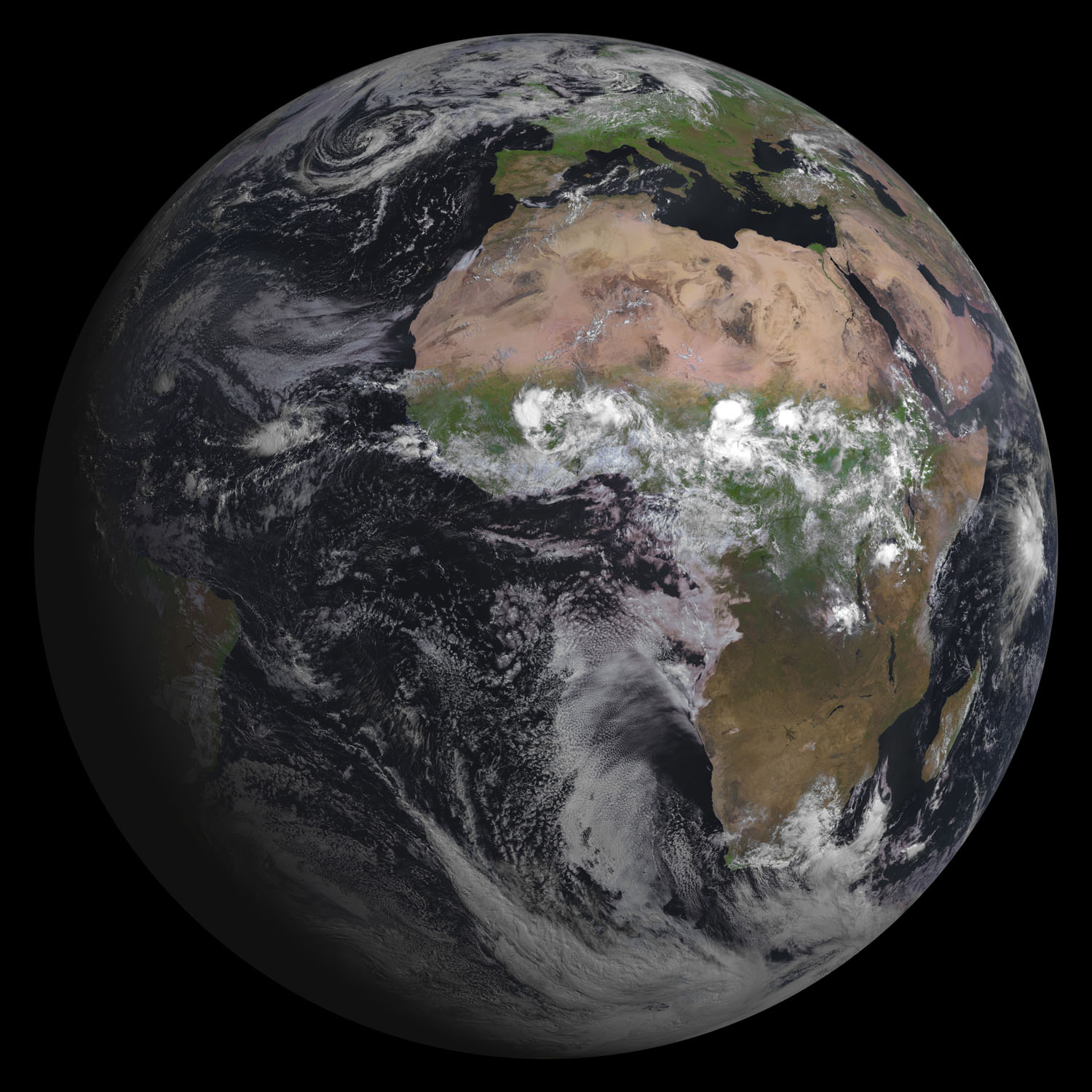
    MSG-3 first image of Earth, acquired on August 7, 2012 by its Spinning Enhanced Visible and Infrared Imager (SEVIRI). Credit: Eumetsat

    Launched on July 5, the MSG-3 weather satellite used the Spinning Enhanced Visible and Infrared Imager (SEVIRI) instrument to capture its first image of Earth.

    Today, the Spinning Enhanced Visible and Infrared Imager (SEVIRI) instrument on MSG-3 captured its first image of the Earth. This demonstrates that Europe’s latest geostationary weather satellite, launched on 5 July, is performing well and is on its way to taking over operational service after six months of commissioning.

    The European Space Agency (ESA) was responsible for the initial operations after launch (the so-called launch and early orbit phase) of MSG-3 and handed over the satellite to EUMETSAT on 16 July.

    The first image is a joint achievement by ESA, EUMETSAT, and the European space industry. For its mandatory programs, EUMETSAT relies on ESA for the development of new satellites and the procurement of recurrent satellites like MSG-3. This cooperation model has made Europe a world leader in satellite meteorology by making the best use of the respective expertise of the two agencies.

    About Meteosat Second Generation

    MSG is a joint program undertaken by ESA and EUMETSAT. ESA is responsible for the development of satellites fulfilling user and system requirements defined by EUMETSAT and of the procurement of recurrent satellites on its behalf. ESA also performs the Launch and Early Orbit Phase operations required to place the spacecraft in geostationary orbit, before handing it over to EUMETSAT for exploitation.

    EUMETSAT develops all ground systems required to deliver products and services to users and to respond to their evolving needs, procures launch services and operates the full system for the benefit of users.

    MSG-3 is the third in a series of four satellites introduced in 2002. These spin-stabilised satellites carry the primary Spinning Enhanced Visible and Infrared Imager, or SEVIRI. The prime contractor for the MSG satellites is Thales Alenia Space, with the SEVIRI instrument built by Astrium.

    SEVIRI delivers enhanced weather coverage over Europe and Africa in order to improve very short-range forecasts, in particular for rapidly developing thunder storms or fog. It scans Earth’s surface and atmosphere every 15 minutes in 12 different wavelengths, to track cloud development.

    SEVIRI can pick out features as small as a kilometer across in the visible bands, and three kilometers in the infrared.

    In addition to its weather-watching mission and collection of climate records, MSG-3 has two secondary payloads.

    The Geostationary Earth Radiation Budget sensor measures both the amount of solar energy that is reflected back into space and the infrared energy radiated by the Earth system, to better understand climate processes.

    A Search & Rescue transponder will turn the satellite into a relay for distress signals from emergency beacons.

    The MSG satellites were built in Cannes, France, by a European industrial team led by Thales Alenia Space, France. More than 50 subcontractors from 13 European countries are involved.

    The last of the series, MSG-4, is planned for launch in 2015.

    Never miss a breakthrough: Join the SciTechDaily newsletter.
    Follow us on Google and Google News.

    European Space Agency Satellites Weather
    Share. Facebook Twitter Pinterest LinkedIn Email Reddit

    Related Articles

    Strange Times Meet Strange Clouds: Noctilucent or “Night Shining” Clouds

    ESA’s Earth Explorer Satellite SMOS Monitoring Droughts [Video]

    Severe Drought in the Czech Republic Visible From Space

    Aeolus Space Mission Goes Public – Already Hailed a Success

    For 7 Years Proba-V Monitored the Daily Growth of All Earth’s Vegetation – Now It Has a New Mission

    Surprising Trigger Identified for Explosive Eruption of Hawaii’s Kilauea Volcano

    Space Storm Hunter Captures First Images and Data

    Effects of Drought in the U.S. are Now Visible from Space

    Cryosat Mission Took Detailed Data of Polar Ice Caps

    1 Comment

    1. Griff on October 8, 2012 12:02 pm

      Amazing images of our wonderful little world. Sad to think one day humanity will have to move from it.

      Reply
    Leave A Reply Cancel Reply

    • Facebook
    • Twitter
    • Pinterest
    • YouTube

    Don't Miss a Discovery

    Subscribe for the Latest in Science & Tech!

    Trending News

    Breakthrough Bowel Cancer Trial Leaves Patients Cancer-Free for Nearly 3 Years

    Natural Compound Shows Powerful Potential Against Rheumatoid Arthritis

    100,000-Year-Old Neanderthal Fossils in Poland Reveal Unexpected Genetic Connections

    Simple “Gut Reset” May Prevent Weight Gain After Ozempic or Wegovy

    2.8 Days to Disaster: Scientists Warn Low Earth Orbit Could Suddenly Collapse

    Common Food Compound Shows Surprising Power Against Superbugs

    5 Simple Ways To Remember More and Forget Less

    The Atomic Gap That Could Cost the Semiconductor Industry Billions

    Follow SciTechDaily
    • Facebook
    • Twitter
    • YouTube
    • Pinterest
    • Newsletter
    • RSS
    SciTech News
    • Biology News
    • Chemistry News
    • Earth News
    • Health News
    • Physics News
    • Science News
    • Space News
    • Technology News
    Recent Posts
    • Scientists Discover Stem Cells That Could Regrow Teeth and Bone
    • Scientists Discover Natural Molecule That Stops Alzheimer’s Protein Clumps From Forming
    • Early Cannabis Use May Stall Key Brain Skills in Teens
    • Popular Vitamin D Supplement Has “Previously Unknown” Negative Effect, Study Finds
    • Powerful Antioxidant Found To Play a Key Role in Proper Protein Folding
    Copyright © 1998 - 2026 SciTechDaily. All Rights Reserved.
    • Science News
    • About
    • Contact
    • Editorial Board
    • Privacy Policy
    • Terms of Use

    Type above and press Enter to search. Press Esc to cancel.