
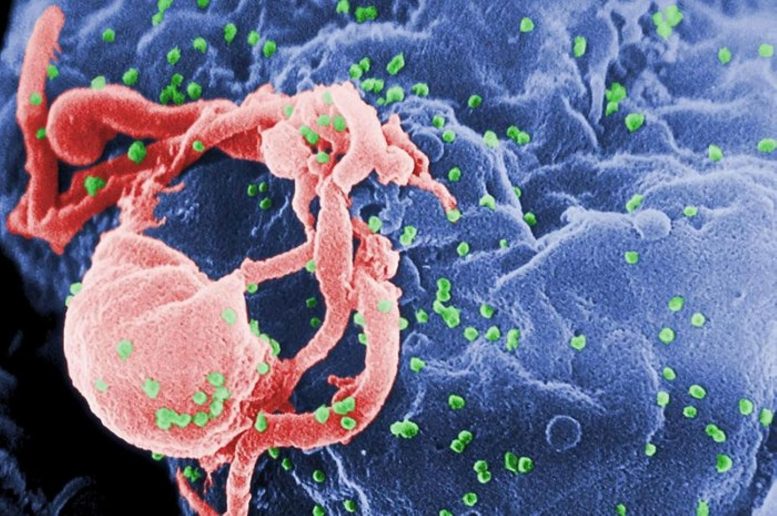
In a newly published study, scientists from Washington University School of Medicine show how nanoparticles carrying melittin fuse with HIV, killing the virus and leaving surrounding cells unharmed.
Nanoparticles carrying a toxin found in bee venom can destroy human immunodeficiency virus (HIV) while leaving surrounding cells unharmed, researchers at Washington University School of Medicine in St. Louis have shown. The finding is an important step toward developing a vaginal gel that may prevent the spread of HIV, the virus that causes AIDS.
“Our hope is that in places where HIV is running rampant, people could use this gel as a preventive measure to stop the initial infection,” says Joshua L. Hood, MD, PhD, a research instructor in medicine.
The study appears in the current issue of the journal Antiviral Therapy.
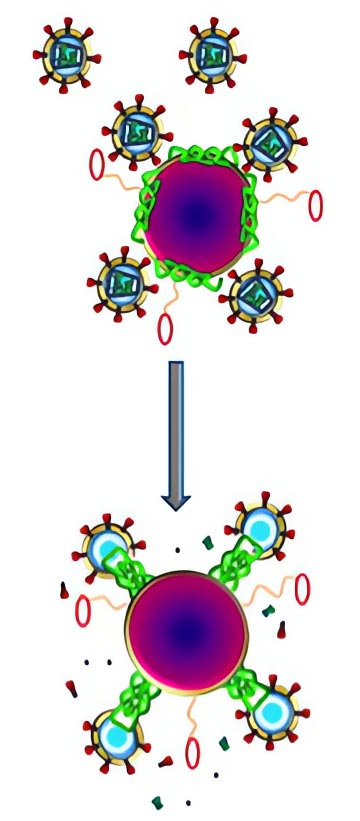
Bee venom contains a potent toxin called melittin that can poke holes in the protective envelope that surrounds HIV, and other viruses. Large amounts of free melittin can cause a lot of damage. Indeed, in addition to anti-viral therapy, the paper’s senior author, Samuel A. Wickline, MD, the J. Russell Hornsby Professor of Biomedical Sciences, has shown melittin-loaded nanoparticles to be effective in killing tumor cells.
The new study shows that melittin loaded onto these nanoparticles does not harm normal cells. That’s because Hood added protective bumpers to the nanoparticle surface. When the nanoparticles come into contact with normal cells, which are much larger in size, the particles simply bounce off. HIV, on the other hand, is even smaller than the nanoparticle, so HIV fits between the bumpers and makes contact with the surface of the nanoparticle, where the bee toxin awaits.
“Melittin on the nanoparticles fuses with the viral envelope,” Hood says. “The melittin forms little pore-like attack complexes and ruptures the envelope, stripping it off the virus.”
According to Hood, an advantage of this approach is that the nanoparticle attacks an essential part of the virus’ structure. In contrast, most anti-HIV drugs inhibit the virus’s ability to replicate. But this anti-replication strategy does nothing to stop initial infection, and some strains of the virus have found ways around these drugs and reproduce anyway.
“We are attacking an inherent physical property of HIV,” Hood says. “Theoretically, there isn’t any way for the virus to adapt to that. The virus has to have a protective coat, a double-layered membrane that covers the virus.”
Beyond prevention in the form of a vaginal gel, Hood also sees potential for using nanoparticles with melittin as therapy for existing HIV infections, especially those that are drug-resistant. The nanoparticles could be injected intravenously and, in theory, would be able to clear HIV from the blood stream.
“The basic particle that we are using in these experiments was developed many years ago as an artificial blood product,” Hood says. “It didn’t work very well for delivering oxygen, but it circulates safely in the body and gives us a nice platform that we can adapt to fight different kinds of infections.”
Since melittin attacks double-layered membranes indiscriminately, this concept is not limited to HIV. Many viruses, including hepatitis B and C, rely on the same kind of protective envelope and would be vulnerable to melittin-loaded nanoparticles.
While this particular paper does not address contraception, Hood says the gel easily could be adapted to target sperm as well as HIV. But in some cases people may only want the HIV protection.
“We also are looking at this for couples where only one of the partners has HIV, and they want to have a baby,” Hood says. “These particles by themselves are actually very safe for sperm, for the same reason they are safe for vaginal cells.”
While this work was done in cells in a laboratory environment, Hood and his colleagues say the nanoparticles are easy to manufacture in large enough quantities to supply them for future clinical trials.
Reference: “Cytolytic nanoparticles attenuate HIV-1 infectivity” by Joshua L Hood, Andrew P Jallouk, Nancy Campbell, Lee Ratner and Samuel A Wickline, 1 January 2013, Antiviral Therapy.
DOI: 10.3851/IMP2346
Never miss a breakthrough: Join the SciTechDaily newsletter.
Follow us on Google and Google News.
2 Comments
If you compare a unicellular bacteria to a virus , it is like comparing an elephant to a mouse as for as the size is concerned. The weapon that kills and elephant cannot kill a mouse and that is the reason that antibiotics are not acting on viruses being bigger molecules, much larger than the size of a virus. Here Nano-particle can do the job because of its comparable size. The research is good it it can tackle corona viruses such as HIV. Thank You.
Is that bee venom cure for hiv is only for your people or you want to cure the world from hiv? I also want to say you that India is in the rank no 1 in aids and pakistan is at the 2nd rank .if that cure become a successfull cure so what will you do?will you spread this cure cheaply in this world or not?or you only want dollars ?