
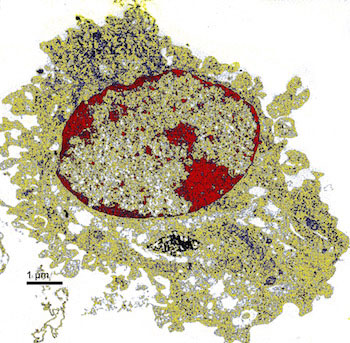
Two new studies identify the black material found in the lungs of smokers who died of emphysema as mostly insoluble nanoparticulate carbon black.
Physicians could only guess – until recently – at the composition of the black material found in the lungs of smokers who died of emphysema.
But research by Baylor College of Medicine and Rice University shows the deposits consist of carbon black nanoparticles that, once embedded in the cells that line the lungs, are impossible to remove.
In new papers in the online publication eLife and the journal Nature Immunology, researchers led by Baylor physicians David Corry and Farrah Kheradmand and Rice chemist James Tour identify the material as mostly insoluble nanoparticulate carbon black, tiny specks that result from the incomplete combustion of such organic material as tobacco. The particles average between 30 and 40 nanometers in size, about half the width of the membrane that surrounds a cell. (By comparison, a human hair is about 75,000 nanometers in diameter.)
Kheradmand, Corry, and their colleagues studied the lungs of mice exposed to cigarette smoke and the lungs of human smokers with emphysema. They found the black material accumulates in the dendritic cells that serve as messengers in the human immune system and in the related antigen-presenting cells of mice.
They sent samples of the material to Tour and his students, who identified it. Ran You, a graduate student in Kheradmand’s lab, then introduced pure nanoparticulate carbon black, in roughly the same proportion of that found in the lungs of human smokers, directly into the noses of mice and found that it caused the animals to develop emphysema.
Tour said the finding is not limited to tobacco smoke. Other products, including tires, contain carbon black nanoparticles in significant amounts.
“I am concerned about how this affects the industry,” Tour said. “It is going to have to change.” He said workers in industries that use carbon black, such as in rubber and plastics manufacturing, could be affected. “As it gets into the air, for example through tire-tread wear, it could affect the public as well, and it is imperative that risk assessments be conducted.”
While carbon black particles about 15 nanometers wide induced the most severe response, Tour said increasing the size of the particles to about 70 nanometers or oxidizing their surfaces greatly reduced their toxicity, based upon data presented in the eLife paper.
Kheradmand and You found the smaller carbon black particles caused double-stranded breaks in the cell’s DNA, a state that is very difficult to repair and activated T helper 17 cells, which induced chronic inflammation in the lungs.
“We showed that it’s dose-dependent,” Kheradmand said. “The more you have, the worse it is. It is also size-dependent. The bigger particles do much less damage.”
“You never get rid of this stuff,” Corry said. “It will be important to conduct further studies to fully assess the spectrum of health-risk profile.”
In the eLife article, the authors wrote: “These findings largely explain the persistent and incurable nature of smoking-related lung disease. Because no medical means of removing accumulated lung nCB (nanoparticulate carbon black) exists, our findings underscore the need for all individuals and societies to minimize the production of and exposure to smoke-related particulate air pollution and industrial nCB.”
In the Nature Immunology article, Corry built upon eLife findings by studying the role of microRNA-22 as a link in the chain from exposure to carbon black to the development of emphysema.
“We used to think of these tiny pieces of genetic material as junk,” Corry said. “Now we know that they are off-switches for protein-coding genes.
“This could be a therapeutic finding. We could design drugs to inhibit the microRNA through inhalation,” he said.
Co-authors of the eLife paper include Lu, Ming Shan, Xiaoyi Yuan, Lizhen Song, and Amanda Hendrix, all of Baylor; former Rice postdoctoral researcher Jacob Berlin of the Beckman Research Institute in Duarte, California; and Errol Samuel, Daniela Marcano, Zhengzong Sun and William Sikkema, all of Rice.
Nature Immunology co-authors include You, Antony Rodrigues, and Tianshu Yang, all of Baylor; and Samuel, Marcano and Sikkema of Rice. Corry, Kheradmand, and Tour were the authors on both reports.
The National Institutes of Health and the U.S. Veterans Affairs Office of Research and Development supported the research.
Kheradmand is a professor of pulmonary medicine at Baylor. Corry is a professor of medicine and chief of the Division of Immunology, Allergy, and Rheumatology at Baylor. Tour is the T.T. and W.F. Chao Chair in Chemistry as well as a professor of materials science and nanoengineering and of computer science.
References:
“Nanoparticulate carbon black in cigarette smoke induces DNA cleavage and TH17-mediated emphysema” by Ran You, Wen Lu, Ming Shan, Jacob M Berlin, Errol LG Samuel, Daniela C Marcano, Zhengzong Sun, William KA Sikkema, Xiaoyi Yuan, Lizhen Song, Amanda Y Hendrix, James M Tour, David B Corry and Farrah Kheradmand, 5 October 2015, eLife.
DOI: 10.7554/eLife.09623
“The microRNA miR-22 inhibits the histone deacetylase HDAC4 to promote TH17 cell–dependent emphysema” by Wen Lu, Ran You, Xiaoyi Yuan, Tianshu Yang, Errol L G Samuel, Daniela C Marcano, William K A Sikkema, James M Tour, Antony Rodriguez, Farrah Kheradmand and David B Corry, 5 October 2015, Nature Immunology.
DOI: 10.1038/ni.3292
Never miss a breakthrough: Join the SciTechDaily newsletter.
Follow us on Google and Google News.