
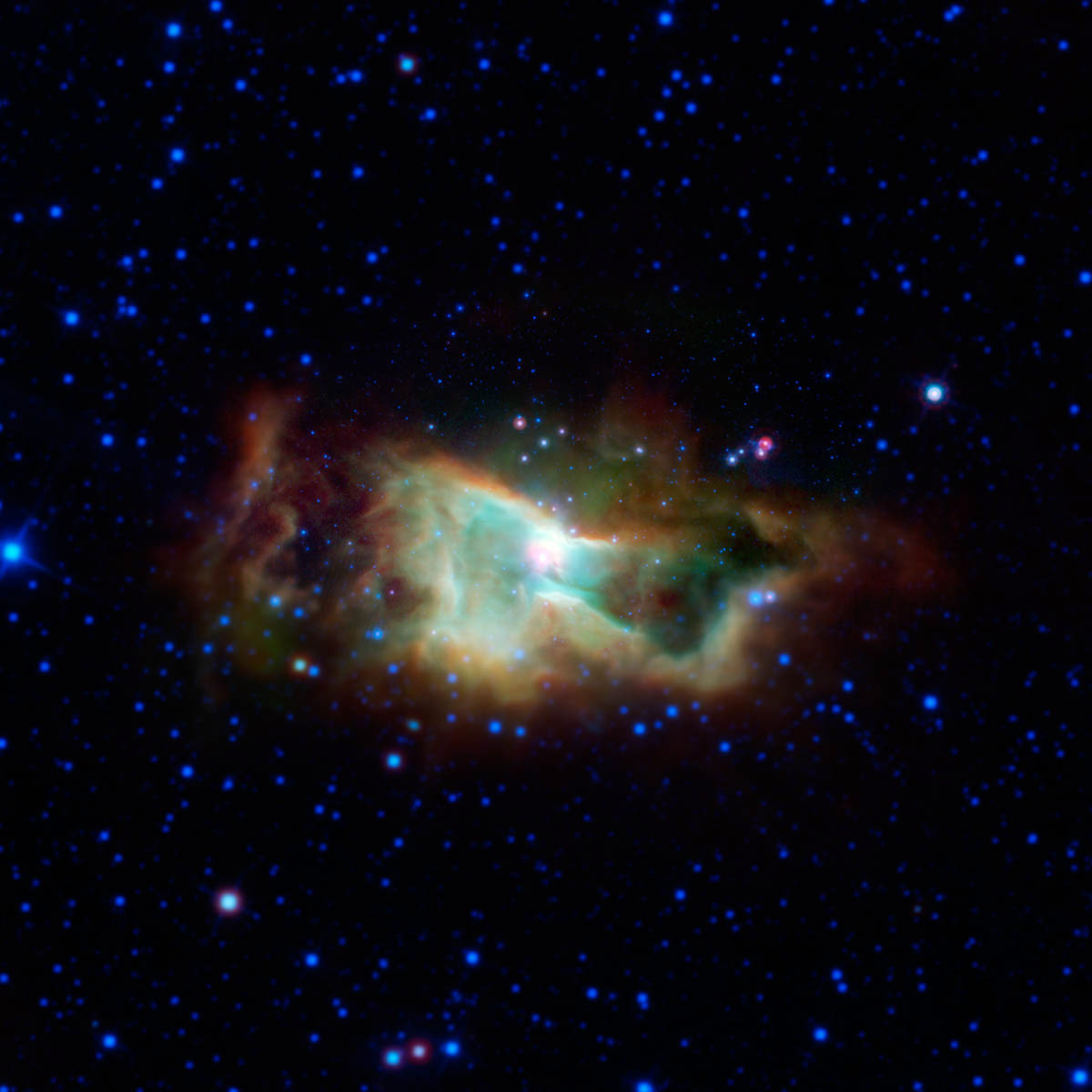
New updates to the PAH Infrared Spectroscopic Database allow scientists to map the distribution of polycyclic aromatic hydrocarbons and track its role across the universe.
Scientists at NASA’s Ames Research Center in Moffett Field, California, released a significant expansion and upgrade to a public, online database that houses a unique and extensive collection of information about a family of complex, carbon-rich molecules that are both widespread and abundant throughout the universe. Scientists believe more than 20 percent of the carbon in the universe is tied up in this extensive family of compounds, collectively know as polycyclic aromatic hydrocarbons, or simply PAHs.
Using the Ames-developed PAH Infrared Spectroscopic Database, scientists will now have access to data on hundreds more compounds and several powerful new tools –including an advanced web app and a dedicated astronomical software package – to map the distribution of this life-essential element and track its role across the universe.
“Analyzing the PAH emission bands with the web app, new tools, and expanded database provides a powerful new way for astronomers to trace the evolution of cosmic carbon and, at the same time, probe conditions across the universe,” said Christiaan Boersma, a research fellow at Ames who designed and developed many parts of the web app and tools. “We have expanded the computational spectral collection to 700 spectra, including those of extremely large PAHs composed of hundreds of carbon atoms, and the experimental collection to 75 spectra.”
Over the past 20 years, NASA scientists experimentally measured and computed PAH spectroscopic signatures to track and analyze the unexpected, widespread PAH emission originating from deep space. NASA made the original collection of spectra and accompanying software available online four years ago.
The approach of analyzing the infrared spectra emitted by everything from dying stars to clouds of gas and dust to entire galaxies using the one-two punch of known PAH spectra and the new, blind, algorithm-driven codes now available, provides a unique look into the evolution of cosmic PAHs.
In addition to substantially increasing the number of spectra available, the new version of the database includes powerful, astronomer-friendly tools that mimic the PAHs’ response to the local space environment and make it possible to understand which types of PAHs are present in different regions of space. It also allows astronomers to tie these evolutionary changes to variations in local conditions such as those due to the radiation field, physical shape, and history of the region.
“PAHs are so widespread and abundant in space that they don’t just witness the conditions in their cosmic neighborhoods, they are active participants in many astronomical phenomena,” said Louis Allamandola, an astrophysics researcher at Ames. “PAHs both are an important source of carbon for young, primordial planets, and influence how quickly they can form. For example, very bright PAH emission comes from places where new stars and exo-planets are forming.”
NASA’s Spitzer Space Telescope managed and operated by NASA’s Jet Propulsion Laboratory in Pasadena, California, detected the PAH signature across the universe and showed PAHs were already forming only a couple of billion years after the Big Bang. Because their spectral signature is very sensitive to their local environment, especially radiation levels, the temperatures of PAHs in space can vary from nearly minus 450 degrees Fahrenheit to roughly 1,000 degrees, after which they break apart.
“Since PAHs are so sensitive to local conditions, analyzing the PAH bands as we did here represents a powerful new astronomical tool to trace the evolution of cosmic carbon and, at the same time, probe conditions in objects spanning the universe,” said Allamandola.
The upgraded database allows scientists to determine how the PAH signature changes across this vast range of temperatures. Astronomers need simply to upload the spectra of their favorite celestial object into the website and see which PAH classes are needed to reproduce their spectra.
“This capability is a major step forward because it allows astronomers to directly tie their astronomical spectra to the spectra of individual, bona-fide PAHs, not generic, model dependent, mythical, cosmic material,” said Allamandola. “And they can do all this on their mobile devices like iPads and iPhones, as well as personal computers.”
PAHs in space are probably made the same way soot is made in the combustion engines that power trucks and cars here on Earth. In addition to astronomical applications, the expanded PAH database and powerful new software also is a useful research tool for scientists, educators, policy makers, and consultants working in the fields of medicine, health, chemistry, fuel composition, engine design, environmental assessment, environmental monitoring and protection, and nanotechnology.
This work was supported by NASA’s Astrobiology and Laboratory Astrophysics Programs and Carbon in the Galaxy Consortium under the auspices of the Astrophysics Research and Analysis Program.
Never miss a breakthrough: Join the SciTechDaily newsletter.
Follow us on Google and Google News.
1 Comment
Polycyclic Aromatic Hydrocarbons or PAH seems to be the precursor of life forming amino-acids. The fact that 20 percent of carbon in the galaxy is locked up in such aromatic hydrocarbons, clearly indicates that life was extra-planetary in origin and got embedded in Earth by most probably comets, which brought the waters of oceans also. The rest of the carbon is trapped in the atmosphere of the planets as CO2 ,CH4(Methane)etc. Since PAH is heat sensitive, the chance of formation of amino-acids are rare. At the outset,life on other planets are possible in the galaxy, but… communicating and contemporary living is remote in the time scale of cosmos, where intelligent beings live only for a miniscule of time of the nature. Thank YOu.