
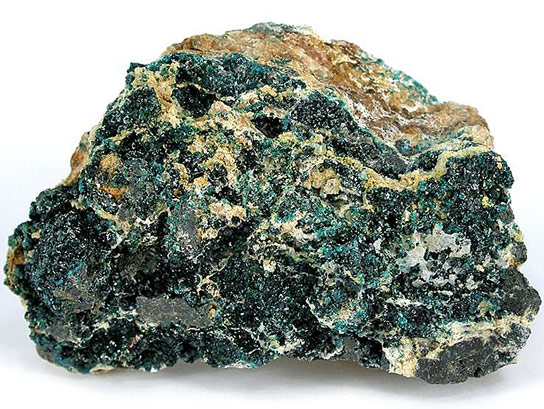
A newly published study provides a detailed analysis of how herbertsmithite’s electrons respond to light, revealing a signature in the optical conductivity of the spin-liquid state that reflects the influence of magnetism on the motion of electrons.
Using low-frequency laser pulses, a team of researchers has carried out the first measurements that reveal the detailed characteristics of a unique kind of magnetism found in a mineral called herbertsmithite.
In this material, the magnetic elements constantly fluctuate, leading to an exotic state of fluid magnetism called a “quantum spin liquid.” This is in contrast to conventional magnetism, found in materials called ferromagnets — where all of the magnetic forces align in the same direction, reinforcing each other — or antiferromagnets, where adjacent magnetic elements align in opposite directions, leading to complete cancellation of the material’s overall magnetic field.
Although a spin-liquid state has previously been observed in herbertsmithite, there has never been a detailed analysis of how the material’s electrons respond to light — a key to determining which of several competing theories about the material is correct.
Now a team at MIT, Boston College, and Harvard University has successfully carried out these measurements. The new analysis is reported in a paper in Physical Review Letters, co-authored by Nuh Gedik, the Biedenharn Career Development Associate Professor of Physics at MIT, graduate student Daniel Pilon, postdoc Chun Hung Lui and four others.
Their measurements, using laser pulses lasting just a trillionth of a second, reveal a signature in the optical conductivity of the spin-liquid state that reflects the influence of magnetism on the motion of electrons. This observation supports a set of theoretical predictions that have not previously been demonstrated experimentally. “We think this is good evidence,” Gedik says, “and it can help to settle what has been a pretty big debate in spin-liquid research.”
“Theorists have provided a number of theories on how a spin-liquid state could be formed in herbertsmithite,” Pilon explains. “But to date there has been no experiment that directly distinguishes among them. We believe that our experiment has provided the first direct evidence for the realization of one of these theoretical models in herbertsmithite.”
The concept of quantum spin liquids was first proposed in 1973, but the first direct evidence for such a material was only found within the last few years. The new measurements help to clarify the fundamental characteristics of this exotic system, which is thought to be closely related to the origins of high-temperature superconductivity.
Gedik says, “Although it is hard to predict any potential applications at this stage, basic research on this unusual phase of matter could help us to solve some very complicated problems in physics, particularly high-temperature superconductivity, which might eventually lead to important applications.” In addition, Pilon says, “This work might also be useful for the development of quantum computing.”
Leon Balents, a professor of physics at the University of California at Santa Barbara who was not involved in this work, says, “If the observed optical conductivity in these measurements is truly intrinsic, it is an important and exciting result, which will be very important in understanding the nature of the spin-liquid state.”
Balents adds that further work is needed to confirm this result, but says “this is clearly an exciting and important measurement, which I hope will be pursued further by extending the frequency and magnetic field range in the future.”
Reference: “Spin-Induced Optical Conductivity in the Spin-Liquid Candidate Herbertsmithite” by D. V. Pilon, C. H. Lui, T. -H. Han, D. Shrekenhamer, A. J. Frenzel, W. J. Padilla, Y. S. Lee and N. Gedik, 18 September 2013, Physical Review Letters.
DOI: 10.1103/PhysRevLett.111.127401
The work was supported by the U.S. Department of Energy, and also included Young Lee and Tian-Heng Han of MIT, David Shrekenhamer and Willie J. Padilla of Boston College, and graduate student Alex J. Frenzel of MIT and Harvard.
Never miss a breakthrough: Join the SciTechDaily newsletter.
Follow us on Google and Google News.
2 Comments
Has anyone out there recognised the fact that there has been an ‘EXPLOSION’ of such experiments as those noted here since, (June 2011) (Take a look back and you’ll see). You will also observe that the upsurge coincides with the deposit of my theories with, Durham University in the UK and Harvard in America?
Strange though, how I have never been given any credit for my ‘ENORMOUS”GROUNDBREAKING’ contributions towards our understanding of such phenomena. A set of theories which has at its base the concept, our entire universe is; ‘Electromagnetic’. A set of theories that shows how Protons and Neutrons are made entirely of Electromagnetic Strands that formed into circles of energy (Planck Length x Pi), units which then melded together under the heat and pressure of our developing universe to form the Globes of energy we define as Protons and Neutrons… This work serving to provide proof that I was correct in my original assumptions because, such results wouldn’t be possible if the particles in question consisted of, ‘Mythical Quarks’.
I WANT THE CREDIT I DESERVE FOR MY TEN YEARS OF RESEARCH AND COMPILATION OF THE GREATEST SET OF THEORIES ON THE CREATION OF OUR UNIVERSE EVER PRODUCED!
Peter,
I can sympathize with your outrage if you feel like your hard work has been stolen, but please remember that this site reports the research; it does not create the research. It will not do you any good to vent here. If you feel like you have been take advantage of, you should seek legal counsel, and get the help only a professional can provide.
Good luck