
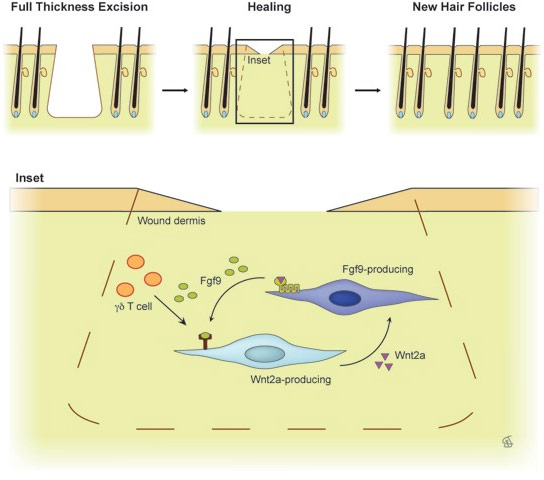
A newly published study reveals that the overexpression of growth factor Fgf9 in a mouse model increases the number of new hair follicles produced during the wound healing process, providing a better understanding of hair regeneration and the potential therapeutic uses for people with hair disorders.
Researchers in the Perelman School of Medicine at the University of Pennsylvania have determined the role of a key growth factor, found in skin cells of limited quantities in humans, which helps hair follicles form and regenerate during the wound healing process. When this growth factor, called Fgf9, was overexpressed in a mouse model, there was a two- to three-fold increase in the number of new hair follicles produced. Researchers believe that this growth factor could be used therapeutically for people with various hair and scalp disorders. The study appears in an advance online publication of Nature Medicine.
“The findings help explain why humans don’t regenerate their hair after wounding,” said senior author George Cotsarelis, MD, professor and chair of Dermatology. “The study also points us to a way to treat wounds and grow hair.”
Following up on earlier work, which showed that increased signaling from the Wnt pathway doubled the number of new hair follicles, the Penn team looked further upstream in the pathway and identified an important cascade of signals that prompt further expression, as well as perpetuate and amplify signals sent during a crucial phase of hair-follicle regeneration.
Fgf9 is initially secreted from gd T cells, an unconventional, rare subset of T cells involved in the immune response. Once released, Fgf9 serves as the catalyst for a signal sent via the dermal Wnt pathway. The signal prompts further expression of Fgf9 in structural cells called fibroblasts, and adds to the generation of new hair follicles.
When a wound occurs in an adult person, hair follicle growth is blocked and the skin heals with a scar. However, hair does regenerate to a great extent in the wound-healing process in mice. The team compared how the process works in adult mice versus humans. Humans have low numbers of gd T cells in their skin compared to mice, and this may explain why human skin scars but does not regenerate hair follicles.
In adult mice, the amount of Fgf9 secreted modulates hair-follicle regeneration after wounding. When Fgf9 was reduced, there was a decrease in wound-induced hair follicle growth. Conversely, when Fgf9 was increased, there was a two- to three-fold increase in the number of new hair follicles, equal to the amount seen in the mice expressing Wnt. Importantly, when the investigators added Fgf9 back to the wounds that do not normally regenerate, FGF9 triggered the molecular cascade of events necessary for skin and hair regeneration; thus, leaving the door open for using Fgf9 to treat wounds and hair loss in people.
The Penn team suggests that, given the differences in skin development and regeneration in response to wounding, treatments intended to compensate for the lack of Fgf9 may be most effective if timed with a wounding response. “Testing activators of Fgf9 or Wnt pathways during the wound healing process may be warranted,” they stated.
Reference: “Fgf9 from dermal γδ T cells induces hair follicle neogenesis after wounding” by Denise Gay, Ohsang Kwon, Zhikun Zhang, Michelle Spata, Maksim V Plikus, Phillip D Holler, Mayumi Ito, Zaixin Yang, Elsa Treffeisen, Chang D Kim, Arben Nace, Xiaohong Zhang, Sheena Baratono, Fen Wang, David M Ornitz, Sarah E Millar and George Cotsarelis, 2 June 2013, Nature Medicine.
DOI: 10.1038/nm.3181
The study was funded by the National Institutes of Health (R01AR46837, P30AR057217, RO1AR055309, R01HL105732, T32AR007465), the Edwin and Fannie Gray Hall Center for Human Appearance at Penn Medicine, and The Dermatology Foundation.
Additional collaborators on the research include co-lead authors Denise Gay and Ohsang Kwon, Zhikun Zhang, Michelle Spata, Maksim V Plikus, Phillip D. Holler, Zaixin Yang, Elsa Treffeisen, Arben Nace, X Zhang, Sheena Baratono and Sarah E. Millar from Penn’s Department of Dermatology, along with collaborators from New York University Langone Medical Center (Mayumi Ito), Seoul National University College of Medicine, Chungnam National University in Daejeon, Korea, Texas A&M University Health Science Center, and Washington University School of Medicine.
Notes: Cotsarelis, Ito and Kwon are listed as inventors on patent applications related to hair-follicle neogenesis, Wnt and FGF9, which are owned by the University of Pennsylvania. Cotsarelis also serves on the scientific advisory board and has equity in Follica, a start-up company that has licensed related patents from the University of Pennsylvania starting in 2007. Cotsarelis was also a co-founder of Follica.
Never miss a breakthrough: Join the SciTechDaily newsletter.
Follow us on Google and Google News.
1 Comment
When there are localised alopacia in scalp probably due to fungus the general treatment is to rub the bald skin with salt, pepper and lemon to make a scar which eventually heals and forms hair follicles. This I have seen myself in many cases. But I don’t know if this superficial scarring can do something for the male baldness to cure. Incision of implanted skin can perhaps do wonders. Thank You.