
Tightly curled scalp hair protected early humans from the sun’s radiative heat, allowing their brains to grow to sizes comparable to those of modern humans.
Curly hair does more than simply look good — it may explain how early humans stayed cool while conserving water, according to researchers who studied the role human hair textures play in regulating body temperature. The findings can shed light on an evolutionary adaptation that enabled the human brain to grow to modern-day sizes.
“Humans evolved in equatorial Africa, where the sun is overhead for much of the day, year in and year out,” said Nina Jablonski, Evan Pugh University Professor of Anthropology at Penn State. “Here the scalp and top of the head receive far more constant levels of intense solar radiation as heat. We wanted to understand how that affected the evolution of our hair. We found that tightly curled hair allowed humans to stay cool and actually conserve water.”
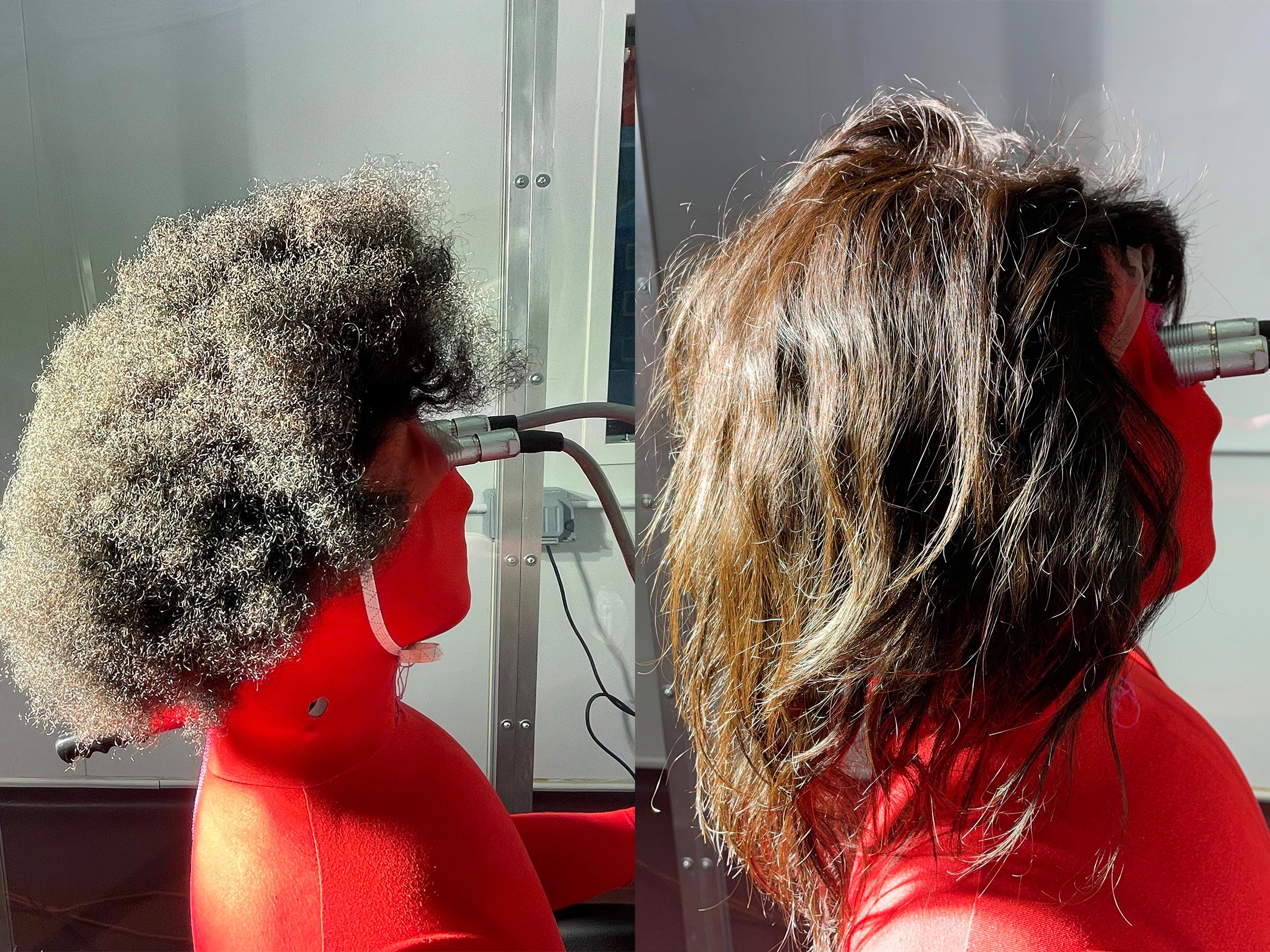
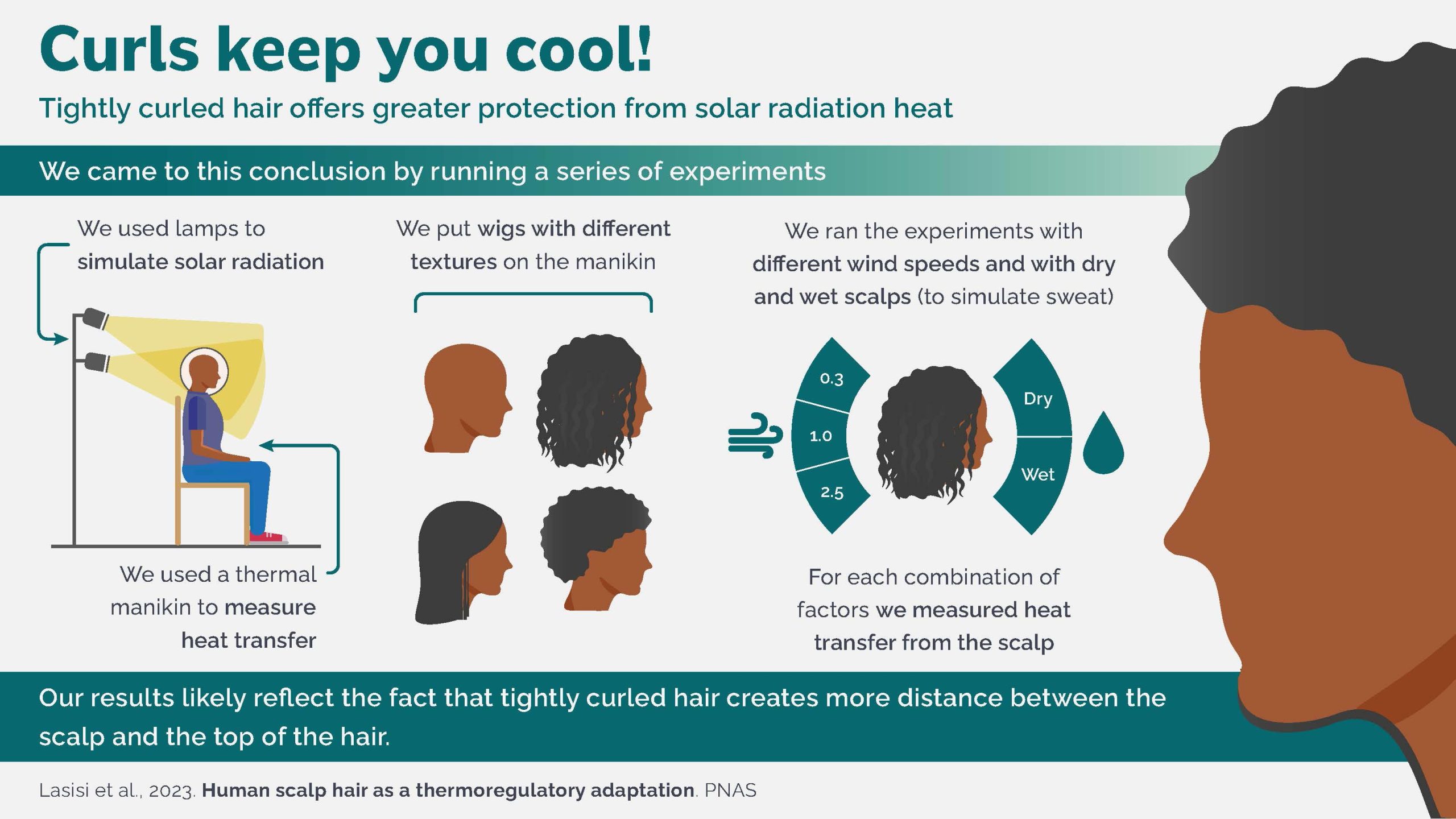
The researchers used a thermal manikin — a human-shaped model that uses electric power to simulate body heat and allows scientists to study heat transfer between human skin and the environment — and human-hair wigs to examine how diverse hair textures affect heat gain from solar radiation. The scientists programmed the manikin to maintain a constant surface temperature of 95 degrees Fahrenheit (35 degrees Celsius), similar to the average surface temperature of skin, and set it in a climate-controlled wind tunnel.
The team took base measurements of body heat loss by monitoring the amount of electricity required by the manikin to maintain a constant temperature. Then they shined lamps on the manikin’s head to mimic solar radiation under four scalp hair conditions — none, straight, moderately curled, and tightly curled.
The scientists calculated the difference in total heat loss between the lamp measurements and the base measurements to determine the influx of solar radiation to the head, explained George Havenith, director of the Environmental Ergonomics Research Centre at Loughborough University, U.K., who led the manikin experiments. They also calculated heat loss at different windspeeds and after wetting the scalp to simulate sweating. They ran their results through a model to study how the diverse hair textures would affect heat gain in 86-degree Fahrenheit (30 degrees Celsius) heat and 60% relative humidity, like environments in equatorial Africa.
Tightly Curled Hair and Solar Protection
The researchers found that all hair reduced solar radiation to the scalp, but tightly curled hair provided the best protection from the sun’s radiative heat while minimizing the need to sweat to stay cool. They reported their findings on June 6, 2023, in the Proceedings of the National Academy of Sciences.
“Walking upright is the setup and brain growth is the payoff of scalp hair,” said Tina Lasisi, who conducted the study as part of her doctoral dissertation at Penn State. Lasisi will start as an assistant professor of anthropology at the University of Michigan in the fall.
As early humans evolved to walk upright in equatorial Africa, the tops of their heads increasingly took the brunt of solar radiation, explained Lasisi. The brain is sensitive to heat, and it generates heat, especially the larger it grows. Too much heat can lead to dangerous conditions like heat stroke. As humans lost much of their body hair, they developed efficient sweat glands to keep cool, but sweating comes at a cost in lost water and electrolytes. Scalp hair likely evolved as a way to reduce the amount of heat gain from solar radiation, thereby keeping humans cool without the body having to expend extra resources, said Lasisi.
How Scalp Hair Enabled Brain Growth
“Around 2 million years ago we see Homo erectus, which had the same physical build as us but a smaller brain size,” she said. “And by 1 million years ago, we’re basically at modern-day brain sizes, give or take. Something released a physical constraint that allowed our brains to grow. We think scalp hair provided a passive mechanism to reduce the amount of heat gained from solar radiation that our sweat glands couldn’t.”
The multidisciplinary research provides important preliminary results for bettering our understanding of how human hair evolved without putting humans in potentially dangerous situations, said Jablonski.
The study also shows that evolutionary anthropologists have an extra tool in the thermal manikin – normally used for testing the functionality of protective clothing – for quantifying human data that is otherwise very difficult to capture, added Havenith.
“The work that’s been done on skin color and how melanin protects us from solar radiation can shape some of the decisions that a person makes in terms of the amount of sunscreen needed in certain environments,” said Lasisi. “I imagine that similar decision-making can occur with hair. When you think about the military or different athletes exercising in diverse environments, our findings give you a moment to reflect and think: is this hairstyle going to make me overheat more easily? Is this the way that I should optimally wear my hair?”
Reference: “Human scalp hair as a thermoregulatory adaptation” by Tina Lasisi, James W. Smallcombe, W. Larry Kenney, Mark D. Shriver, Benjamin Zydney, Nina G. Jablonski and George Havenith, 6 June 2023, Proceedings of the National Academy of Sciences.
DOI: 10.1073/pnas.2301760120
Also contributing to the research were James Smallcombe, Loughborough University and the University of Australia; and from Penn State Larry Kenney, professor of physiology, kinesiology and Marie Underhill Noll Chair in Human Performance; Mark Shriver, professor of anthropology; and Benjamin Zydney, previously an undergraduate research assistant and now a Penn State alum.
The National Science Foundation and the Wenner-Gren Foundation supported this work.
Never miss a breakthrough: Join the SciTechDaily newsletter.
Follow us on Google and Google News.
2 Comments
“Tightly curled scalp hair protected early humans from the sun’s radiative heat …”
I don’t think that the lede picture is a good representation of what was being described.
As a girl with curly hair who grew up in a tropical country, I can only agree with the possibility of protection from radiative heat from the sun. Curly hair, in my case worked to heat up my head and neck and increase the need to sweat. Most certainly not helping me to cool down.