
Close Menu
    Facebook X (Twitter) Instagram
    SciTechDaily
    • Biology
    • Chemistry
    • Earth
    • Health
    • Physics
    • Science
    • Space
    • Technology
    Facebook X (Twitter) Pinterest YouTube RSS
    SciTechDaily
    Home»Health»Why Do We Find It So Hard To Resist Treats Like Chocolate Bars? Scientists Discover Sweets Change Our Brain
    Health

    Why Do We Find It So Hard To Resist Treats Like Chocolate Bars? Scientists Discover Sweets Change Our Brain

    By Max Planck SocietyJune 9, 20231 Comment3 Mins Read
    Facebook Twitter Pinterest Telegram LinkedIn WhatsApp Email Reddit
    Share
    Facebook Twitter LinkedIn Pinterest Telegram Email Reddit
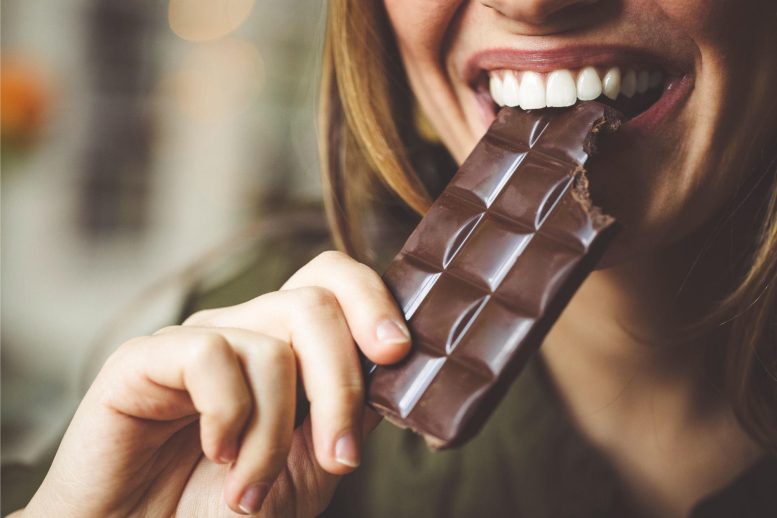
    Eating Chocolate
    Regular consumption of high-fat and high-sugar foods rewires the brain to subconsciously prefer these unhealthy options due to changes in the brain’s dopaminergic system responsible for motivation and reward.

    Why Do We Find It So Hard To Resist Chocolate Bars and Similar Treats?

    Why is it so hard to resist chocolate bars, chips, and fries while shopping at the supermarket? According to researchers at the Max Planck Institute for Metabolism Research in Cologne and Yale University, consuming foods high in fat and sugar can actually alter our brains. Regular consumption, even in small amounts, trains the brain to crave these foods in the future.

    Why do we like unhealthy and fattening foods so much? How does this preference develop in the brain? “Our tendency to eat high-fat and high-sugar foods, the so-called Western diet, could be innate or develop as a result of being overweight. But we think that the brain learns this preference,” explains Sharmili Edwin Thanarajah, lead author of the study.

    To test this hypothesis, the researchers gave one group of volunteers a small pudding containing a lot of fat and sugar per day for eight weeks in addition to their normal diet. The other group received a pudding that contained the same number of calories but less fat. The volunteer’s brain activity was measured before and during the eight weeks.

    Our Brain Unconsciously Learns To Prefer High-Fat Snacks

    The brain’s response to high-fat and high-sugar foods was greatly increased in the group that ate the high-sugar and high-fat pudding after eight weeks. This particularly activated the dopaminergic system, the region in the brain responsible for motivation and reward. “Our measurements of brain activity showed that the brain rewires itself through the consumption of chips and co. It subconsciously learns to prefer rewarding food. Through these changes in the brain, we will unconsciously always prefer the foods that contain a lot of fat and sugar,” explains Marc Tittgemeyer, who led the study.

    During the study period, the test persons did not gain more weight than the test persons in the control group and their blood values, such as blood sugar or cholesterol, did not change either. However, the researchers assume that the preference for sugary foods will continue after the end of the study. “New connections are made in the brain, and they don’t dissolve so quickly. After all, the whole point of learning is that once you learn something, you don’t forget it so quickly,” explains Marc Tittgemeyer.

    Reference: “Habitual daily intake of a sweet and fatty snack modulates reward processing in humans” by Sharmili Edwin Thanarajah, Alexandra G. DiFeliceantonio, Kerstin Albus, Bojana Kuzmanovic, Lionel Rigoux, Sandra Iglesias, Ruth Hanßen, Marc Schlamann, Oliver A. Cornely, Jens C. Brüning, Marc Tittgemeyer and Dana M. Small, 22 March 2023, Cell Metabolism.
    DOI: 10.1016/j.cmet.2023.02.015

    Never miss a breakthrough: Join the SciTechDaily newsletter.
    Follow us on Google and Google News.

    Brain Diet Max Planck Institute Metabolism Obesity Popular Yale University
    Share. Facebook Twitter Pinterest LinkedIn Email Reddit

    Related Articles

    Scientists Reveal Why You Still Have Room for Dessert Even When You’re Full

    Can Food Memories Make You Overeat? New Research Says Yes

    Stanford Scientists Rewrite the Ketosis Rulebook: Metabolites That Suppress Hunger and Promote Weight Loss

    Intermittent Fasting vs. USDA Diet: Johns Hopkins Scientists Uncover Surprising Brain Health Benefits

    Not Just Weight Loss: The Unexpected Brain Benefits of an Anti-Obesity Drug

    Obesity May Permanently Change the Brain – Yale Study Finds Severely Impaired Response to Nutrients

    Scientists Discover That Eating Too Much During Development Permanently Alters the Brain

    Yale Scientists Discover Key Regulator of Body Weight

    Researchers Find Belly Fat Is Resistant to Intermittent Fasting – “The Location Makes a Big Difference”

    1 Comment

    1. Joe Biden on June 10, 2023 4:25 am

      The brain runs on glucose so naturally it wants that.

      Reply
    Leave A Reply Cancel Reply

    • Facebook
    • Twitter
    • Pinterest
    • YouTube

    Don't Miss a Discovery

    Subscribe for the Latest in Science & Tech!

    Trending News

    Researchers Have Found a Dietary Compound That Increases Longevity

    Scientists Baffled by Bizarre “Living Fossil” From 275 Million Years Ago

    Your IQ at 23 Could Predict Your Wealth at 27, Study Finds

    320 Light-Years Away, a Planet Confirms a Fundamental Cosmic Assumption

    The Crown Jewel of Dentistry? Breakthrough Tech Could Transform Tooth Repair

    Python Blood Could Hold the Secret to Weight Loss Without Side Effects

    Naturally Occurring Bacteria Completely Eradicate Tumors in Mice With a Single Dose

    New “Nanozyme Hypothesis” Could Rewrite the Story of Life’s Origins

    Follow SciTechDaily
    • Facebook
    • Twitter
    • YouTube
    • Pinterest
    • Newsletter
    • RSS
    SciTech News
    • Biology News
    • Chemistry News
    • Earth News
    • Health News
    • Physics News
    • Science News
    • Space News
    • Technology News
    Recent Posts
    • Accidental Deep Ocean Discovery Reveals Hidden Carbon Sink
    • Cooling the Planet Could Come at a Devastating Cost
    • These New Molecules Could Change How We Treat Lupus and Arthritis
    • Saunas May Do More Than Raise Body Temperature – They Activate Your Immune System
    • Exercise in a Pill? Metformin Shows Surprising Effects in Cancer Patients
    Copyright © 1998 - 2026 SciTechDaily. All Rights Reserved.
    • Science News
    • About
    • Contact
    • Editorial Board
    • Privacy Policy
    • Terms of Use

    Type above and press Enter to search. Press Esc to cancel.