

A study by NYU Grossman School of Medicine researchers found that melanocyte stem cells (McSCs) lose their ability to move between hair follicle compartments as people age, leading to hair graying. Restoring McSC motility or moving them back to their germ compartment could potentially reverse or prevent hair graying in humans.
Certain stem cells have a unique ability to move between growth compartments in hair follicles, but get stuck as people age and so lose their ability to mature and maintain hair color, a new study shows.
Led by researchers from NYU Grossman School of Medicine, the new work focused on cells in the skin of mice and also found in humans called melanocyte stem cells, or McSCs. Hair color is controlled by whether nonfunctional but continually multiplying pools of McSCs within hair follicles get the signal to become mature cells that make the protein pigments responsible for color.
Publishing in the journal Nature on April 19, the new study showed that McSCs are remarkably plastic. This means that during normal hair growth, such cells continually move back and forth on the maturity axis as they transit between compartments of the developing hair follicle. It is inside these compartments where McSCs are exposed to different levels of maturity-influencing protein signals.
Specifically, the research team found that McSCs transform between their most primitive stem cell state and the next stage of their maturation, the transit-amplifying state, and depending on their location.
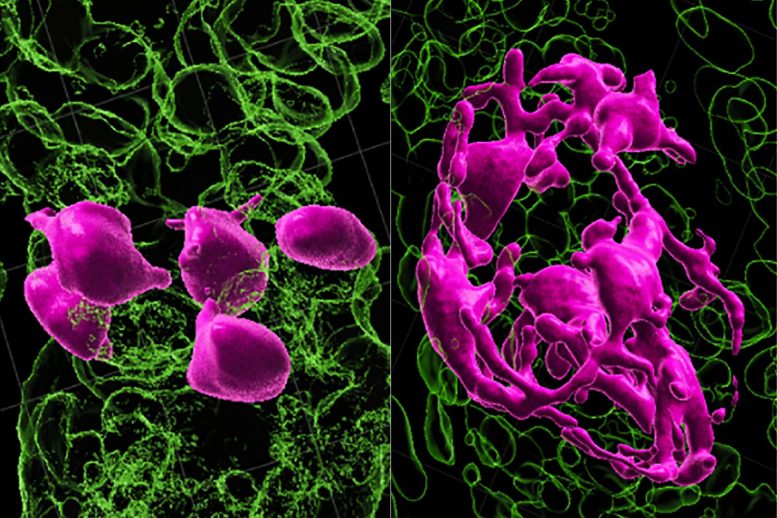
The researchers found that as hair ages, sheds, and then repeatedly grows back, increasing numbers of McSCs get stuck in the stem cell compartment called the hair follicle bulge. There, they remain, do not mature into the transit-amplifying state, and do not travel back to their original location in the germ compartment, where WNT proteins would have prodded them to regenerate into pigment cells.
Implications for Reversing Graying Hair
“Our study adds to our basic understanding of how melanocyte stem cells work to color hair,” said study lead investigator Qi Sun, PhD, a postdoctoral fellow at NYU Langone Health. “The newfound mechanisms raise the possibility that the same fixed-positioning of melanocyte stem cells may exist in humans. If so, it presents a potential pathway for reversing or preventing the graying of human hair by helping jammed cells to move again between developing hair follicle compartments.”
Researchers say McSC plasticity is not present in other self-regenerating stem cells, such as those making up the hair follicle itself, which are known to move in only one direction along an established timeline as they mature. For example, transit-amplifying hair follicle cells never revert to their original stem cell state. This helps explain in part why hair can keep growing even while its pigmentation fails, says Sun.
Earlier work by the same research team at NYU showed that WNT signaling was needed to stimulate the McSCs to mature and produce pigment. That study had also shown that McSCs were many trillions of times less exposed to WNT signaling in the hair follicle bulge than in the hair germ compartment, which is situated directly below the bulge.
Forced Aging and Stuck McSCs
In the latest experiments in mice whose hair was physically aged by plucking and forced regrowth, the number of hair follicles with McSCs lodged in the follicle bulge increased from 15% before plucking to nearly half after forced aging. These cells remained incapable of regenerating or maturing into pigment-producing melanocytes.
The stuck McSCs, the researchers found, ceased their regenerative behavior as they were no longer exposed to much WNT signaling and hence their ability to produce pigment in new hair follicles, which continued to grow.
By contrast, other McSCs that continued to move back and forth between the follicle bulge and hair germ retained their ability to regenerate as McSCs, mature into melanocytes, and produce pigment over the entire study period of two years.
“It is the loss of chameleon-like function in melanocyte stem cells that may be responsible for graying and loss of hair color,” said study senior investigator Mayumi Ito, PhD, a professor in the Ronald O. Perelman Department of Dermatology and the Department of Cell Biology at NYU Langone Health.
“These findings suggest that melanocyte stem cell motility and reversible differentiation are key to keeping hair healthy and colored,” said Ito, who is also a professor in the Department of Cell Biology at NYU Langone.
Ito says the team has plans to investigate means of restoring motility of McSCs or of physically moving them back to their germ compartment, where they can produce pigment.
For the study, researchers used recent 3D-intravital-imaging and scRNA-seq techniques to track cells in almost real time as they aged and moved within each hair follicle.
Reference: “Dedifferentiation maintains melanocyte stem cells in a dynamic niche” by Qi Sun, Wendy Lee, Hai Hu, Tatsuya Ogawa, Sophie De Leon, Ioanna Katehis, Chae Ho Lim, Makoto Takeo, Michael Cammer, M. Mark Taketo, Denise L. Gay, Sarah E. Millar and Mayumi Ito, 19 April 2023, Nature.
DOI: 10.1038/s41586-023-05960-6
Funding for the study was provided by National Institutes of Health grants P30CA016087, S10OD021747, R01AR059768, R01AR074995, and U54CA263001; and Department of Defense grants W81XWH2110435 and W81XWH2110510.
Besides Sun and Ito, other NYU Langone researchers involved in this study are co-investigators Wendy Lee, Hai Hu, Tatsuya Ogawa, Sophie De Leon, Ioanna Katehis, Chae Ho Lim, Makoto Takeo, Michael Cammer, and Denise Gay. Other study co-investigators are M. Mark Taketo, at Kyoto University in Japan, and Sarah Millar, at Icahn School of Medicine at Mount Sinai in New York City.
Never miss a breakthrough: Join the SciTechDaily newsletter.
Follow us on Google and Google News.