
Close Menu
    Facebook X (Twitter) Instagram
    SciTechDaily
    • Biology
    • Chemistry
    • Earth
    • Health
    • Physics
    • Science
    • Space
    • Technology
    Facebook X (Twitter) Pinterest YouTube RSS
    SciTechDaily
    Home»Biology»Stem Cells Help Re-grow Healthy Heart Muscle After Heart Attack
    Biology

    Stem Cells Help Re-grow Healthy Heart Muscle After Heart Attack

    By SciTechDailyFebruary 14, 20121 Comment3 Mins Read
    Facebook Twitter Pinterest Telegram LinkedIn WhatsApp Email Reddit
    Share
    Facebook Twitter LinkedIn Pinterest Telegram Email Reddit
    stem-cell-therapy-heart-attack
    Heart attack patients can be treated with an infusion of their own heart-derived cells to promote the regrowth of healthy heart muscles.

    A new study published in the journal The Lancet shares the results from a Cedars-Sinai Heart institute clinical trial, which demonstrated that heart attack patients could be treated with an infusion of their own heart-derived cells that helped re-grow healthy heart muscles.

    The patients who underwent the stem cell procedure showed a significant reduction in size of the scar left on the heart muscle by a heart attack. These patients also experienced a sizable increase in the health of their heart muscle following the experimental stem cell treatments.
    heart-attack-stem-cells

    A year after receiving the stem cell treatment, scar sizes were reduced from 12 to 24 percent in heart attack patients. The effects are substantial, and were never accomplished before, even despite a decade of cell therapy trials, and even more pronounced in humans than in animal tests.

    This is one of the first regenerative therapies that could potentially reverse the damage caused by a heart attack. This clinical trial was named CADUCEUS (CArdiosphere-Derived aUtologous stem CElls to Reverse ventricUlar dySfunction), and it was part of an investigative study approved by the FDA and supported by the National Heart, Lung, and Blood Institute.

    stem-cells-heart

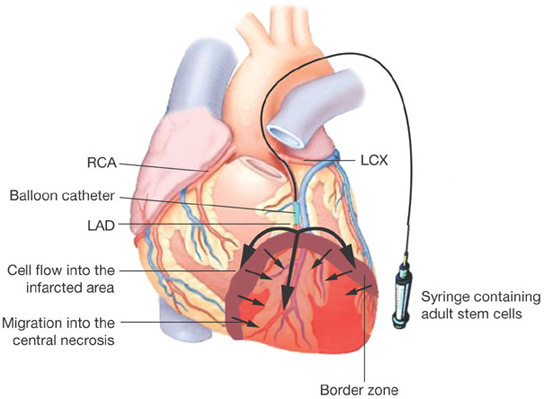
    In 2009, Eduardo Marbán, director of the Cedars-Sinai Heart Institute, and his team completed the first procedure in which a patient’s own heart tissue was used to grow specialized heart stem cells, which were injected back into the patient’s heart in an effort to repair the heart muscle that had been injured by a heart attack.

    25 patients, of a median age of 53, participated in this study. They all had damaged heart muscles and each underwent imaging scans. Eight patients served as a control group in the study, receiving conventional medical care for heart attacks. In the other 17 patients, a heart biopsy was performed. The biopsied heart tissue was then cultured, which multiplied the cells. Finally, the cells were reintroduced into the patient’s coronary arteries.

    Patients who received the stem cell treatment experienced an average of 50 percent reduction in their heart attack scars 12 months after the infusion of stem cells, while other patients received no shrinkage.

    Reference: “Intracoronary cardiosphere-derived cells for heart regeneration after myocardial infarction (CADUCEUS): a prospective, randomised phase 1 trial” by Raj R Makkar, MD; Rachel R Smith, PhD; Ke Cheng, PhD; Konstantinos Malliaras, MD; Louise EJ Thomson, MD; Prof Daniel Berman, MD; Lawrence SC Czer, MD; Linda Marbán, PhD; Adam Mendizabal, MS; Peter V Johnston, MD; Stuart D Russell, MD; Karl H Schuleri, MD; Albert C Lardo, PhD; Prof Gary Gerstenblith, MD and Prof Eduardo Marbán, MD, 14 February 2012, The Lancet.
    DOI: 10.1016/S0140-6736(12)60195-0

    Never miss a breakthrough: Join the SciTechDaily newsletter.
    Follow us on Google and Google News.

    Cardiology Heart Attack Medicine Popular Rejuvenation Stem Cells
    Share. Facebook Twitter Pinterest LinkedIn Email Reddit

    Related Articles

    A Common Medication Improves Survival for Heart Failure Patients

    New Genetic Study Links Stem Cell Mutations to Hydrocephalus

    Nanoparticle Shows Promise for Treating Breast Cancer

    Researchers Identify Role of Mesp1 Gene in Cardiovascular Lineage Segregation

    Researchers Use Human Stem Cells to Create Model of the Human Kidney Glomerulus

    Trans-Fatty Acid Ban Results in Reduced Heart Attacks and Stroke

    New Drug Cocktail Unlocks Potential to Regrow Inner-Ear ‘Hair’ Cells

    Stem Cells Help Restore a Man’s Vision

    Genetic Trickery Coaxes Heart to Heal Itself

    1 Comment

    1. Madanagopal.V.C. on September 15, 2012 11:23 pm

      These are not the omnipotent embroyonic stem cells but only the pluripotent stem cells derived from the heart muscles through biopsy. Pluripontent cells are always latent in the respective organ`s tissues. The researcch is overwhelmingly applauded in as much as the availablility of stem cells are harvested from the same patient and from the diseased organ. The same method can also be tried succesfully in the nephrological cases.Thank You.

      Reply
    Leave A Reply Cancel Reply

    • Facebook
    • Twitter
    • Pinterest
    • YouTube

    Don't Miss a Discovery

    Subscribe for the Latest in Science & Tech!

    Trending News

    This Copper Drug Clears Alzheimer’s Brain Toxins and Boosts Memory

    Adults Over 65 Lost Massive Amounts of Weight With Ozempic

    How Flocking Birds “Defy” One of Physics’ Most Fundamental Laws

    Physicists Create a New Kind of Schrödinger’s Cat State From Exotic Quantum Building Blocks

    Your Diet Could Be Missing the Key Ingredient for Heart Protection

    Researchers Warn Widely Prescribed Blood Pressure Drugs Could Be Harming Diabetic Kidneys

    James Webb Spots Something Strange Between Day and Night on an Alien Planet

    How Ancient People Moved a 6-Ton Stone 700 Kilometers to Stonehenge

    Follow SciTechDaily
    • Facebook
    • Twitter
    • YouTube
    • Pinterest
    • Newsletter
    • RSS
    SciTech News
    • Biology News
    • Chemistry News
    • Earth News
    • Health News
    • Physics News
    • Science News
    • Space News
    • Technology News
    Recent Posts
    • Scientists Uncover Cause of Inflammatory Bowel Disease Solving Decades-Old Mystery
    • The Surprising Reason Swimming Could Be Better for Your Heart Than Running
    • Could Vitamin C Be the Secret to Keeping Your Brain Younger?
    • The Surprising Fix for Robot Traffic Jams
    • Near Absolute Zero, This Transistor Starts Acting Like a Brain Cell
    Copyright © 1998 - 2026 SciTechDaily. All Rights Reserved.
    • Science News
    • About
    • Contact
    • Editorial Board
    • Privacy Policy
    • Terms of Use

    Type above and press Enter to search. Press Esc to cancel.