
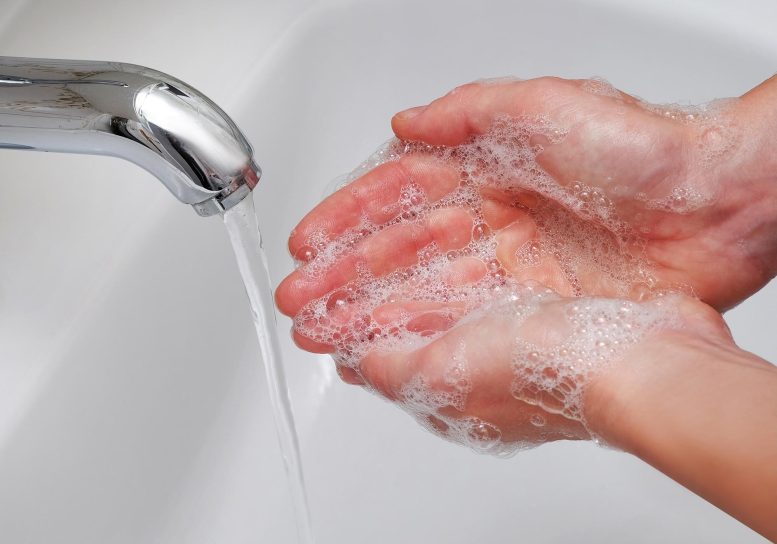
Healthcare professionals often substitute alcohol-based hand sanitizers and harsh soaps for skin-friendly cleansers in order to treat or prevent irritant contact dermatitis.
- Gentle cleansers are just as effective in killing viruses – including coronavirus – as harsh soaps, according to a new study from scientists at the University of Sheffield
- Healthcare professionals often substitute alcohol-based hand sanitizers and harsh soaps for skin-friendly cleansers in order to treat or prevent irritant contact dermatitis, which develops when chemical or physical agents damage the skin surface faster than the skin can repair
- Incidence and severity of irritant contact dermatitis increased from 20 percent to 80 percent among healthcare professionals during the COVID-19 pandemic
- Researchers also found non-enveloped viruses such as norovirus were resistant to all hand wash products tested, and were only killed with bleach disinfectants, which aren’t a feasible option for washing hands
Gentle cleansers are just as effective in killing viruses – including coronavirus – as harsh soaps, a new study by University of Sheffield experts has found.
Healthcare professionals often substitute harsh soaps or alcohol-based hand sanitizers with skin-friendly cleansers in order to treat or prevent irritant contact dermatitis – a common skin disease that causes red and swollen skin with a dry and damaged surface.
During the COVID-19 pandemic, the incidence and severity of the disease amongst healthcare professionals increased from 20 percent to 80 percent.
Despite the widespread use of gentle cleansing products for handwashing, there has been limited evidence to show the antiviral efficacy of the products to prevent the spread of viruses such as human coronavirus, herpes simplex virus, norovirus, and influenza.
Enveloped vs. Non-Enveloped Viruses
Scientists from the University of Sheffield’s Sheffield Dermatology Research (SDR) group tested multiple handwash products as part of the study. These included antibacterial soap, natural soap, foam cleansers and bath wash products, with the team investigating their ability to kill both enveloped viruses; such as human coronavirus and influenza, which have an additional layer of structural protection; compared to non-enveloped viruses, such as norovirus and adenovirus.
The findings, published in the journal Frontiers in Virology, show gentle cleansers were effective in killing enveloped viruses, but non-enveloped viruses displayed resistance against skin-friendly cleansers, as well as harsh soaps.
Lead author of the study, Dr. Munitta Muthana from the University of Sheffield’s Department of Oncology and Metabolism, said: “Washing our hands with soap and warm water for 20 seconds was a fundamental message advocated in the UK to help stop the spread of COVID-19. But for healthcare professionals, who can wash their hands as many as 100 times during a 12-hour shift, this may cause unintended adverse effects.
“Not only does irritant contact dermatitis cause the skin to become inflamed, blister, and crack, which increases the transmission of bacteria and viruses, it can also lead to less compliance with personal protective equipment (PPE) and inadequate hand washing for fear of making symptoms worse. The disease can also significantly impact workplace productivity.
“For the first time, our study has shown substituting harsh soaps with milder wash products such as gentle cleansers is effective in fighting against enveloped viruses, including human coronavirus, which is very encouraging — especially for those in jobs in which irritant contact dermatitis is an occupational hazard. We also found that using additional agents such as moisturizers to help protect the skin didn’t prevent the products’ antiviral activity, which means we don’t have to use very harsh products on our skin in order to kill viruses. ”
Importantly, the study also found non-enveloped viruses demonstrated greater resistance across all types of hand-washing products tested, including harsh chemical substances and milder solutions. Norovirus — known as the winter vomiting bug — was the most resilient.
Future Directions for Effective Hand Hygiene
First author of the study, Natalie Winder, PhD Researcher at the University of Sheffield’s Department of Oncology and Metabolism, said: “Even when we increased the exposure of norovirus to the handwashing products from 20 seconds to one minute, the virus wasn’t disrupted. Bleach was the only agent which affected the virus — however bleach-based hand washes are not a feasible option due to its corrosivity, which would be extremely harmful to the skin.
“Norovirus can spread very easily — it takes just 18 norovirus particles to infect another person, as opposed to 1,000 coronavirus particles needed to spread the infection. Our findings show that although good hand hygiene practices are important to preventing the spread of many viruses, they are insufficient at controlling the norovirus.”
“Measures such as isolation and disinfecting surfaces with bleach are more effective in preventing the spread of the norovirus infection and more research needs to be done to see whether heavily diluted bleach-based hand washes, which are safe to use on the skin, can be produced.”
Reference: “Are mild cleansers appropriate for hand hygiene in the COVID era? An in vitro investigation of the antiviral efficacy of different hand hygiene products” by Natalie Winder, Zahra Ashraf, Sara Gohar, Nada Baalbaki, Micheal Cork, Simon Danby and Munitta Muthana, 6 June 2023, Frontiers in Virology.
DOI: 10.3389/fviro.2023.1180815
The study was conducted by the University of Sheffield and funded by CeraVe.
Never miss a breakthrough: Join the SciTechDaily newsletter.
Follow us on Google and Google News.
1 Comment
Can’t be true…you mean the so-called “conspiracy theories” are actually true?