
Photocatalyst made using a combination of titanium dioxide (TiO2) and copper oxide (CuxO) nanoclusters inactivates various variant types of novel coronavirus SARS-CoV-2. Scientists in Nara Medical University, Kanagawa Institute of Industrial Science and Technology, and Tokyo Institute of Technology have developed this antiviral photocatalyst, in a recent breakthrough, which has been proven to be effective under both darkness and indoor light.
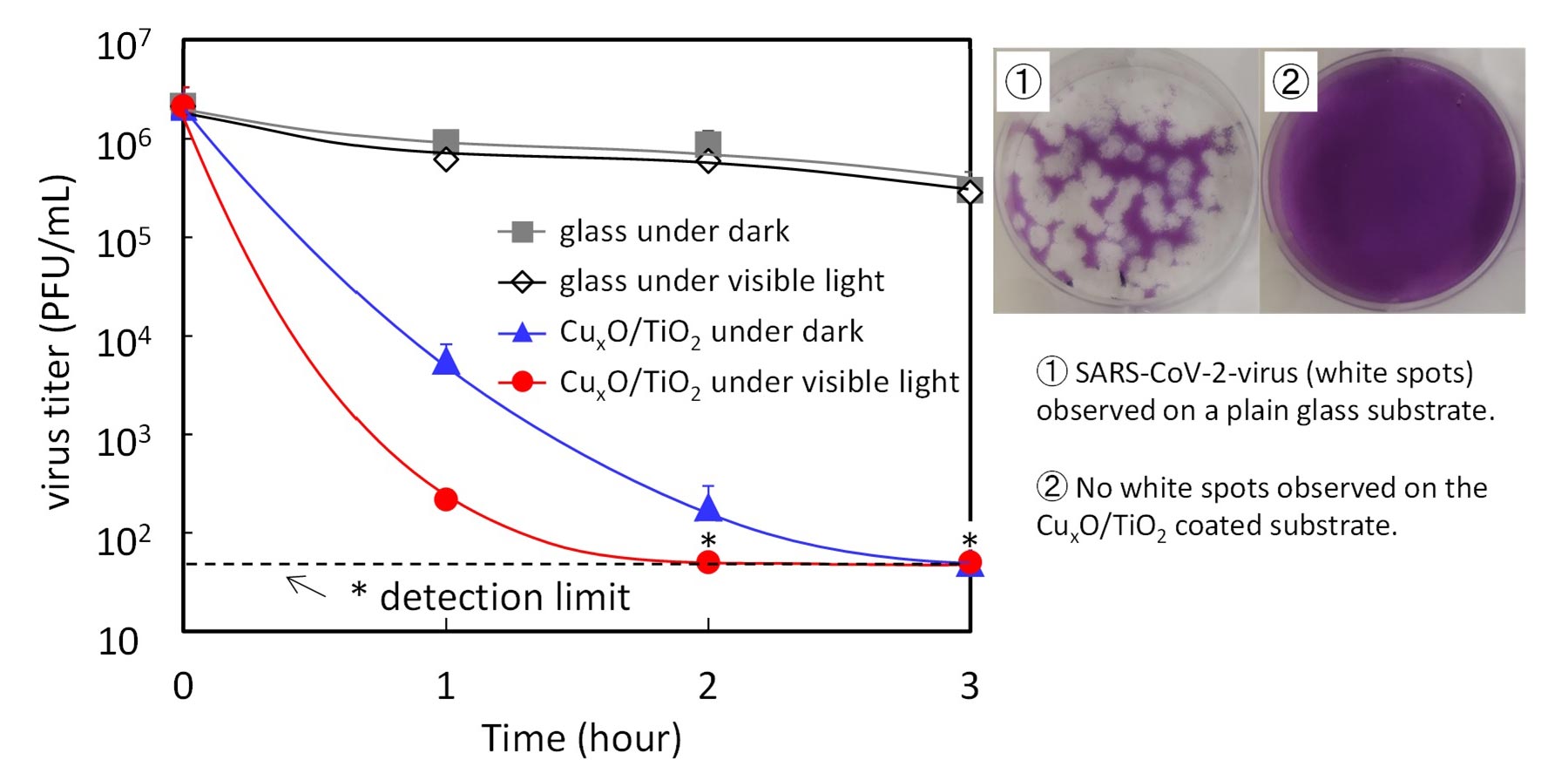
- CuxO/TiO2 inactivates various variant types (Alfa, Beta, Gamma, and Delta) of SARS-CoV-2 below their detection limit for 2 h under visible light irradiation (Figure 1).
- CuxO/TiO2 also exhibits the antiviral activity even under dark conditions.
- Antiviral activity on CuxO/TiO2 is caused by denaturation of spike proteins and RNA fragmentation of SARS-CoV-2 viruses.
The novel coronavirus (SARS-CoV-2), responsible for the ongoing COVID-19 pandemic, has affected millions of people worldwide. The main transmission pathway of the virus is through droplets released by infected people into the air. Additionally, these droplets exist on various surfaces as well. Viral infections mainly occur in indoor environments where many people gather, Antiviral chemicals, such as alcohol and hydrogen peroxide, are often used to decontaminate regularly touched surfaces. These chemicals essentially render the virus inactive by breaking down their proteins. However, these chemicals are volatile in nature and, therefore evaporate away. As a result, the disinfection process has to be carried out regularly.
Development of Solid-State Photocatalyst for Virus Defense
Now in a study published today (April 14, 2022) in Scientific Reports, a research team of Nara Medical University, Kanagawa Institute of Industrial Science and Technology, and Tokyo Institute of Technology has developed a solid-state photocatalyst as an alternative defense against the virus. Unlike chemical disinfectants, solid-state coatings remain for a long time, and since the viral outbreak, have been the subject of intensive research around the world. Solid-state antiviral coatings have the advantage of being non-toxic, abundant, and chemically and thermally stable.
Many of these solid-state coatings use TiO2 photocatalysts that, when exposed to ultraviolet (UV) light, cause oxidation reaction that can destroy organic matter like the spike proteins found on the surfaces of coronaviruses. However, these coatings are activated only when exposed to UV light, which is not present in typical indoor environments. In most indoor environments, lightings are usually turned off in the night time, thus the antiviral material under dark condition is desired.
CuxO/TiO2 Composite: Effective in Light and Dark
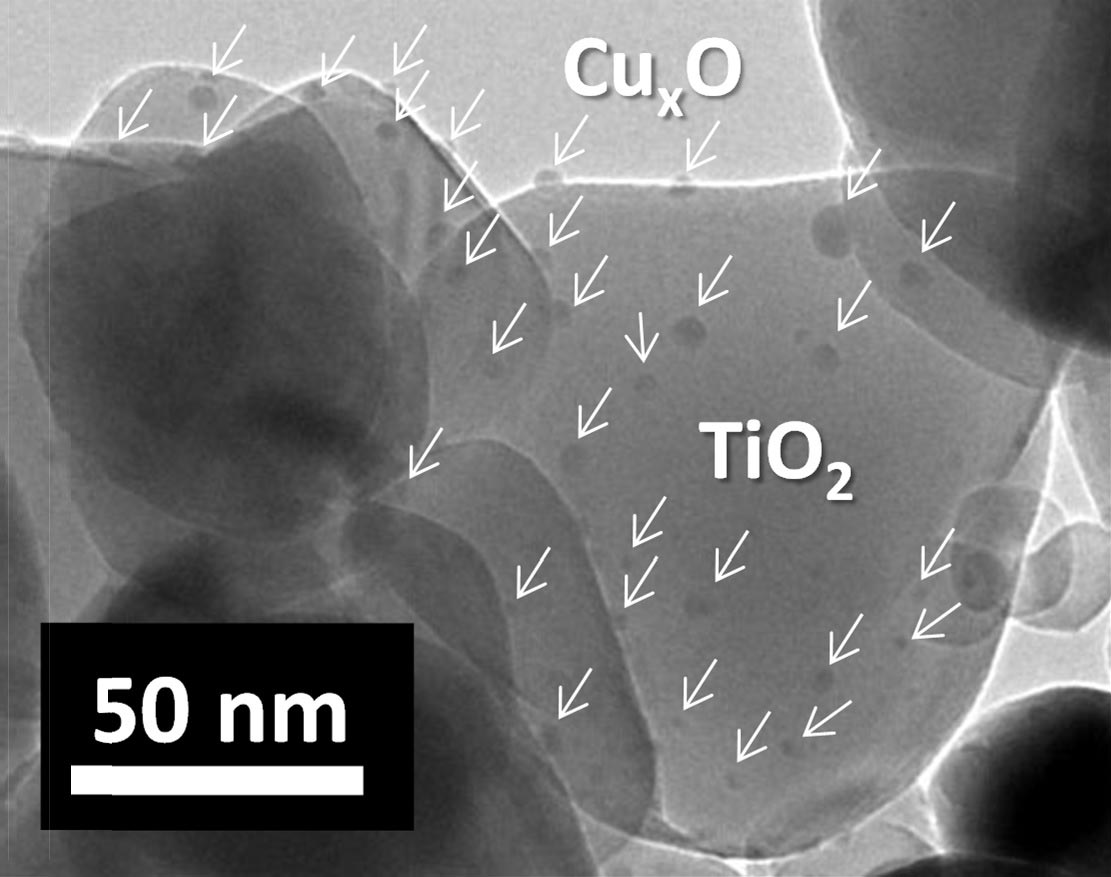
To get the coating to work under visible light as well as dark conditions, the team has developed a composite consisting of TiO2 and CuxO nanoclusters (Figure 2). CuxO nanoclusters are composed of a mixed valence number oxide, in which Cu(I) and Cu(II) species are present. The Cu(II) species in CuxO contributes to the visible-light-driven photocatalysis reaction, whereas the Cu(I) species plays a crucial role in denaturing virus proteins, thereby causing their inactivation under dark conditions.
By coating the CuxO/TiO2 powder on a glass, the team showed that it could inactivate even the highly virulent Delta variant of SARS-CoV-2 as shown in Figure 1. The team has also confirmed the inactivation of Alfa, Beta, and Gamma variants by CuxO/TiO2 in addition to the wild type strain.

Mechanism of Antiviral Action Under Light and Darkness
The team carefully investigated the antiviral mechanism using sodium dodecyl sulfate-polyacrylamide gel electrophoresis (SDS-PAGE), ELISA assay, and RT-qPCR analysis. These analyses strongly suggest that the Cu(I) species in CuxO denaturalizes spike proteins and also causes RNA fragmentation of SARS-CoV-2, even under dark condition (Figure 3). Furthermore, white light irradiation causes the photocatalytic oxidation of the organic molecules of SARS-CoV-2. Based on this antiviral mechanism, the present antiviral material is not limited to a specific variant of the virus and will be effective to inactivate various types of a potential mutant strain.
White light illumination in the present study is usually used as an indoor light apparatus. This can make the CuxO/TiO2 photocatalyst very effective in reducing the risk of COVID-19 infection in indoor environments, which are usually subjected to both light and darkness periodically.
Hopefully, this study will take us one step closer to protecting ourselves better against the coronavirus, and adjusting to the post-COVID era.
Reference: “Inactivation of Various Variant Types of SARS-CoV-2 by Indoor-light-sensitive TiO2-based Photocatalyst” by Ryuichi Nakano, Akira Yamaguchi, Kayano Sunada, Takeshi Nagai, Akiyo Nakano, Yuki Suzuki, Hisakazu Yano, Hitoshi Ishiguro and Masahiro Miyauchi, 14 April 2022, Scientific Reports.
DOI: 10.1038/s41598-022-09402-7
About Nara Medical University
A prefectural medical vocational school was established in Nara in April 1945 and was transformed into the predecessor of Nara Medical University in 1948. It was then reorganized into the present Nara Medical University in 1952. Nara Medical University College of Nursing was established in 1996, and it was re-organized as the Faculty of Nursing, School of Medicine, Nara Medical University in 2004. Since then, Nara Medical University has been steadily advancing as a medical university with the Faculty of Medicine and the Faculty of Nursing, School of Medicine.
About Kanagawa Institute of Industrial Science and Technology
Kanagawa Institute of Industrial Science and Technology (“KISTEC”) is a local incorporated administrative agency established in April 2017. KISTEC has been founded by merger of public test and research institute Kanagawa Industrial Technology Center (“KITC”) and public interest incorporated foundation Kanagawa Academy of Science and Technology (“KAST”). We promote regional industry and science and technology, utilizing the mutual advantages of KITC’s technical support capability and KAST’s research and development capability. And we also try to make the residents’ lives more enriched, and to fulfill the needs of our users, with five main activities; “Research and Development,” “Technical Support,” “Commercialization Support,” “Personnel Training”, and “Collaborative Network”.
About Tokyo Institute of Technology
Tokyo Tech stands at the forefront of research and higher education as the leading university for science and technology in Japan. Tokyo Tech researchers excel in fields ranging from materials science to biology, computer science, and physics. Founded in 1881, Tokyo Tech hosts over 10,000 undergraduate and graduate students per year, who develop into scientific leaders and some of the most sought-after engineers in industry. Embodying the Japanese philosophy of “monotsukuri,” meaning “technical ingenuity and innovation,” the Tokyo Tech community strives to contribute to society through high-impact research.
Never miss a breakthrough: Join the SciTechDaily newsletter.
Follow us on Google and Google News.