
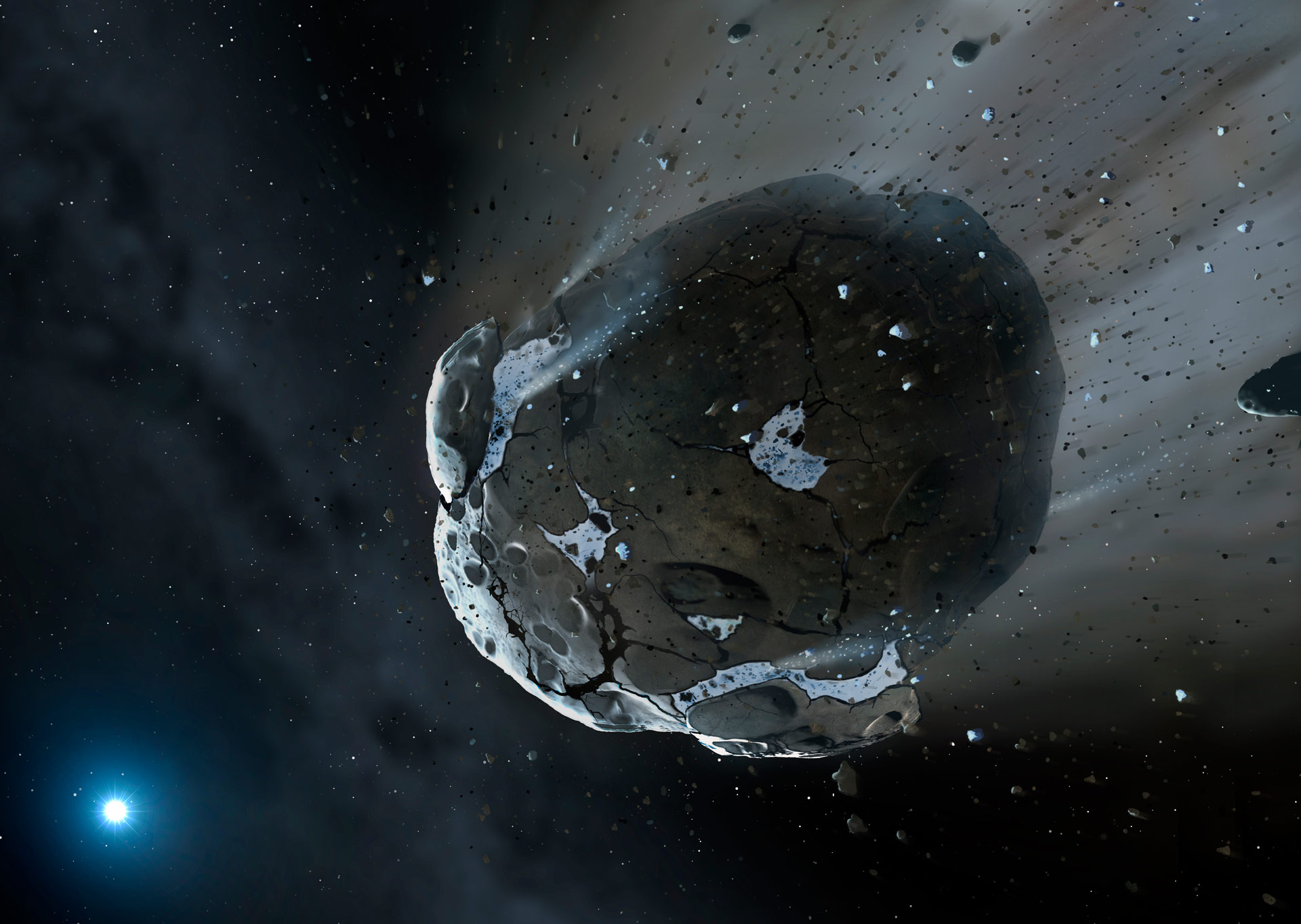
Using the Hubble Space Telescope and the large telescopes of the W. M. Keck Observatory, scientists have found the first evidence of a water-rich rocky planetary body outside our solar system.
Astrophysicists have found the first evidence of a water-rich rocky planetary body outside our solar system in its shattered remains orbiting a white dwarf.
A new study by scientists at the Universities of Warwick and Cambridge published in the journal Science analyzed the dust and debris surrounding the white dwarf star GD61 170 light years away.
Using observations obtained with the Hubble Space Telescope and the large telescopes of the W. M. Keck Observatory, they found an excess of oxygen – a chemical signature that indicates that the debris had once been part of a bigger body originally composed of 26 percent water by mass. By contrast, only approximately 0.023 percent of the Earth’s mass is water.
Evidence for water outside our solar system has previously been found in the atmosphere of gas giants, but this study marks the first time it has been pinpointed in a rocky body, making it of significant interest in our understanding of the formation and evolution of habitable planets and life.
We know from our own solar system that the dwarf planet Ceres contains ice buried beneath an outer crust, and the researchers draw a parallel between the two bodies. Scientists believe that bodies like Ceres were the source of the bulk of our own water on Earth.
The researchers suggest it is most likely that the water detected around the white dwarf GD 61 came from a minor planet at least 90 km in diameter but potentially much bigger, that once orbited the parent star before it became a white dwarf.
Like Ceres, the water was most likely in the form of ice below the planet’s surface. From the amount of rocks and water detected in the outer envelope of the white dwarf, the researchers estimate that the disrupted planetary body had a diameter of at least 90km.
However, because their observations can only detect what is being accreted in recent history, the estimate of its mass is on the conservative side.
It is likely that the object was as large as Vesta, the largest minor planet in the solar system. In its former life, GD 61 was a star somewhat bigger than our Sun, and host to a planetary system.
About 200 million years ago, GD 61 entered its death throes and became a white dwarf, yet, parts of its planetary system survived. The water-rich minor planet was knocked out of its regular orbit and plunged into a very close orbit, where it was shredded by the star’s gravitational force. The researchers believe that destabilizing the orbit of the minor planet requires a so far unseen, much larger planet going around the white dwarf.
Professor Boris Gänsicke of the Department of Physics at the University of Warwick “At this stage in its existence, all that remains of this rocky body is simply dust and debris that has been pulled into the orbit of its dying parent star.
“However this planetary graveyard swirling around the embers of its parent star is a rich source of information about its former life.
“In these remnants lie chemical clues which point towards a previous existence as a water-rich terrestrial body.
“Those two ingredients – a rocky surface and water – are key in the hunt for habitable planets outside our solar system so it’s very exciting to find them together for the first time outside our solar system.”
Lead author Jay Farihi, from Cambridge’s Institute of Astronomy, said: “The finding of water in a large asteroid means the building blocks of habitable planets existed – and maybe still exist – in the GD 61 system, and likely also around a substantial number of similar parent stars.
“These water-rich building blocks, and the terrestrial planets they build, may in fact be common – a system cannot create things as big as asteroids and avoid building planets, and GD 61 had the ingredients to deliver lots of water to their surfaces,” Farihi said.
“Our results demonstrate that there was definitely potential for habitable planets in this exoplanetary system.”
For their analysis, the researchers used ultraviolet spectroscopy data obtained with the Cosmic Origins Spectrograph on board the Hubble Space Telescope of the white dwarf GD 61. As the atmosphere of the Earth blocks the ultraviolet light, such study can only be carried out from space. Additional observations were obtained with both of the 10m telescopes of the W. M. Keck Observatory on the summit of Mauna Kea, Hawaii.
The Hubble and Keck data allows the researchers to identify the different chemical elements that are polluting the outer layers of white dwarf. Using a sophisticated computer model of the white dwarf atmosphere, developed by Detlev Koester from the University of Kiel, they can then infer the chemical composition of the shredded minor planet.
To date observations of 12 destroyed exoplanets orbiting white dwarves have been carried out, but this is the first time the signature of water has been found.
Reference: “Evidence for Water in the Rocky Debris of a Disrupted Extrasolar Minor Planet” by J. Farihi, B. T. Gänsicke and D. Koester, 11 October 2013, Science.
DOI: 10.1126/science.1239447
Never miss a breakthrough: Join the SciTechDaily newsletter.
Follow us on Google and Google News.
1 Comment
Water, Water everywhere in cosmos. This is the conclusion drawn from a rocky planet remains outside our solar system. Again I believe that all the ocean on earth and water everywhere in other planets like Mars, Moon, Titan etc is the contribution of Kuiper Belt of comets around Sun and everywhere which is also universal in plan in the cosmos around every star.Thank You.